
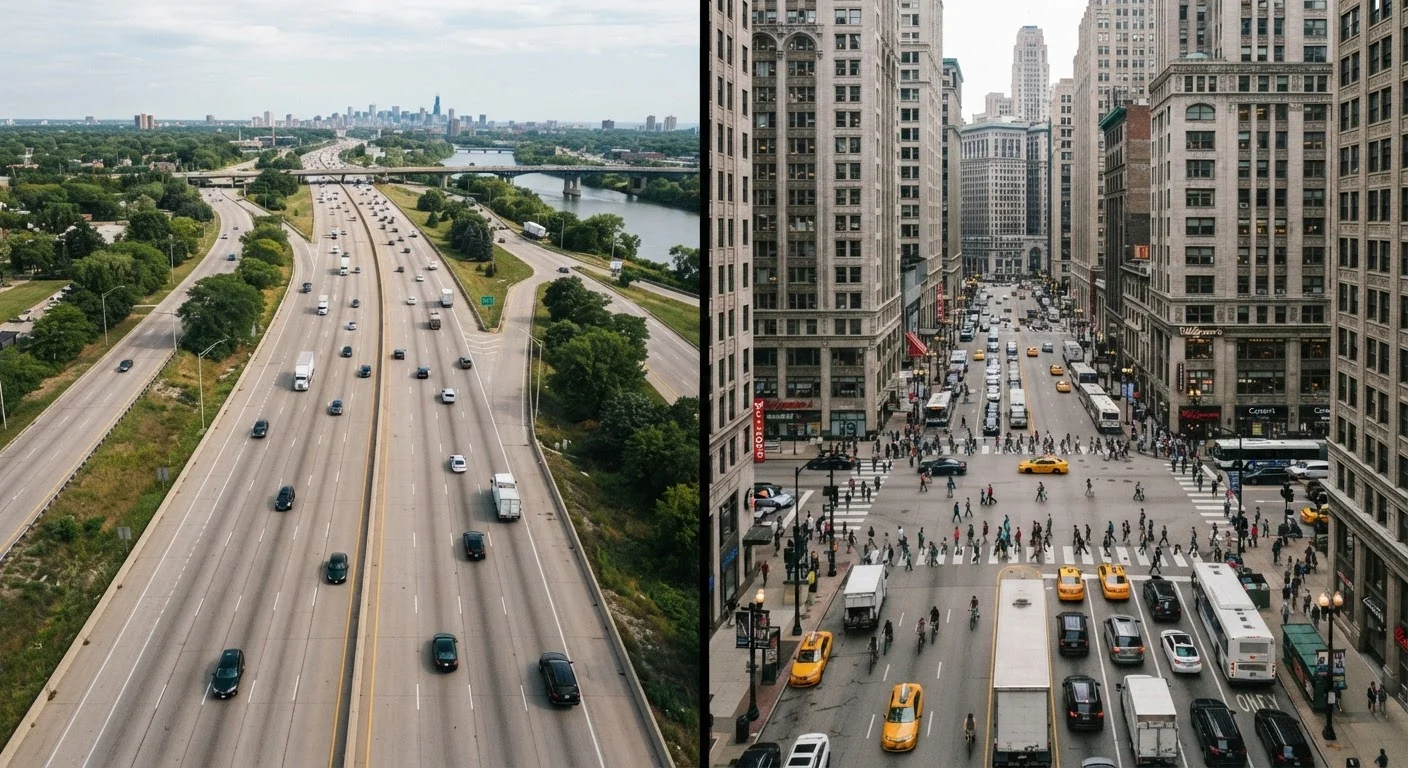
Why the Risk Profile Differs So Sharply
Most drivers instinctively sense that a highway and a city street feel different - but the data confirms that the type of danger differs just as much as the feeling. According to the National Highway Traffic Safety Administration (NHTSA), a disproportionate share of traffic fatalities occur on rural and high-speed roads, where crashes may be less frequent but are far more likely to be fatal. Urban roads, by contrast, generate a higher volume of crashes overall, largely because of the sheer density of vehicles, pedestrians, cyclists, and intersections.
Understanding why each environment is dangerous - on its own terms - is the foundation of defensive driving. Treating a city street like a highway, or vice versa, is a recipe for the kind of error that causes crashes.
| Criterion | Highway Driving | City Driving |
|---|---|---|
| Typical speed range | 55-80+ mph | 15-45 mph |
| Crash frequency | Lower overall | Higher overall |
| Crash severity | Higher (more fatalities) | Lower (more property damage) |
| Primary hazard type | Speed, fatigue, merging | Intersections, pedestrians, distraction |
| Decision frequency | Low (fewer inputs per mile) | Very high (constant inputs) |
| Fatigue type | Physical drowsiness (monotony) | Cognitive overload (complexity) |
| Stopping distance concern | Critical - very long at speed | Moderate - but tailgating still risky |
| Vulnerable road users | Rare (limited access roads) | Frequent (pedestrians, cyclists) |
The Highway Risk Profile: Speed, Fatigue, and Merging
On the highway, speed is the dominant risk multiplier. Physics is unforgiving: stopping distances increase dramatically as speed rises, and the energy released in a collision scales with the square of velocity. A vehicle traveling at 70 mph needs roughly twice the stopping distance of one going 50 mph.
Three hazard categories define highway driving:
- Following distance: At highway speeds, even a momentary lapse in attention can close a safe gap in under a second. The standard guidance is a minimum three-second gap - and more in wet or compromised conditions. See how weather affects stopping distance for conditions that require even more buffer.
- Driver fatigue: Long, monotonous stretches of highway are a leading contributor to drowsy driving crashes. The absence of stimulation - few traffic signals, limited scenery change - means mental alertness can erode without the driver noticing. Rest stops every two hours are a widely recommended guideline.
- Merging and lane changes: High-speed merges require precise timing and scanning. Merging safely onto a highway involves more than simply matching speed - it demands reading gaps, signaling early, and avoiding abrupt movements.
~54%
Fatal crashes on rural roads
NHTSA data consistently shows rural roads account for a disproportionate share of U.S. traffic fatalities despite lower overall traffic volume.
3 sec
Minimum safe following distance
Traffic safety authorities widely recommend at least a three-second gap at highway speeds, increasing in adverse conditions.
~40%
Crashes occurring at intersections
The Federal Highway Administration estimates that roughly 40 percent of all U.S. crashes involve intersections, which are concentrated in urban areas.
The City Driving Risk Profile: Intersections, Pedestrians, and Complexity
Urban driving is cognitively exhausting in a way that highway driving is not. A driver covering one mile of city street may encounter dozens of traffic signals, crosswalks, parked cars opening doors, cyclists, delivery vehicles, and pedestrians stepping off curbs - each requiring a real-time decision. This constant demand on attention is where most urban crashes originate.
Key city-specific hazards include:
- Intersections: NHTSA data consistently identifies intersections as the site of a large proportion of urban crashes. Red-light running, left-turn conflicts, and failure to yield are among the most common contributing factors.
- Pedestrians and cyclists: Vulnerable road users are concentrated in cities. Drivers must actively scan sidewalks, crosswalks, and bike lanes - not just the lane ahead.
- Stop-and-go rear-end collisions: Frequent braking creates chain-reaction risks, especially when drivers are distracted. Distracted driving laws vary significantly by state, but the physical risk of phone use in stop-and-go traffic is consistent regardless of local statute.
- Special zones: School zones and work zones impose reduced speed limits and heightened legal penalties. Understanding what the law requires in these zones is both a safety and a legal obligation.
Adapting Your Defensive Driving Approach
Defensive driving is not a single technique - it is a mindset calibrated to the environment. Skilled drivers consciously shift their approach at the on-ramp and again when they exit into urban traffic.
On the highway: expand your scanning horizon to 12-15 seconds ahead, maintain generous following distances, take regular breaks on long trips, and keep lane changes deliberate and signaled. Night highway driving adds fatigue and reduced visibility to an already demanding environment and warrants extra caution.
In the city: keep your eyes moving across a wider field - mirrors, crosswalks, side streets - rather than fixating on the vehicle directly ahead. Anticipate the light cycle rather than reacting to it. Give cyclists and pedestrians more space than feels strictly necessary; urban environments compress margins quickly.
In both environments, aggressive behavior elevates risk for everyone. Research on road rage shows that confrontational responses to other drivers' mistakes are a significant crash contributor. The goal is not to win an interaction - it is to complete a trip safely.
Risk Doesn't Disappear at Lower Speeds
A common misconception is that city driving is inherently safer because speeds are lower. While crash fatalities are statistically higher on highways, urban collisions still cause serious injuries - particularly to pedestrians and cyclists. Low speed does not mean low consequence, especially when vulnerable road users are involved.
Building consistent road safety habits across both environments is the most reliable long-term protection, regardless of experience level.