Why School and Work Zones Have Separate Rules
Standard traffic law draws a clear distinction between ordinary roadways and zones where pedestrian vulnerability or worker exposure is elevated. School zones and work zones (also called construction zones) each receive their own legal framework in every U.S. state - one that overrides default speed limits and often doubles or triples associated fines.
The reasoning is straightforward: children crossing near schools and road workers operating inches from live traffic represent two of the highest-risk groups in the public right-of-way. Legislators across the country have responded with enhanced penalties designed to change driver behavior in precisely these locations. Understanding what those rules require - not just what the signs say - is the practical starting point for legal compliance and safe driving.
For a broader look at how speed regulations work in general, see how speed limits, advisories, and posted signs differ legally.
| Typical school zone speed limit | 15-25 mph (Varies by state and local ordinance) |
| States with doubled work zone fines | All 50 states (Federal Highway Administration) |
| Most common work zone crash type | Rear-end collisions (Federal Highway Administration work zone safety data) |
| Crossing guard authority | Equivalent to a traffic signal in most states (State traffic codes vary; verify locally) |
| Move Over laws covering work vehicles | Majority of U.S. states (American Automobile Association (AAA)) |
School Zone Laws: Speed, Hours, and Crossing Guards
School zone speed limits typically range from 15 to 25 mph, depending on the state and local jurisdiction. The reduced limit is usually active only during designated hours - most commonly when children are arriving or departing - though some states post the limit as active whenever children are visibly present, regardless of the time of day. Drivers must know which standard applies in their state.
Key legal obligations in school zones
- Obey the posted reduced speed limit during the active window, whether marked by specific times or flashing beacons.
- Stop for crossing guards - a crossing guard holding a stop sign or extending a flag has the same legal authority as a traffic signal in most states.
- Yield to pedestrians in crosswalks, including in adjacent crosswalks beyond the immediate school entrance.
- Prohibit passing - many states prohibit overtaking another vehicle in an active school zone entirely.
- No cell phone use - several states impose a total ban on handheld device use in school zones, even where hands-free use is otherwise permitted on open roads. See how distracted driving laws vary by state for details.
Fines for school zone violations are routinely double the standard penalty. In some states, a single speeding ticket in a school zone during active hours can exceed $300 before court fees are added.
School Zone
A designated area surrounding a school where reduced speed limits and additional traffic restrictions apply during specified hours or when children are present. Boundaries are established by local ordinance and marked with signs.
Work Zone (Construction Zone)
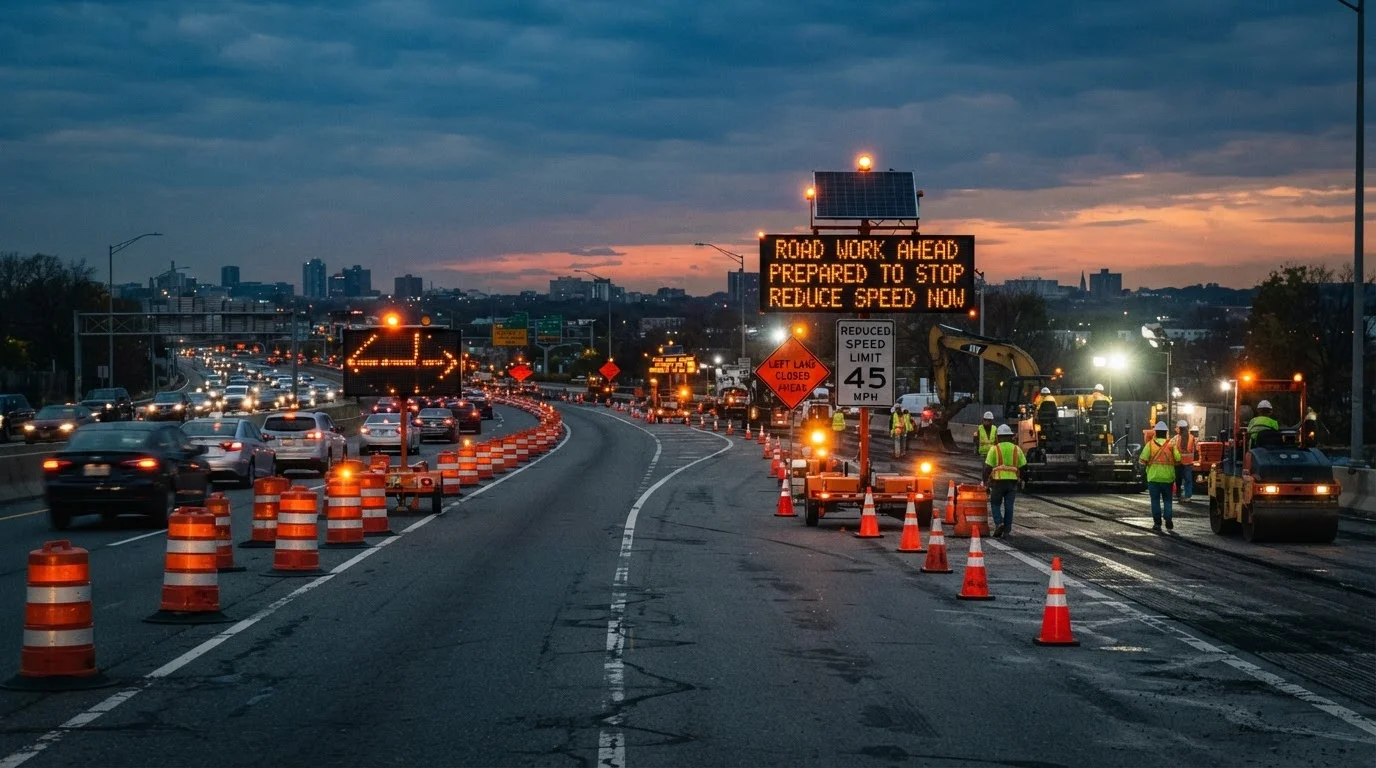
A section of roadway where construction, maintenance, or utility work is in progress, marked by advance warning signs, channelizing devices, and often reduced speed limits. Work zones may include active workers or only equipment and lane changes.
Flagger
A trained traffic control person stationed in or near a work zone who directs vehicle traffic using hand signals, a flag, or a stop/slow paddle. Flaggers carry the same legal authority as a traffic signal device.
Enhanced Penalty Zone
A legally designated area - such as a school or work zone - where standard traffic fines are increased, often doubled, as a deterrent. Designation is established by state statute and is independent of whether a crash occurs.
Move Over Law
A state law requiring drivers to change lanes away from, or slow down for, stopped emergency vehicles, law enforcement, tow trucks, and - in most states - construction vehicles displaying warning lights.
MUTCD
The Manual on Uniform Traffic Control Devices, a federal document that establishes minimum national standards for road signs, signals, and pavement markings, including those used in work zones.
Work Zone Laws: What Drivers Are Legally Required to Do
Work zones present a dynamic hazard: lane configurations shift, workers appear without warning, and equipment may extend into the travel lane. Federal guidelines under the MUTCD set minimum standards for how work zones must be signed and marked, but individual states layer additional requirements on top.
857
Work zone fatalities in one recent year
According to Federal Highway Administration data, hundreds of people - including drivers, passengers, and workers - are killed in work zones annually.
2x-3x
Fine multiplier in most school and work zones
Virtually every state statute doubles or triples base fines for speeding and other moving violations committed within designated zones.
Core work zone legal requirements
- Reduce speed to the posted work zone limit - this applies whether workers are actively present or not, unless a state's law specifies otherwise.
- Obey flaggers - a flagger has the legal authority of a traffic control device. Disobeying a flagger's signal is treated the same as running a red light in most jurisdictions.
- Maintain safe following distance - rear-end collisions are the most common work zone crash type. Following distance guidance recommends at least a four-second gap in construction zones.
- Move over for stopped work vehicles - most states' Move Over laws now cover stationary construction vehicles with activated warning lights, not just emergency vehicles.
- No aggressive lane changes - abrupt merging in work zone lane closures significantly increases crash risk; most states require a zipper merge at the designated merge point.
Work zone fines are enhanced in all 50 states. Many states classify repeat work zone offenses as criminal violations, not civil infractions, and some impose mandatory license suspension for workers who are injured as a direct result of a driver's violation.
Traffic laws, fine schedules, and active-hours definitions vary by state and locality. Always verify current rules with your state's department of motor vehicles or department of transportation before drawing legal conclusions.