
The Three Categories of Speed Signs
When you're behind the wheel, the speed signs you encounter fall into three legally distinct categories: statutory speed limits, posted regulatory limits, and advisory speed signs. Each carries a different level of legal obligation, and confusing them can lead to citations - or worse, dangerous driving decisions.
| Regulatory sign color | White background, black text (Manual on Uniform Traffic Control Devices (MUTCD)) |
| Advisory sign color | Yellow background, black text (MUTCD) |
| Legal force of advisory speed | None by itself - but reckless driving laws may still apply (Varies by state) |
| Default residential speed (statutory) | Typically 25 mph where not otherwise posted (Varies by state statute) |
| Variable speed limits (VSL) | Regulatory authority varies by state; always treat as binding |
| Basic speed law | Requires safe speed for conditions, regardless of posted limit (Enforced in most U.S. states) |
Understanding each type is especially relevant when conditions change. As covered in our guide on adjusting your driving for rain, snow, and fog, posted limits assume normal road conditions - the law may still hold you accountable for excessive speed even when you're technically under the limit.
Regulatory Speed Limits: Legally Binding Maximums
Regulatory speed limits are the white rectangular signs you see most often. These are enforceable by law. Exceeding them is a traffic violation regardless of road conditions or traffic volume. They are established by state or local statute and must be obeyed by all drivers.
There are two sub-types worth knowing:
- Statutory (prima facie) limits: Default speeds set by state law for specific road types - such as 25 mph in residential areas or 55 mph on undivided highways - even where no sign is posted.
- Posted regulatory limits: Speeds set by a traffic engineering study and displayed on white signs. These supersede the statutory default for that road segment.
Notably, some states also enforce a basic speed law, which requires drivers to operate at a speed that is safe for current conditions - meaning you can be cited for driving 35 mph in a 35 mph zone if conditions (such as ice or dense fog) make that speed unsafe. See also our reference on school zone and work zone speed requirements, where regulatory limits are often lower and fines are doubled.
Statutory speed limit
A default maximum speed established by state law for a given road type, applicable even when no sign is posted. Common examples include 25 mph in school zones or residential areas.
Posted regulatory limit
A legally enforceable speed maximum displayed on a white rectangular sign, determined by a traffic engineering study and superseding the statutory default for that road segment.
Advisory speed
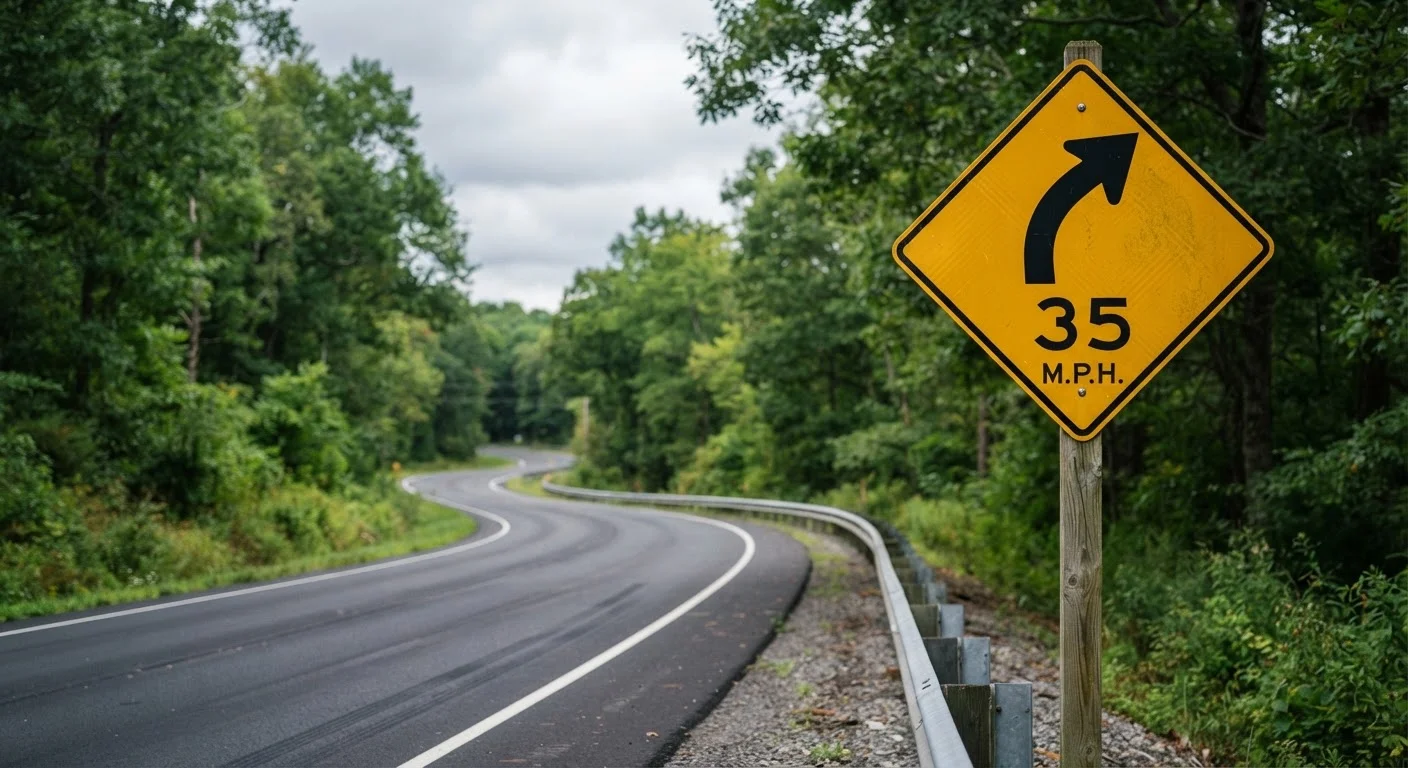
A recommended speed displayed on a yellow diamond-shaped sign, indicating the safe negotiating speed for a specific road feature such as a curve or ramp under dry, normal conditions. It is not a legal maximum.
Basic speed law
A legal principle, recognized in most U.S. states, requiring drivers to travel at a speed that is reasonable and prudent for current road, weather, and traffic conditions - regardless of the posted limit.
Variable speed limit (VSL)
An electronically displayed speed limit that changes based on real-time conditions such as congestion, weather, or roadway incidents. Regulatory authority of VSL signs varies by state.
Prima facie limit
A speed limit that is presumed lawful but can be challenged in court by demonstrating that a different speed was actually safe for conditions. Used in several states as a framework for speed enforcement.
Advisory Speed Signs: Recommendations, Not Requirements
Advisory speed signs are the yellow diamond-shaped signs you see before curves, ramps, intersections, and other road features. They typically display a speed in black numerals and may include a supplementary plaque such as "CURVE" or "EXIT RAMP."
These signs are not regulatory - exceeding the posted advisory speed is not automatically a traffic violation. However, they are engineered benchmarks: the speed at which a vehicle with normal handling characteristics can safely navigate the feature under dry pavement conditions. Exceeding an advisory speed in poor weather, with a heavily loaded vehicle, or in a degraded vehicle dramatically increases crash risk.
Law enforcement can still cite a driver who exceeds an advisory speed if the posted advisory, combined with the road condition, supports a reckless or negligent driving charge. Treat advisory signs as expert engineering guidance, not mere suggestions. For context on how speed compounds risk, our article on highway versus city driving risk profiles discusses how velocity affects stopping distance and crash severity.
Variable Speed Limits and Special Zone Signs
A growing number of highways use variable speed limit (VSL) signs - electronic displays that change the posted speed based on real-time traffic, weather, or incident conditions. In jurisdictions where VSL signs carry regulatory authority (which varies by state), the displayed speed is legally binding at that moment, even if it differs from the static signs nearby.
Other specialized regulatory signs include:
- Minimum speed signs: White rectangular signs establishing a floor, commonly found on interstate highways to reduce speed differentials that cause rear-end collisions.
- Nighttime speed limit signs: Some roads post a lower limit for nighttime hours, typically displayed with an added panel specifying the time range.
- Truck and vehicle-class limits: Certain roads post separate limits for vehicles over a specified gross weight.
Maintaining an appropriate following distance is equally critical when navigating variable-speed corridors. Our reference on the two-second following distance rule explains why gaps must increase as speed rises. Traffic laws also vary meaningfully by jurisdiction - just as distracted driving laws differ state by state, VSL enforcement authority is not uniform nationwide. Always verify the rules for the state you're driving through.
This article provides general educational information about traffic sign categories and is not legal advice. Traffic laws vary by state and locality. Consult your state's DMV handbook or a qualified legal professional for guidance specific to your situation.