The Patchwork of U.S. Distracted Driving Law
There is no single federal distracted driving law in the United States. Instead, each state sets its own rules governing when and how drivers may use mobile devices behind the wheel. The result is a complex patchwork that can catch even careful drivers off guard the moment they cross a state line.
| States with all-driver handheld bans | Majority of U.S. states (Governors Highway Safety Association (GHSA)) |
| States with all-driver texting bans | Nearly all 50 states (GHSA Distracted Driving Laws, current) |
| States with teen/novice device bans | Most GDL-participating states (Insurance Institute for Highway Safety (IIHS)) |
| Typical first-offense fine range | $20-$200+ (Varies significantly by state) |
| Federal distracted driving law | None - regulation is state-level (NHTSA policy overview) |
| Enhanced fines in school/work zones | Common across many states (State traffic code provisions) |
At the broadest level, state laws fall into a few categories: handheld bans that prohibit holding a phone while driving, hands-free requirements that permit calls only through a Bluetooth or speakerphone system that doesn't require holding the device, texting-only bans that restrict manual text entry but may not address voice calls, and novice or teen driver restrictions that layer additional prohibitions on top of the general rules. Understanding which category a state falls into is the first step to staying compliant - and safe. For a broader look at how traffic rules vary by state, see our guide on right-of-way rules drivers consistently get wrong.
Key Categories of Distracted Driving Restrictions
Here is how the major regulatory categories break down across U.S. states:
- Handheld device bans (all drivers)
- A majority of states now prohibit all drivers from holding a phone or other electronic device while operating a vehicle. This applies even when stopped at a red light in most of these jurisdictions. Violators face fines that range from around $20 in some states to over $200 for a first offense - and significantly more for repeat violations.
- Texting bans (all drivers)
- Nearly every state bans manual text entry while driving, even if a broader handheld ban is not in place. A small number of states historically treated texting restrictions as secondary offenses, meaning officers could only cite a driver for it after stopping them for another infraction - though that distinction has narrowed over time.
- Teen and novice driver restrictions
- Most states that participate in Graduated Driver Licensing (GDL) programs prohibit new drivers - typically under age 18 or within a set period of licensure - from using any mobile device while driving, including hands-free calls. These restrictions are usually stricter than the general adult rules. See our reference on how GDL programs work in the U.S. for more detail.
Handheld ban
A law that prohibits a driver from physically holding a mobile device while the vehicle is in operation. Hands-free use through a mounted device or Bluetooth is typically permitted.
Hands-free requirement
A legal standard requiring that any phone use while driving be conducted without holding the device - typically via Bluetooth, a car's integrated system, or a dashboard mount.
Secondary offense
A traffic violation that an officer can only cite after stopping the driver for a separate, primary infraction. A primary offense, by contrast, can be the sole reason for a traffic stop.
Graduated Driver Licensing (GDL)
A tiered licensing system that restricts new drivers - usually teenagers - in phases, adding privileges as experience is gained. GDL programs often include stricter distracted driving rules for novice licensees.
Fines also vary significantly by school and work zones, where distracted driving penalties are often doubled. Our companion piece on school zone and work zone laws covers those enhanced penalties in detail.
What Drivers Should Know Before Crossing State Lines
When traveling across multiple states, it is not safe to assume that the rules you follow at home apply everywhere else. A few practical principles apply universally:
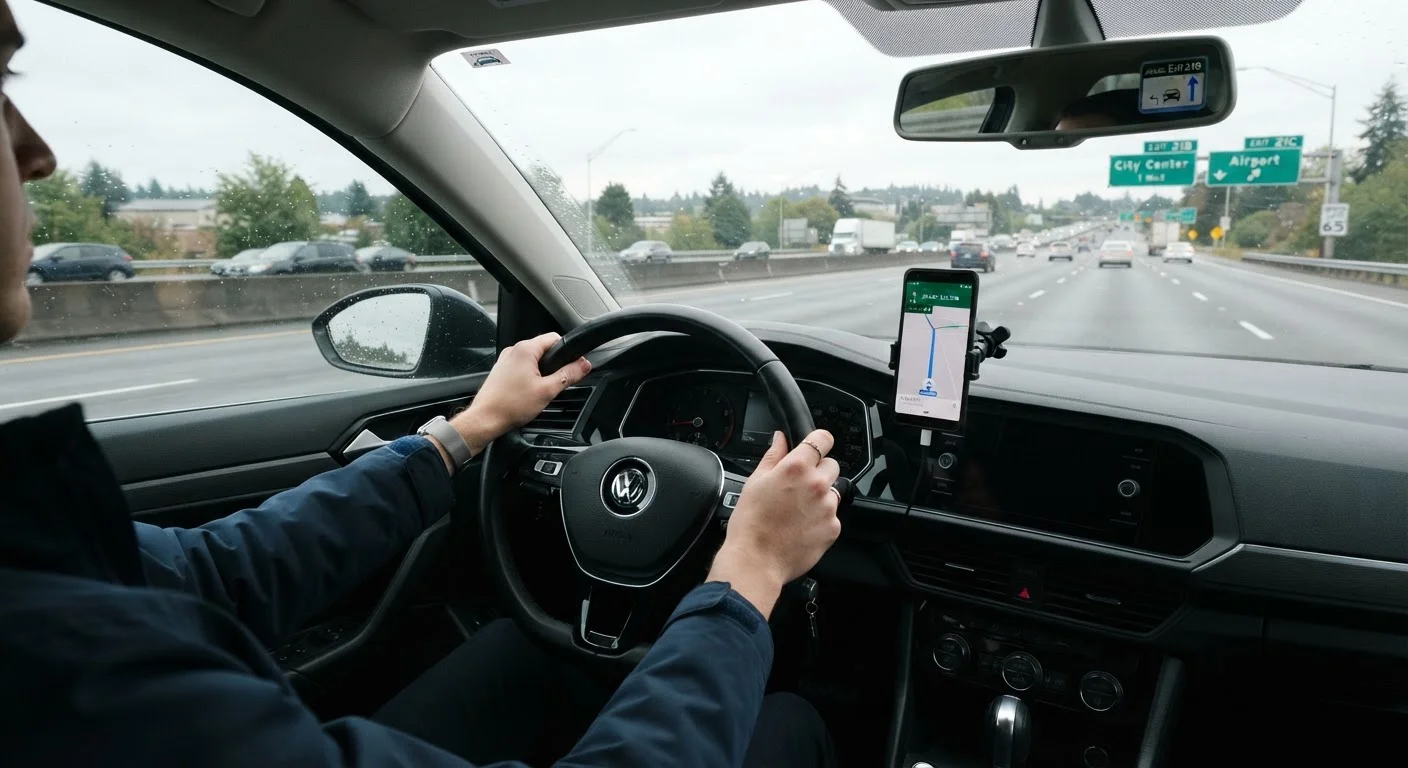
- Default to hands-free. Using a mount-and-voice setup eliminates the risk of unknowingly violating a stricter state's law. Most modern smartphones and vehicles support Bluetooth calling without touching the device.
- Check the destination state's laws before a road trip. Official state DMV websites and the Governors Highway Safety Association (GHSA) publish current distracted driving statutes. These are the most reliable sources.
- Assume red lights don't exempt you. In many states with handheld bans, being stopped at a traffic signal does not permit you to pick up your phone. The law typically applies whenever the engine is running on a public road.
- Know that points may transfer. Some states participate in compacts that report traffic violations to a driver's home state. A citation in another state can affect your record and, potentially, your insurance premiums.
3,308
U.S. distraction-related traffic fatalities in one recent year
According to the National Highway Traffic Safety Administration (NHTSA), distracted driving claimed thousands of lives in a single recent reporting year.
~8-9%
Share of all U.S. traffic deaths linked to distraction
NHTSA data consistently shows distraction as a factor in roughly one in ten fatal crashes nationally.
Risk doesn't respect state borders either. Distracted driving contributes to thousands of fatalities on U.S. roads each year, according to federal traffic safety data. Understanding the legal landscape is one layer of protection - but the core safety rationale remains constant regardless of which state you're driving through. For context on how environment shapes crash risk, see our article on highway driving vs. city driving risk profiles.
This article provides general educational information about traffic laws and is not legal advice. Laws change; always verify current statutes with your state's official DMV or a licensed legal professional before making decisions based on specific rules.