Why Right-of-Way Confusion Causes Real Crashes
Failure to yield is consistently ranked among the top causes of intersection crashes in the United States, according to data from the National Highway Traffic Safety Administration (NHTSA). Yet many drivers believe their instincts about who goes first are correct - until a collision proves otherwise.
Right-of-way is not about who has the biggest vehicle, who is in the most hurry, or even who flashes their headlights first. It is a legal framework designed to create predictable, orderly movement. Misreading it - even once - can have serious consequences. The myths below represent some of the most common and dangerous misunderstandings on American roads.
Myth
At a four-way stop, the driver on the busier or wider road goes first.
Fact
Order of arrival determines right of way at a four-way stop, not road size or traffic volume.
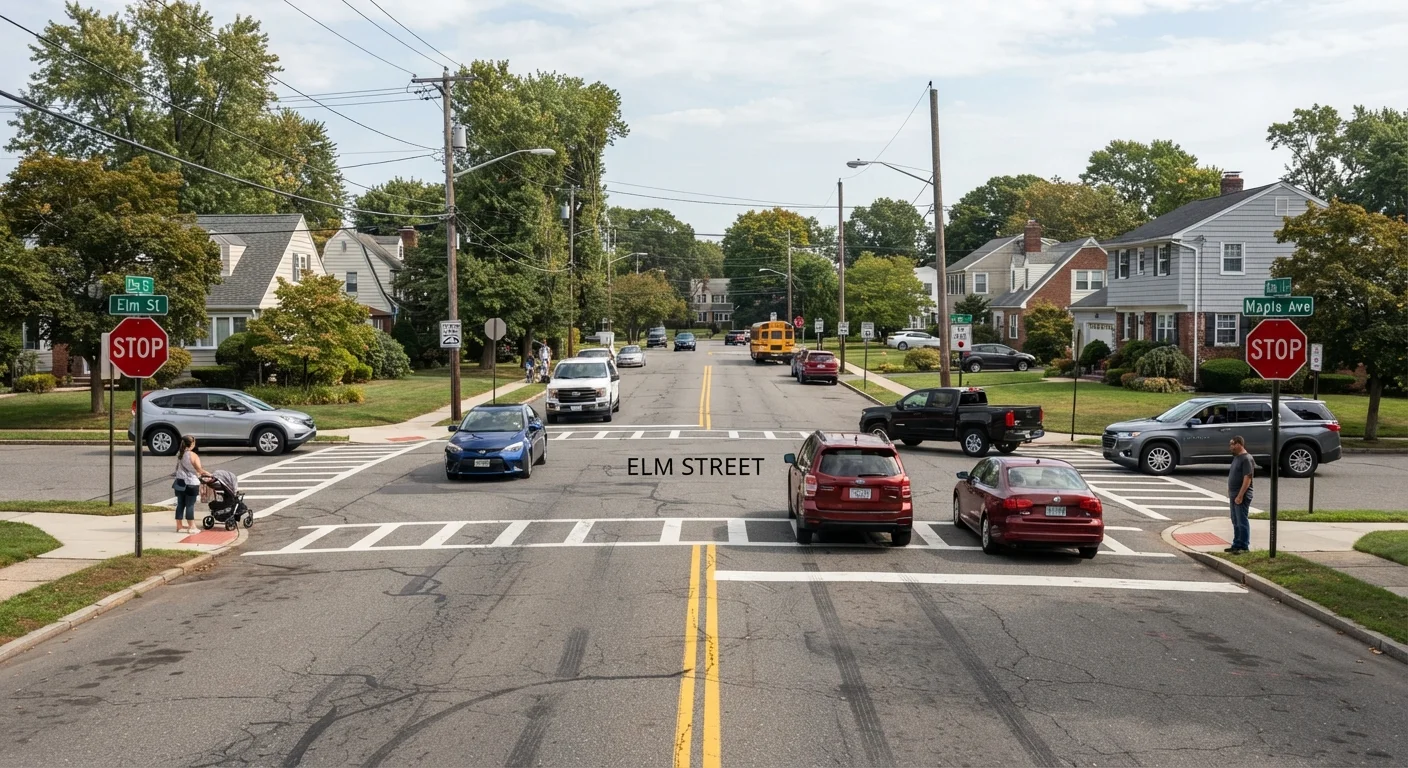
The rule is straightforward: the first vehicle to come to a complete stop at a four-way intersection goes first. If two vehicles arrive simultaneously, the driver on the left yields to the driver on the right. Road width and traffic volume are irrelevant under the law. Assuming a major road automatically confers priority is one of the most common errors drivers make - and it catches people off guard when the other driver doesn't yield as expected.
Myth
When entering a roundabout, the entering vehicle has the right of way if it arrives first.
Fact
Vehicles already circulating inside a roundabout always have priority over entering vehicles.
Roundabouts follow a yield-on-entry rule: you must wait for a gap in circulating traffic before proceeding. It does not matter how long you have been waiting at the entry point or whether you feel the gap is large enough - if a vehicle is in the circle, it has the right of way. Treating roundabout entry like a normal intersection stop is a leading cause of roundabout collisions. For a full breakdown of multilane roundabout rules, see our roundabout explainer.
Myth
The driver who waves you forward has legally given you the right of way.
Fact
A hand gesture from another driver carries no legal weight; yielding decisions remain your responsibility.
A well-meaning wave from another driver does not transfer legal right of way. If you proceed on a wave and are struck by a vehicle the waving driver could not see, you may still share legal liability for the collision. Always independently verify that your path is clear before moving - never rely solely on another driver's signal.
Myth
If you are turning left and traffic is stopped, you can go ahead since no one is moving.
Fact
Stopped traffic does not eliminate your duty to yield when turning left across oncoming lanes.
A left-turning driver must yield to all oncoming traffic - including cyclists and pedestrians - regardless of whether nearby lanes appear stopped. Vehicles may be stopped for a reason you cannot see, and a gap in one lane does not mean all lanes are clear. Left turns across multiple lanes of traffic are among the highest-risk maneuvers at intersections, and impatience is a documented contributing factor in many of these crashes.
Myth
Pedestrians must wait on the curb until the road is completely clear before crossing.
Fact
Pedestrians who have entered a marked or unmarked crosswalk have the legal right of way in all U.S. states.
Once a pedestrian steps off the curb and into a legal crosswalk, motorists are required by law to stop and allow them to cross safely. This applies to unmarked crosswalks at intersections as well as marked ones. While pedestrians also bear a duty of care for their own safety, drivers are not legally permitted to proceed simply because a pedestrian has not fully entered their lane. Many states have strengthened pedestrian right-of-way protections in recent years in response to rising pedestrian fatality rates.
Merging, Pedestrians, and Emergency Vehicles
Beyond intersections, right-of-way confusion extends to highways, crosswalks, and encounters with emergency responders. Understanding these scenarios closes gaps that even experienced drivers often overlook.
~40%
Of crashes occurring at intersections
NHTSA data consistently shows that roughly 40 percent of all U.S. traffic crashes occur at or are related to intersections, with failure to yield as a primary contributing factor.
~7,500
Pedestrian fatalities per year
NHTSA estimates approximately 7,500 pedestrian deaths occur annually in the U.S., many involving failure-to-yield situations at crosswalks.
On highway on-ramps, the common assumption is that through-traffic must make room. In reality, the merging driver bears the legal responsibility to match speed and find a gap - through-traffic is not obligated to yield, though courtesy and safety often mean experienced drivers do adjust. For a deeper look at safe merging technique, see our guide to merging skills.
At marked or unmarked crosswalks, pedestrians who have stepped into the roadway have the right of way in all 50 states. Stopping only when a pedestrian is directly in your lane - and not before - is a common and dangerous misreading of the law.
When an emergency vehicle approaches with lights and siren active, drivers are required to pull to the right edge of the road and stop - not merely slow down or shift lanes. This applies even when the emergency vehicle is approaching from the opposite direction on an undivided road. Ignoring this rule is both illegal and life-threatening.
Move Over Laws Apply to Stopped Emergency Vehicles Too
Every U.S. state has a Move Over law requiring drivers to change lanes or slow down when passing stationary emergency, law enforcement, or roadside assistance vehicles with lights activated. Failing to move over is a moving violation in all 50 states and can carry significant fines. Check your state's specific requirements, as thresholds and fines vary.
Right-of-way rules also intersect with broader safe driving habits. The road safety habits worth building resource covers lane discipline and situational awareness practices that complement knowing the rules on paper.
This article provides general educational information about U.S. traffic laws and is not legal advice. Traffic laws vary by state; always consult your state's official driver handbook or a qualified legal professional for guidance specific to your jurisdiction.