
Why Layering Order Actually Matters
Your skin is a selectively permeable barrier. It absorbs some ingredients readily and blocks others — and the order in which you apply products directly influences how well each one penetrates. If you apply a thick occlusive moisturizer before a water-based serum, the serum sits on top of a sealed layer rather than reaching the skin cells where it can work.
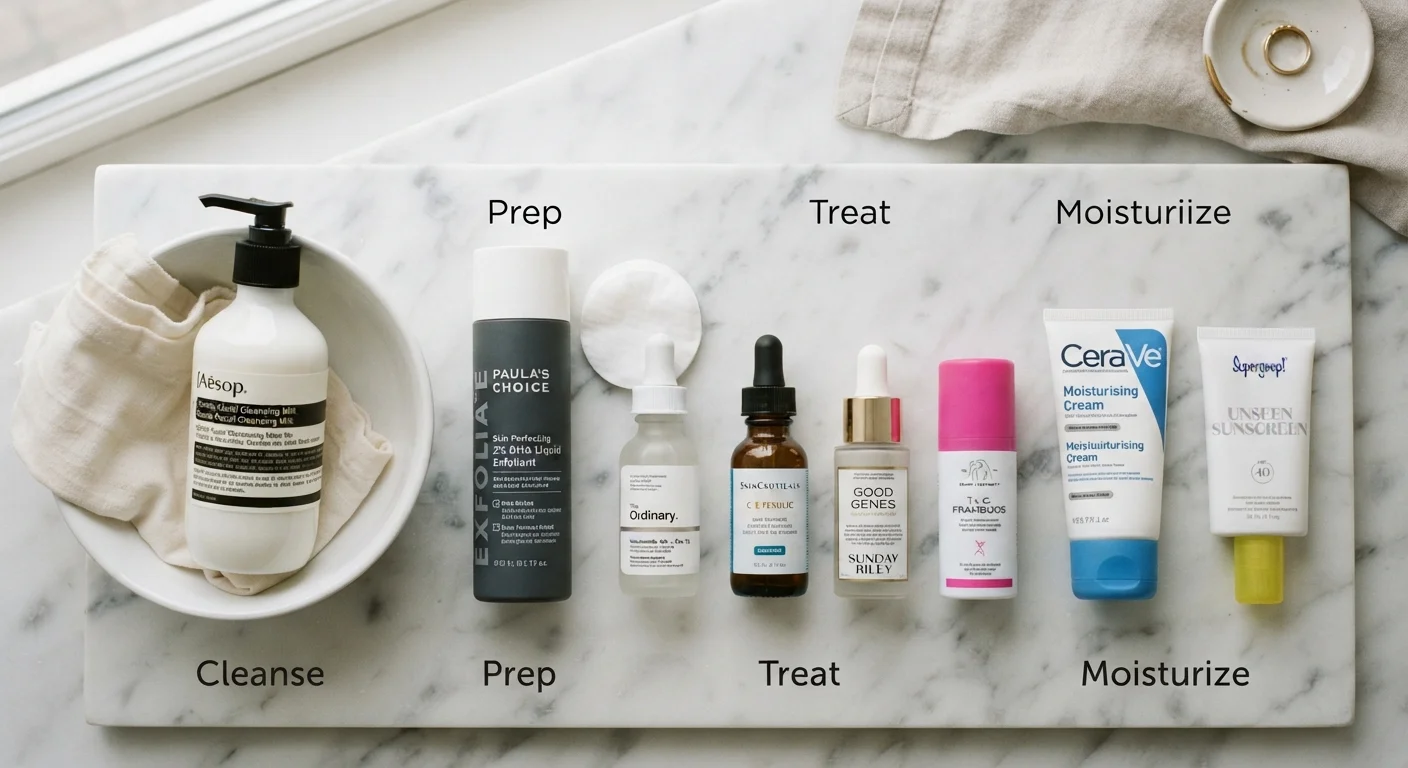
The general principle is simple: go thinnest to thickest. Start with water-based, lightweight formulas — like toners and essences — then layer on serums, followed by heavier moisturizers, and finish with oils or occlusives if you use them. This sequence mirrors how ingredients are absorbed, allowing each product a clear path to do its job. For a deeper look at what each of these steps actually contributes, see our breakdown of core skincare steps.
70%+
Skincare users who layer multiple actives daily
Surveys by market research firms consistently show a majority of skincare users apply three or more leave-on products as part of their regular routine.
30–60 sec
Recommended wait time between layers
Dermatologists broadly recommend allowing each product to absorb before applying the next, to prevent dilution and disruption of active formulas.
Ingredient Combinations That Cause Problems
Not all active ingredients play nicely. Some reduce each other's effectiveness; others create a compounded irritation risk when applied together. Understanding a few key pairings can save your skin — and your budget.
Never apply vitamin C (ascorbic acid) and niacinamide in the same step
When formulated together at high concentrations, these two ingredients can convert into compounds that may cause temporary flushing in some people. While recent research suggests the reaction is less severe than once thought, applying them at separate times — one in AM, one in PM — is still a cautious, widely recommended approach.
Keep retinol and AHAs/BHAs in separate routines
Retinol already increases cell turnover and skin sensitivity on its own. Pairing it with exfoliating acids like glycolic (AHA) or salicylic acid (BHA) in the same session compounds that sensitivity, raising the risk of redness, peeling, and a compromised skin barrier.
Apply benzoyl peroxide and retinol at different times of day
Benzoyl peroxide is an oxidizing agent, and research suggests it can degrade retinol, reducing its effectiveness when applied at the same time. Keeping them separated preserves both ingredients' potency.
Layer water-soluble actives before oil-based products
Oil forms a partial seal over the skin's surface. If you apply an oil or balm before a water-based serum, that serum cannot penetrate as efficiently. The sequence matters even when both products contain beneficial ingredients.
Use SPF as your final daytime layer, after all other products
Sunscreen is formulated to sit on the skin's surface and create a protective film. Applying additional products on top of SPF disrupts that film and can reduce the effective protection it provides.
If you're ever unsure whether a new active is causing a reaction, our guide on warning signs your routine is harming your skin covers what to watch for.
Smart Strategies for a Harmonious Routine
The most effective skincare routines aren't necessarily the most complex ones. A few deliberate habits will do more for your skin than a cabinet full of actives applied at random.
When In Doubt, Do Less
A routine with two or three well-chosen, correctly ordered products will typically outperform a complicated stack of six or seven applied without a plan. If your skin is reacting and you're unsure why, simplifying is usually the fastest way to identify the problem. Our guide on signs your routine is doing more harm than good can help you triage.
It's also worth revisiting some assumptions before you layer up. Many popular beliefs about what skincare does — and doesn't — do are simply not accurate. Our article on common skincare myths separates fact from fiction. And if you're introducing a new active into your routine, pacing that introduction carefully reduces your risk of irritation significantly.
This article provides general skincare education and is not a substitute for advice from a qualified dermatologist or healthcare professional. If you experience persistent irritation, breakouts, or skin reactions, consult a licensed professional.