
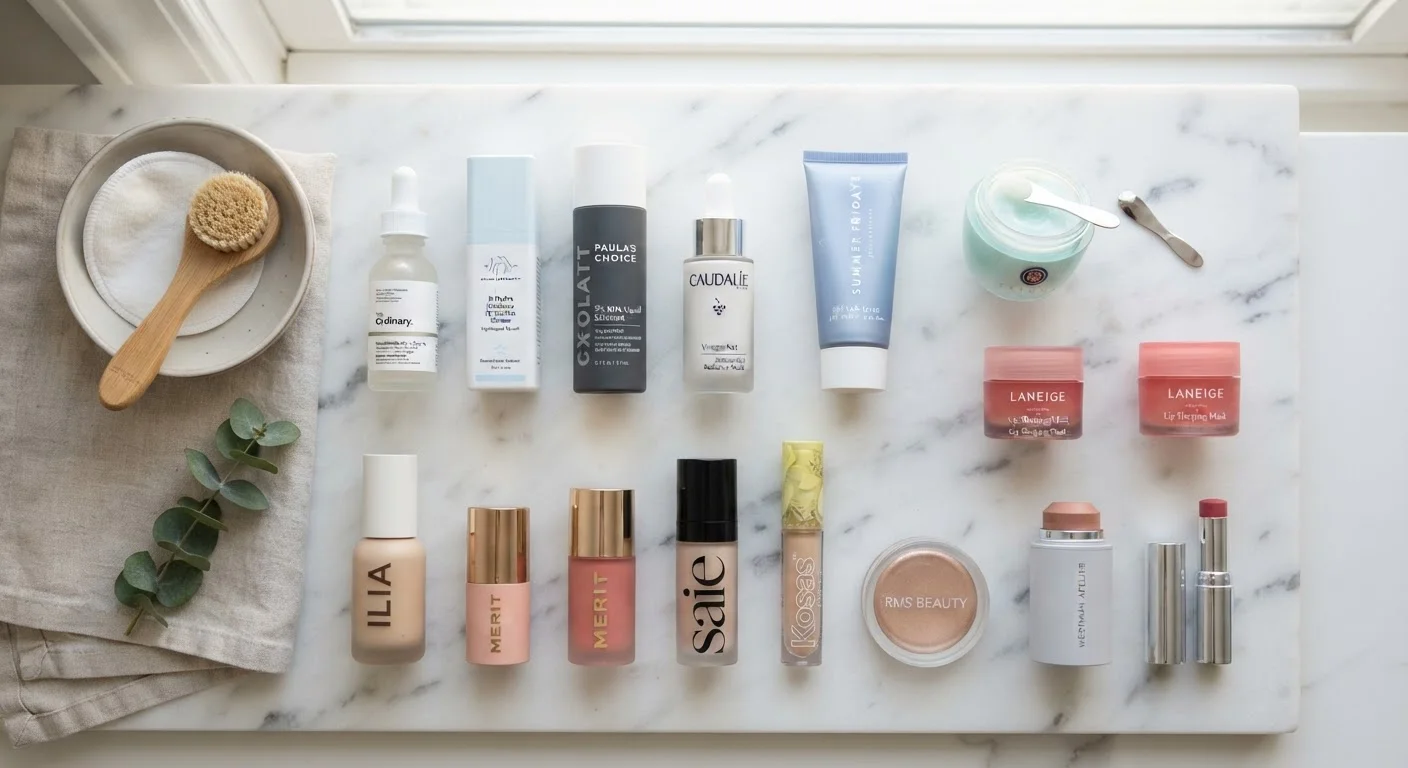
Why Beauty Myths Are So Hard to Shake
Skincare and makeup advice travels fast — from beauty counters to social media to family group chats — and it often travels without evidence attached. Many beliefs that feel like common knowledge are actually rooted in outdated science, clever marketing language, or simply a misunderstanding of how skin works. The result is a lot of well-intentioned routines built on shaky foundations.
Understanding what's actually true about skin biology helps you spend your time, money, and effort more wisely. The Skincare Essentials hub is a great place to build that foundation, but first — let's clear out some of the most persistent myths standing in the way.
Myth
Steam opens your pores, and cold water closes them.
Fact
Pores have no muscles and cannot open or close in response to temperature.
This is one of the most repeated myths in skincare. Pores are follicle openings — they don't contain muscle tissue, so they literally cannot dilate or contract the way a blood vessel might. Steam can help soften sebum and debris, making cleansing feel more effective, but it isn't mechanically "opening" anything. Similarly, a cold rinse feels refreshing but does not shrink pores. Pore size is primarily determined by genetics and skin elasticity — not water temperature. For more on how the skin's structure actually works, see the science behind your skin barrier.
Myth
Natural and organic ingredients are always safer than synthetic ones.
Fact
Whether an ingredient is natural or synthetic says nothing about its safety or irritation potential.
Poison ivy is natural. So is latex, a common allergen. Many plant-derived extracts — citrus oils, essential oils, certain botanical extracts — are among the most frequent triggers of contact dermatitis. Conversely, many synthetic ingredients have been extensively safety-tested and are well-tolerated by most skin types. The word "natural" on a label is a marketing descriptor, not a clinical safety guarantee. Always assess ingredients on their own merits, and patch-test new products regardless of how they're positioned. The research on fragrance in skincare is a useful case study in how "natural" scents can cause real sensitivity issues.
Myth
Oily skin doesn't need moisturizer.
Fact
All skin types benefit from appropriate moisturization; skipping it can trigger increased oil production.
Oiliness and hydration are not the same thing. Sebum (the skin's natural oil) and water content are separate systems. When skin is dehydrated — even oily skin — it can signal the sebaceous glands to produce more sebum to compensate. Using a lightweight, non-comedogenic moisturizer helps maintain the skin barrier without adding greasiness. If your routine is leaving your skin feeling tight, stripped, or reactive, that's a signal worth paying attention to. Our article on signs your skincare routine is doing more harm than good walks through exactly those warning signs.
Myth
Higher-priced skincare products are more effective.
Fact
Product efficacy is determined by formulation and active ingredient concentration, not retail price.
Packaging, brand prestige, and fragrance can all drive up the cost of a product without improving its performance on your skin. What matters is whether a product contains the right active ingredients at effective concentrations, has a stable formulation, and is suited to your skin type. A drugstore retinol or niacinamide serum may perform just as well as a luxury equivalent — sometimes better, because budget-oriented brands invest heavily in core ingredients rather than packaging. That said, very cheap formulations may cut corners on stability or preservation. Look at ingredient lists, not price tags, as your primary guide.
Myth
SPF in your foundation or powder is enough daily sun protection.
Fact
The amount of makeup required to reach labeled SPF is far more than most people apply.
SPF ratings on makeup products are tested at a specific application thickness — roughly 2 milligrams per square centimeter of skin — which is much more product than the average person uses. In practice, most people apply a fraction of what's needed to replicate the labeled protection. This doesn't mean SPF in makeup is useless, but it shouldn't be your only line of defense. Dermatologists widely recommend applying a dedicated sunscreen underneath makeup for reliable daily protection. The evidence behind this recommendation is examined in detail in why sunscreen is the one step dermatologists agree on.
Myth
You must use primer before every makeup application.
Fact
Primer improves wear for many people but is not universally necessary — skin type and product pairing matter more.
Primer can create a smoother base, extend wear, and help control shine for those who need it. But for people with dry skin or well-balanced skin, a good moisturizer may do the same job, and adding primer can sometimes cause pilling or uneven texture depending on formulation compatibility. Whether primer works for you depends on your skin type, the foundation formula you use, and what you want from your makeup. If you're curious about building a toolkit that's truly suited to your needs, see our breakdown of every basic makeup kit tool.
Clearing Up Makeup Misconceptions
Makeup myths are just as stubborn as skincare ones. Several revolve around primer, SPF, and the idea that there's one "correct" application order for every person. In reality, much depends on skin type, product formulation, and personal preference. For a practical look at how layering actually works, see how to layer skincare before makeup for real-world guidance.
Don't Rely on Makeup SPF Alone Outdoors
If you'll be spending extended time outdoors, foundation or powder with SPF is not a reliable substitute for a dedicated sunscreen. Apply a broad-spectrum SPF 30 or higher sunscreen as a separate step before makeup. Reapplication throughout the day is also important — something makeup alone cannot practically deliver.
Building a reliable makeup routine starts with understanding your actual tools. Our guide to basic makeup kit tools breaks down what each brush and sponge genuinely does — no guesswork required. And if you've been layering actives without a clear plan, layering skincare products correctly explains the logic behind effective sequencing.
This article is for general informational purposes only and is not a substitute for professional dermatological or medical advice. If you have concerns about your skin's health, consult a qualified healthcare provider.