Separation Anxiety vs. Boredom: Why the Distinction Matters
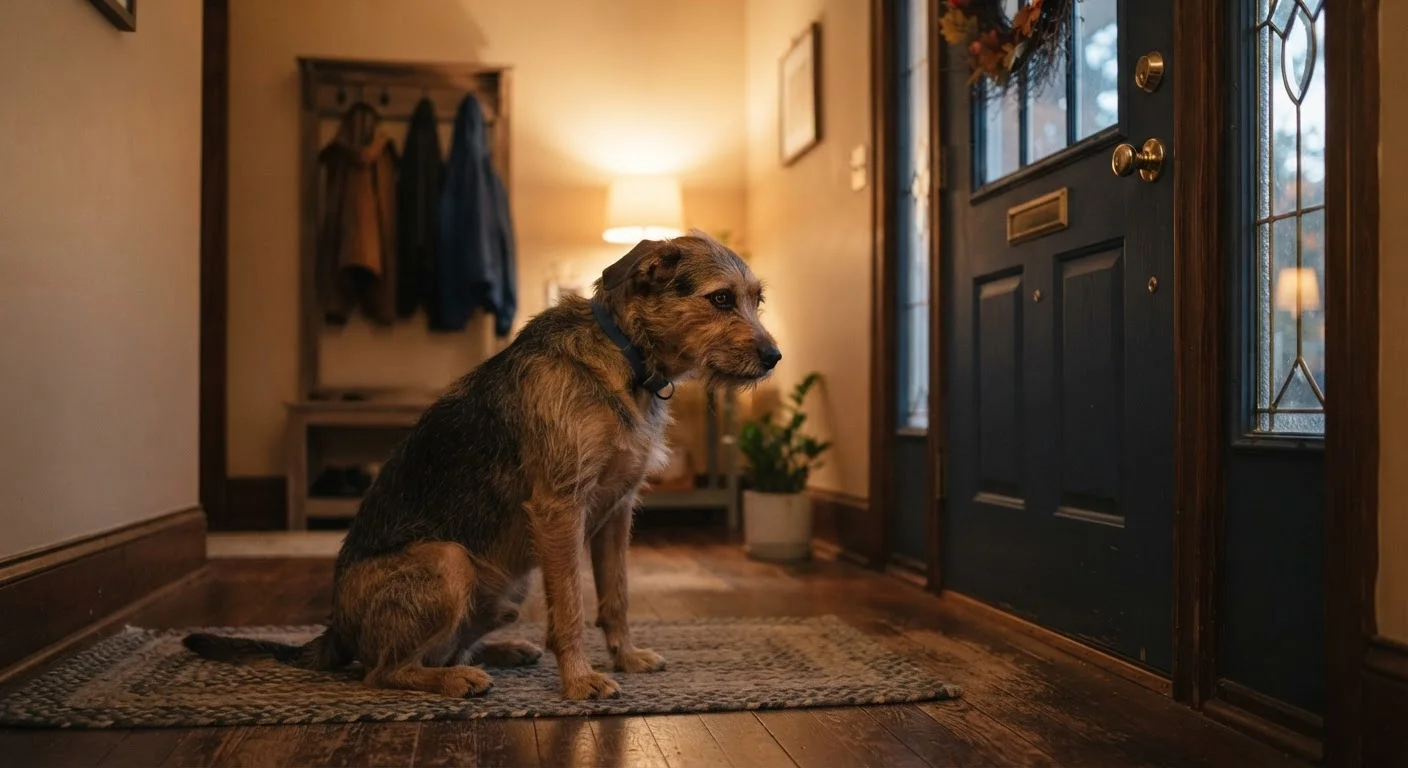
A chewed baseboard or an overturned trash can does not automatically mean separation anxiety. Dogs left alone with insufficient enrichment often entertain themselves destructively — but that behavior is rooted in boredom or excess energy, not panic. True separation anxiety is a fear-based response to isolation that begins within minutes of the owner's departure and typically involves signs of genuine physiological distress.
Common indicators that point toward separation anxiety rather than boredom include: frantic or repetitive vocalization (howling, barking) that starts as you leave rather than hours later; destructive behavior concentrated around exit points like doors and windows; house soiling that occurs only during absences despite reliable house-training; excessive salivation, panting, or trembling before you've even walked out the door; and self-injurious escape attempts.
Because anxious and bored dogs can look superficially similar, it's worth reading the body language signals every dog owner should recognize before drawing conclusions. It's also worth considering whether a physical cause is driving the behavior — problem behaviors sometimes signal underlying medical issues that a vet should rule out first.
What You'll Need Before You Begin
Desensitization to departures is a methodical process. Having the right tools and baseline information in place before you start increases the chance of success.
What you will need
Pet camera with two-way audio
Allows you to monitor your dog's actual behavior during absences in real time without your physical presence skewing the data.
Long-lasting food puzzle or stuffed toy (frozen)
Provides a positive, absorbing activity associated exclusively with departure — a technique called a 'departure cue conditioner.'
Indoor baby gate or exercise pen
Creates a safe, defined space that limits destructive escape attempts without fully confining the dog (which can worsen panic in some individuals).
Training journal or app
Tracks session durations, dog's stress level, and progress over time so you can make data-driven decisions about when to advance.
Certified behavior professional (CSAT or CAAB)
Provides personalized protocol design and troubleshooting for moderate-to-severe cases that don't respond to owner-led training alone.
The Graduated Desensitization Protocol
The following steps reflect the approach most certified applied animal behaviorists and veterinary behaviorists recommend. Progress is non-linear — be prepared to move backward a step whenever your dog shows stress signals. Refer to this guide on stress signals during training to recognize when to pause or retreat.
Confirm the diagnosis with video evidence
Before changing anything, record your dog during a realistic absence — leave the house, drive away, and stay gone for 30–60 minutes. Review the footage carefully. Note the exact minute distress behaviors begin, what they look like, and whether they resolve or escalate. This baseline is your starting point and will help a professional assess severity if you later seek help.
Neutralize pre-departure cues
Many dogs begin showing anxiety while their owner is still home — when keys jingle, shoes go on, or a bag is picked up. Systematically repeat these cues multiple times daily without leaving, until the dog stops reacting. Put on your coat, then sit back down. Pick up keys, then put them down. The goal is to strip these signals of their predictive power before you begin absence training.
Introduce the departure object
Choose a food puzzle, stuffed toy, or long-lasting chew that your dog will only ever receive at departure time. Give it to your dog a few minutes before any planned absence — including practice ones. Over time this object becomes a reliable predictor of safety rather than dread. Once the association is formed, many dogs show measurably reduced arousal when it appears.
Begin sub-threshold absences
Start with absences so brief they produce zero distress — often 5 to 30 seconds. Step outside, close the door, and return before your dog has time to react. Do multiple repetitions per session. Use your camera to verify the dog is calm. The critical rule: never return while your dog is actively distressed, as that reinforces vocalization or pawing as an escape strategy. Wait for a pause, then re-enter calmly.
Increase duration incrementally and non-linearly
Once your dog is reliably calm at a given duration, increase by a small increment — perhaps 15–30 seconds at first, then larger jumps as confidence builds. Crucially, vary the lengths so the dog cannot predict how long you'll be gone. Mix longer absences with shorter ones in the same week. If a step produces distress, drop back two steps and consolidate before trying again.
Manage necessary absences during training
Training takes weeks to months. During that time, you still need to leave for work, appointments, and errands. Arrange care — a trusted friend, a dog walker, doggy daycare — to prevent your dog from experiencing full panic-level absences while the protocol is in progress. Every significant panic episode can set the program back considerably.
Track progress and reassess regularly
Review your training journal every two weeks. Are session durations increasing? Is latency to distress lengthening? Is the dog calmer during pre-departure cues? If you see no measurable change after four to six weeks of consistent effort, that is a clear signal to consult a certified behavior professional or veterinary behaviorist rather than continuing the same approach alone.
Exercise Before Departure Can Help
A meaningful exercise session — a 20–30 minute walk or play session — before a planned training absence can lower baseline arousal and make it slightly easier for your dog to settle. This does not replace the desensitization protocol, but it is a useful daily management tool alongside it.
This article provides general behavioral information and is not a substitute for individualized guidance from a licensed veterinary or behavior professional. If your dog's distress is severe, causing self-injury, or not improving, consult a veterinary behaviorist or certified applied animal behaviorist.
When to Involve a Professional
Mild separation anxiety often responds well to owner-led graduated training. Moderate-to-severe cases — where a dog cannot tolerate even a 30-second absence without spiraling — usually require professional support. A veterinary behaviorist (a veterinarian with specialist board certification in behavior) can evaluate whether medication is appropriate alongside behavioral modification. Anti-anxiety medications do not sedate or train the dog; rather, they lower the baseline arousal level enough that learning can occur.
A certified applied animal behaviorist (CAAB) or a trainer holding the Certified Separation Anxiety Trainer (CSAT) credential can build and supervise a customized protocol. If your dog's distress also includes physical symptoms you haven't been able to explain, signs of pain can overlap with anxiety signs and warrant a veterinary check. Similarly, if vet visits themselves trigger significant fear, strategies for reducing vet-visit stress can help you access the care your dog needs.
Never Use Punishment for Anxiety-Based Behavior
Scolding, physical correction, or startling devices do not address the emotional state driving separation anxiety — they worsen it. A dog already in a state of panic cannot learn that being alone is safe through an aversive experience. These methods can also damage trust and introduce additional fear responses that complicate treatment.