
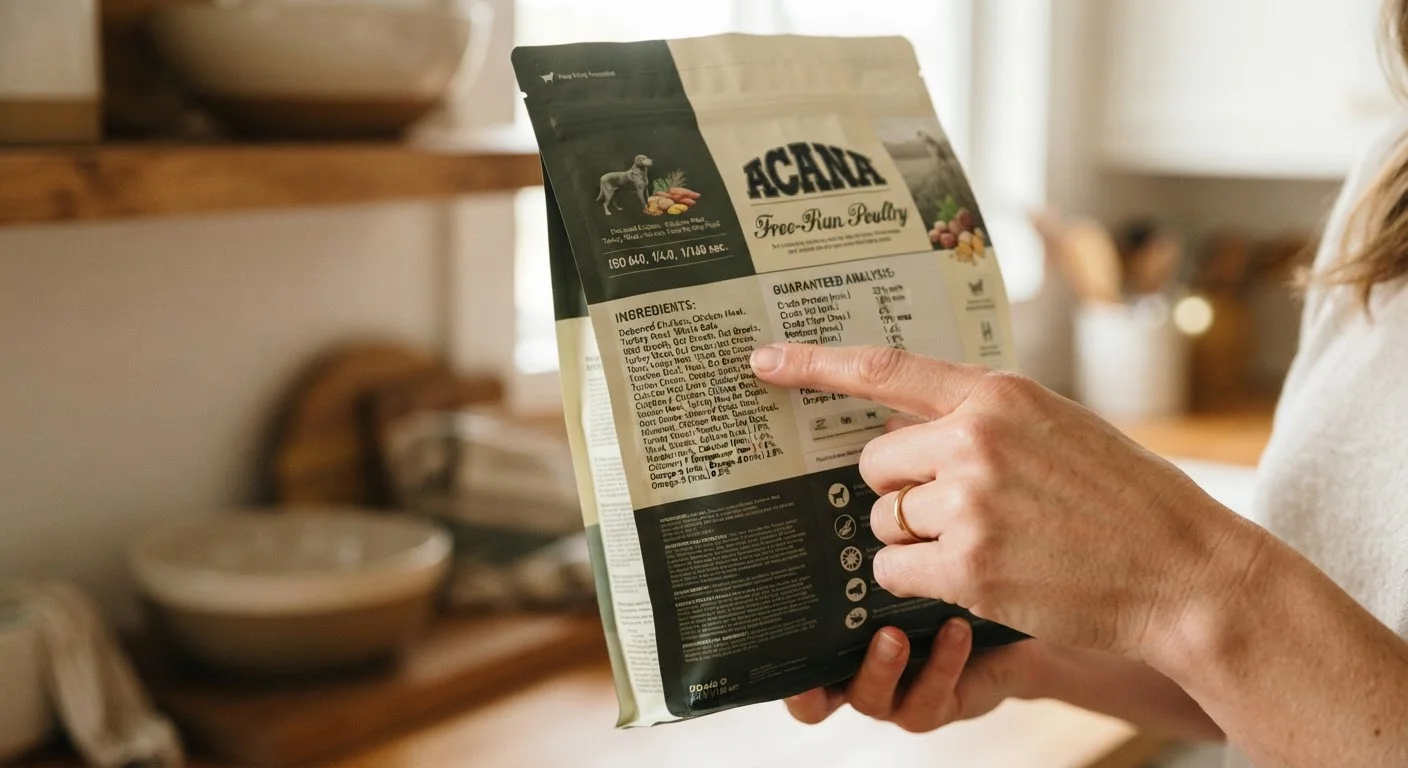
The Five Sections Every Label Must Include
Pet food labels sold in the United States must include five core elements under AAFCO model regulations: the product name, the ingredient list, the guaranteed analysis, the nutritional adequacy statement, and feeding directions. Together, these sections are meant to give owners a clear picture of what's in the bag — though each requires some interpretation to be genuinely useful.
Understanding the purpose of each section prevents the common mistake of fixating on front-of-package marketing language, which is the least regulated part of any pet food product. For a deeper look at how front-label claims can mislead, see our article on pet food claims that sound scientific but aren't.
The Ingredient List: What Order Really Means
Ingredients are listed in descending order by pre-cooking weight — a detail that significantly affects how you should interpret what you're reading. Fresh meats like chicken or beef contain 70–75% water, so they rank high by raw weight. Once cooked and dried into kibble, their contribution shrinks considerably.
This is why chicken meal — a pre-rendered, water-reduced ingredient — often delivers more concentrated protein per cup than fresh chicken listed above it. Neither presentation is inherently deceptive, but understanding the distinction helps you compare labels accurately.
Watch for Ingredient Splitting
When the same base ingredient appears multiple times under different names — such as ground corn, corn flour, and corn gluten meal — each entry is listed separately by weight. Taken together, these fractions may outweigh the first-listed protein source. Scan the full ingredient list rather than stopping at the first few entries.
Also watch for ingredient splitting: when a single ingredient, such as corn, appears in multiple forms (ground corn, corn flour, corn gluten meal) spread across the list, they may collectively outweigh the named protein at the top. Reading the full ingredient list — not just the first three entries — gives a more complete picture. For a broader look at what nutrients your pet's diet should cover, visit the six nutrients every pet diet should cover.
Guaranteed Analysis: A Floor and a Ceiling, Not Exact Numbers
The guaranteed analysis panel lists four core values: minimum crude protein, minimum crude fat, maximum crude fiber, and maximum crude moisture. The word crude refers to the chemical measurement method used — it doesn't describe quality.
78%
Typical moisture content of canned pet food
Compared to roughly 10% in dry kibble, this difference makes direct label comparisons misleading without dry-matter conversion.
2
Types of AAFCO nutritional adequacy claims
Foods may be substantiated by nutrient profile formulation or by live animal feeding trials — the latter considered a higher standard by many veterinary nutritionists.
4
Guaranteed analysis values required on US pet food labels
Minimum crude protein, minimum crude fat, maximum crude fiber, and maximum crude moisture are the four required disclosures under AAFCO model regulations.
These are regulatory thresholds, not precise measurements. A food labeled "minimum 26% protein" may contain 28% or more. Comparing the guaranteed analysis across different food types — dry kibble versus canned food, for example — also requires a conversion to dry-matter basis, because moisture content varies dramatically. A wet food at 78% moisture and a kibble at 10% moisture can't be compared directly on the as-fed percentages shown on their labels.
To understand how moisture content affects your overall feeding decisions, our piece on dry kibble versus wet food covers the practical tradeoffs.
The AAFCO Statement: The Single Most Informative Line on the Label
The nutritional adequacy statement — sometimes called the AAFCO statement — is one of the most meaningful pieces of text on any pet food label. It comes in two main forms:
- Formulated to meet AAFCO nutrient profiles — the manufacturer calculated that the recipe meets established minimums, but feeding trials were not conducted.
- Animal feeding tests using AAFCO procedures — the food was tested on live animals and found to support the stated life stage through the duration of the trial.
The statement will also specify the intended life stage: growth (for puppies and kittens), adult maintenance, all life stages, or senior (note: AAFCO does not have a separate senior standard, so this is a marketing term). Feeding a food labeled for adult maintenance to a growing puppy, for example, may leave the animal short on critical nutrients like calcium and phosphorus.
The 'Senior' Life Stage Has No AAFCO Standard
AAFCO establishes nutrient profiles for growth and adult maintenance, but not specifically for senior pets. A food marketed as 'senior formula' is typically meeting adult maintenance standards. If your older pet has specific health needs, your veterinarian can recommend whether a standard adult diet or a prescription therapeutic food is more appropriate.
If you're evaluating whether to switch your pet's diet, our checklist for evaluating a new pet food walks through AAFCO compliance alongside other key criteria.
Feeding Guidelines: Where to Start, Not Where to Stop
Feeding guidelines appear on every label and provide a weight-based daily serving range. They are calculated for average, healthy, moderately active animals and represent a reasonable starting point — nothing more. Individual factors including a pet's metabolism, reproductive status, whether they're spayed or neutered, and any health conditions can substantially shift their actual caloric needs.
Overreliance on label guidelines is one reason overfeeding is common. For context, portion size is frequently underestimated even by attentive owners. Body condition scoring — a hands-on assessment your veterinarian can demonstrate — is generally a more reliable calibration tool than bag guidelines alone.
“The guaranteed analysis gives you the floor and the ceiling, but not the full picture. Understanding both the ingredient list and the AAFCO statement together is what tells you whether a food is truly appropriate for your animal.”
— Board-Certified Veterinary Nutritionist, Diplomate, American College of Veterinary Nutrition
This article provides general educational information about pet food labels and is not a substitute for guidance from your veterinarian about your pet's specific nutritional needs.