
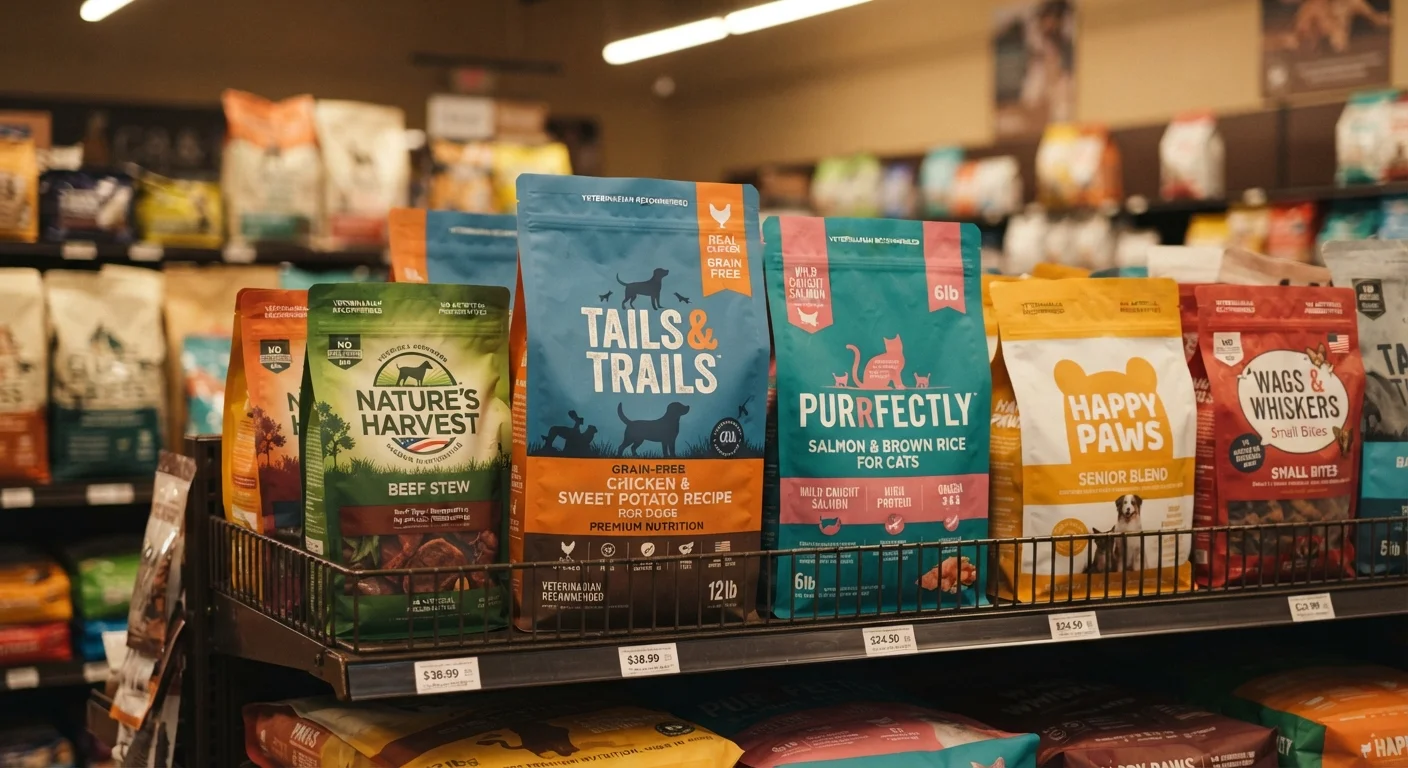
Why Pet Food Marketing Outpaces the Science
Walk down any pet food aisle and you'll encounter a cascade of reassuring words: "ancestral," "superfood," "clean," "wild-caught." These terms feel authoritative, but most exist in a regulatory gray zone. Unlike human food, where the FDA and USDA enforce strict definitions for many label claims, pet food labeling is overseen by a patchwork of federal guidelines and voluntary state-level standards set by the Association of American Feed Control Officials (AAFCO). The result: manufacturers can use emotionally compelling language that implies scientific rigor without being required to demonstrate it.
Understanding which claims are substantive — and which are simply packaging strategy — is one of the most practical skills a pet owner can develop. For a deeper dive into what each section of a label actually communicates, see our guide to reading pet food labels.
Myth
Grain-free food is healthier for dogs because grains are unnatural fillers that cause allergies.
Fact
Grains are not inherently harmful to dogs, and true grain allergies are uncommon. Grain-free diets have been associated in ongoing FDA investigations with cases of dilated cardiomyopathy (DCM) in dogs.
The FDA began investigating a potential link between grain-free diets and canine dilated cardiomyopathy (DCM) — a serious heart condition — after a spike in reported cases, many involving legume-heavy grain-free formulas. The mechanism is not fully established, but veterinary cardiologists have raised enough concern that several professional veterinary organizations advise caution. Meanwhile, food allergies in dogs most commonly involve animal proteins, not grains. Switching to grain-free without a veterinary reason may trade a perceived risk for a documented one.
Myth
"Human-grade" pet food is rigorously regulated and significantly safer than standard pet food.
Fact
"Human-grade" has no enforceable legal definition in pet food unless the entire product — ingredients, manufacturing, and facility — meets USDA human food standards, which very few products fully satisfy.
AAFCO has noted that for a pet food to legitimately use "human-grade" as a claim, every ingredient must be human edible and the product must be manufactured, processed, packed, and held in a facility that meets human food regulatory requirements. In practice, many products use this language loosely to refer only to ingredient sourcing, not the full production chain. The claim signals a marketing position more reliably than a safety or quality standard.
Myth
"Natural" on a pet food label means the product contains no artificial or synthetic ingredients.
Fact
AAFCO defines "natural" for pet food, but the definition permits some exceptions and the term does not mean "organic," "nutritionally superior," or "free of all processing."
AAFCO's definition of "natural" generally requires ingredients to be derived solely from plant, animal, or mined sources without chemical alteration — but it allows synthetic vitamins and minerals with a qualifying disclosure. "Natural" does not imply the product is certified organic, that pesticide-free farming was used, or that the food is nutritionally complete. It is a process and sourcing descriptor with specific but limited scope, and should not be read as a broad health endorsement.
Myth
"Holistic" pet food meets a higher nutritional or safety standard than conventional pet food.
Fact
"Holistic" has no regulatory definition whatsoever in the pet food industry. It is purely a marketing term with no required criteria.
Neither the FDA nor AAFCO defines or regulates the use of "holistic" on pet food packaging. Any manufacturer can apply the word to any product without meeting any specific nutritional, sourcing, or safety threshold. When evaluating a food labeled "holistic," set the term aside entirely and focus on verifiable information: the AAFCO nutritional adequacy statement, the guaranteed analysis panel, and whether the manufacturer conducts or references feeding trials. See our decoded label guide for help parsing what those sections actually mean.
Myth
Protein percentage on the label directly tells you how much usable protein your pet is getting.
Fact
Crude protein percentage reflects total nitrogen content, not protein digestibility or amino acid completeness — both of which determine how much protein your pet can actually use.
The guaranteed analysis panel lists "crude protein" as a minimum percentage, but this figure is derived from a laboratory nitrogen measurement. It does not distinguish between highly digestible animal proteins and less digestible plant or by-product sources. Two foods with identical crude protein percentages can differ substantially in how much protein an animal actually absorbs and utilizes. Digestibility data, when available from the manufacturer, is a more meaningful metric — but it is rarely printed on the label itself.
What the Evidence Actually Supports
Cutting through marketing language doesn't mean every premium product is worthless — it means evaluating foods on criteria that actually predict nutritional quality. The single most meaningful marker on any pet food bag is an AAFCO nutritional adequacy statement, which indicates whether the food meets established nutrient profiles for a specific life stage, either through formulation or feeding trials. No marketing claim on the front of the bag carries equivalent weight.
~4%
Estimated prevalence of true food allergies in dogs
Veterinary dermatology literature consistently finds that food allergies affect a small minority of dogs, and grain proteins are rarely the primary trigger.
500+
DCM cases reported to FDA linked to diet
The FDA's ongoing investigation into diet-associated DCM had received over 500 reports involving dogs eating predominantly grain-free diets as of its published updates.
Ingredient quality, digestibility, and caloric density all matter — but none of these are reliably communicated by words like "holistic" or "premium." If you're considering switching your pet's food, our checklist for evaluating a new pet food offers a structured framework for doing so safely. And if you're noticing physical changes in your pet — dull coat, low energy, digestive issues — consult your veterinarian, as these can be early signals of a nutritional gap, as outlined in our article on signs your pet's diet isn't meeting their needs.
AAFCO Statements Are Your Best Label Signal
Before evaluating any front-of-bag claim, find the AAFCO nutritional adequacy statement — typically a small paragraph on the back or side panel. It will tell you whether the food is "complete and balanced" for a specific life stage and whether that conclusion came from formulation or an actual feeding trial. Feeding trial data is generally considered stronger evidence of real-world nutritional performance. No marketing term on the front of the package substitutes for this statement.
This article is for general informational purposes only and does not constitute veterinary or nutritional advice. Consult a licensed veterinarian or board-certified veterinary nutritionist for guidance specific to your pet's health and dietary needs.