What a Roundabout Actually Is
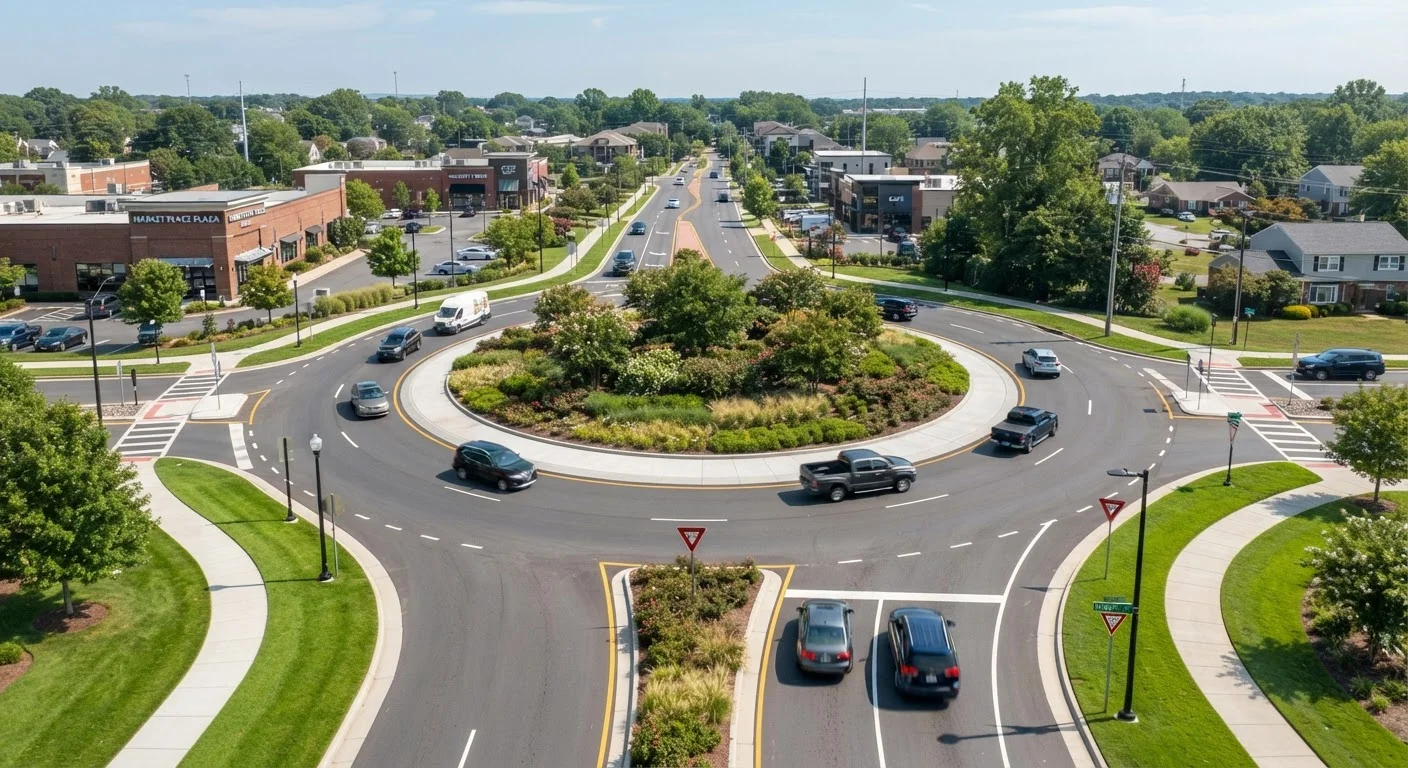
A roundabout is a circular intersection where traffic flows in one direction - counterclockwise in the United States - around a raised central island. Unlike a traffic circle or rotary from an earlier era, the modern roundabout is specifically designed with low entry speeds, yield-on-entry rules, and pedestrian-friendly splitter islands that slow approaching vehicles before they enter the circle.
The confusion many American drivers feel is largely generational and geographic. Traditional signalized intersections dominated U.S. road design for most of the 20th century, so roundabouts were rarely encountered until transportation engineers began installing them more widely from the 1990s onward. Today, the Federal Highway Administration actively promotes roundabouts as a safety improvement, and tens of thousands are now operating across the country.
Roundabout
A circular intersection where all traffic moves counterclockwise around a central island, with entering drivers required to yield to those already in the circle.
Yield on entry
The rule requiring drivers approaching a roundabout to give way to vehicles already circulating before they join the flow of traffic.
Circulatory roadway
The ring-shaped travel lane that surrounds the central island of a roundabout, where traffic moves continuously around the circle.
Splitter island
A raised or painted divider on each approach to a roundabout that separates entering and exiting traffic and provides a refuge point for pedestrians crossing in two stages.
Conflict point
Any location in an intersection where the paths of two vehicles, or a vehicle and a pedestrian, can cross - roundabouts dramatically reduce the number of these compared to standard intersections.
Understanding the basic geometry helps: each road that meets the roundabout is called an approach, and each departure is called an exit. The road encircling the central island is the circulatory roadway. Drivers enter, travel partway around the circle, and exit at their intended road.
The Yield Rule: Who Goes First
The single most important rule in any roundabout is this: traffic already in the circle has the right of way. Every vehicle entering from an approach lane must yield to circulating vehicles before merging in. This is the opposite of older rotary designs, where entering traffic sometimes had priority - which is one reason confusion persists.
At the yield line (marked by a dashed line and often a yield sign), you slow down and look left to check for vehicles coming around the circle. If the road is clear, you enter. If vehicles are present, you wait for a safe gap. You do not have to come to a complete stop unless traffic requires it - hesitating unnecessarily can itself create a hazard.
When in Doubt, Yield and Wait
If you're uncertain whether a gap in circulating traffic is large enough, it's always safer to wait for the next gap rather than force your entry. Roundabouts are designed for steady, low-speed flow - a brief pause at the entry line is far preferable to a collision inside the circle.
For a broader look at which right-of-way rules trip up American drivers most often, see our breakdown of U.S. right-of-way rules. Roundabouts are just one piece of a larger picture.
How to Enter, Navigate, and Exit
Approaching a roundabout, reduce your speed as you near the yield line - typical entry speeds are 15-25 mph. Watch for pedestrians at the crosswalk on the splitter island before you enter the circulatory roadway.
- Yield at the entry line. Look left and wait for a safe gap in circulating traffic.
- Enter smoothly. Accelerate gently into the circle without cutting across lanes.
- Stay in your lane. Keep a consistent position in the circulatory roadway; do not weave.
- Signal your exit. Activate your right turn signal as you pass the exit just before the one you want. This alerts pedestrians and waiting drivers that you are leaving.
- Yield to pedestrians on exit. Before leaving the roundabout, yield to any pedestrians using the crosswalk on your exit approach.
Building these habits connects directly to broader defensive driving practices. Road safety habits worth revisiting - like consistent mirror checks and deliberate signaling - apply just as much inside a roundabout as anywhere else.
Multilane Roundabouts: Added Complexity
Single-lane roundabouts are relatively straightforward once the yield rule clicks. Multilane roundabouts add a layer of lane discipline that catches even experienced drivers off guard.
The core principle: choose your lane before you enter, based on your intended exit. In a two-lane roundabout:
- Right lane: Use for the first exit (right turn) or sometimes the second exit (straight through), as signed.
- Left lane: Use for exits further around the circle - going straight past the first exit, turning left, or making a U-turn.
Once inside, stay in your chosen lane. Do not change lanes while circulating - this is where most multilane collisions occur. Look for pavement markings and overhead signs on the approach; they will indicate which lane leads to which exit or destination road.
Don't Change Lanes Inside the Circle
Switching lanes while circulating in a multilane roundabout is one of the most common causes of roundabout crashes. Commit to your lane on approach and hold it through to your exit. If you miss your exit, continue around the circle and try again - do not cut across lanes or reverse.
This lane discipline requirement shares similarities with highway merging: your decisions need to be made before the moment of action. The scanning and timing skills involved in merging are directly relevant to reading a multilane roundabout approach.
Why Roundabouts Are Safer Than Traditional Intersections
The safety case for roundabouts is well-supported by traffic safety research. Because all vehicles travel in the same direction and at low speeds, the most lethal crash types - head-on collisions and right-angle (T-bone) crashes - are effectively eliminated. Any collision that does occur tends to be a low-speed sideswipe rather than a high-energy broadside impact.
Research published by the Insurance Institute for Highway Safety (IIHS) has found that converting a traditional signalized intersection to a roundabout can reduce injury crashes by approximately 75% and fatal and incapacitating injury crashes by up to 90%. Roundabouts also eliminate the risk of running a red light, since there are no signals to run.
Beyond crash reduction, roundabouts typically improve traffic flow during off-peak hours because drivers don't wait through a full signal cycle when the intersection is lightly loaded. They also reduce vehicle idling, which has modest fuel and emissions benefits.
Understanding roundabouts fits into a wider effort to adapt to different road environments. For comparison, how risk changes between highway and city driving illustrates why matching your behavior to the road type - whether a roundabout, a freeway on-ramp, or a school zone - is the foundation of safe driving.
This article provides general driver education information. Traffic laws, signage requirements, and road rules vary by state and locality. Always follow posted signs and signals at specific intersections, and consult your state's driver handbook for the rules that apply where you drive.