What Is Resource Guarding?
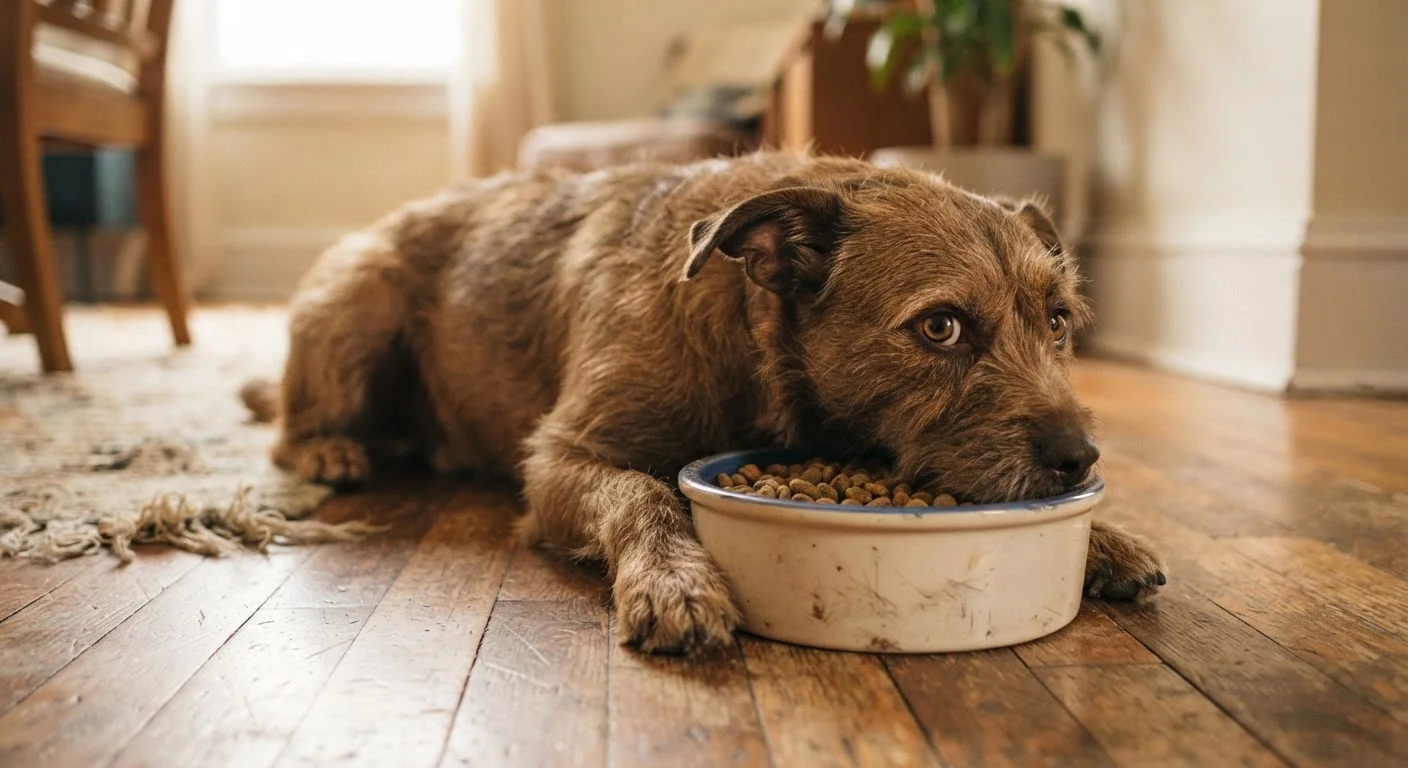
Resource guarding is a behavior in which a dog uses threats — or, in serious cases, aggression — to keep other animals or people away from something it values. That "something" is nearly always one of four categories: food and treats, objects such as toys or stolen items, spaces like a bed or crate, and occasionally a person. The behavior exists on a wide spectrum, from a dog that merely stiffens when another pet walks by its bowl, to one that snaps or bites anyone who comes near.
It is important to frame resource guarding correctly from the outset: it is a normal canine behavior with deep evolutionary roots. Dogs that successfully defended food in the wild were more likely to survive and reproduce. That does not make guarding acceptable in a family home, but understanding its origins is the first step toward addressing it humanely and effectively. For broader context on how dogs communicate stress and tension, see our guide to dog body language.
Why Dogs Guard: The Behavioral Science
Resource guarding is classified by behaviorists as an appetitive behavior — one driven by the motivation to obtain and retain something of value. It is not a sign of dominance over owners, nor a personality defect. Research in comparative animal behavior consistently shows that guarding tendencies can appear in any dog regardless of breed, size, age, or training history, though early-life experiences and genetics may influence intensity.
Two reinforcement mechanisms sustain guarding once it starts. First, guarding works: when a dog growls and the threat withdraws, the dog learns that the behavior was effective. Second, repeated success lowers the threshold — over time, smaller perceived threats can trigger bigger responses. This escalation pattern is why mild guarding should not be ignored.
~77%
of dog bites involve a known dog
According to the American Veterinary Medical Association, the vast majority of dog bites are inflicted by a dog known to the victim, often in a familiar home context.
~50%
of dogs show some guarding behavior
Studies in applied animal behavior suggest guarding of food or objects is observed in roughly half of companion dogs, though severity varies widely.
It is also worth noting that sudden onset of guarding in a previously relaxed dog may signal an underlying health issue, such as pain that makes the dog feel more vulnerable. Our article on when behavior problems signal medical issues explains when a veterinary check should come before any training plan.
Recognizing the Warning Signs
Guarding behavior almost always signals itself before a bite occurs. The challenge is that many owners miss or misread low-intensity signals. Learning this ladder of escalation is essential:
- Eating faster or hunching over the resource — an early, easy-to-miss signal
- Body stiffening or freezing — the dog stops moving normally when you approach
- Side-eye or "whale eye" — the whites of the eyes become visible as the dog tracks you without turning its head
- Lip lift or silent snarl — visible teeth without vocalization
- Growling — a clear warning that should never be punished (see below)
- Snap or lunge — the dog makes contact or near-contact
- Bite — the escalation peak
Most dogs give multiple signals before biting. Suppressing early warnings — such as punishing growling — removes those signals without removing the underlying motivation, making a bite more likely without warning. For a thorough reference on reading canine signals at every stage, visit our dog body language reference.
Never approach a guarding dog head-on or make direct eye contact — turn slightly sideways and toss the treat to the side of the dog rather than over it. This reduces perceived threat without you retreating completely.
Direct frontal approach and eye contact are perceived as confrontational by dogs; an angled body posture signals neutrality and lowers arousal during desensitization exercises.
Keep early trade-and-reward sessions very short — two to three repetitions maximum — and always end before any tension appears. Ending on a calm note means the dog's last experience of you near its resource is a positive one.
Dogs generalize emotional states associated with training sessions; stopping before frustration or tension sets in helps build a positive conditioned emotional response more reliably than longer, push-through sessions.
Safe, Humane Management Strategies
Management and behavior modification work best together. Management prevents rehearsal of the problem behavior while training builds new associations over time.
Environmental Management
- Feed dogs in separate rooms or with physical barriers if multiple pets are present.
- Remove high-value items — bones, chews, stolen objects — from shared spaces when you cannot supervise.
- Give the dog a predictable, low-traffic space to eat so it does not feel crowded.
Trade and Reward Exercises
The most widely endorsed counter-conditioning approach for guarding involves teaching the dog that your approach near a valued resource predicts something even better. Start at a distance where the dog shows no tension. Toss a high-value treat toward the dog without reaching for the resource. Gradually decrease the distance over multiple sessions. Eventually you can approach, drop a treat beside the bowl, briefly touch it, and move away — the dog learns that hands near its bowl mean good things happen, not that something is being taken.
This technique draws on the same principles described in our article on desensitization and counter-conditioning, which covers the methodology in depth.
Start With Low-Stakes Practice
Build trade-and-reward skills around items the dog does not guard intensely before working up to higher-value resources. A dog that happily trades a rubber ball is learning the same cognitive skill it will eventually need around its food bowl. Progress gradually and celebrate small wins — this process can take weeks or months depending on the dog.
Teaching a Reliable "Drop It" or "Leave It"
A conditioned exchange cue gives you a safe way to reclaim objects. Train "drop it" in low-stakes situations first — offer a toy, ask for the drop, immediately reward with a treat and return the toy. The dog learns that surrendering an item does not mean losing it permanently.
What Not to Do
Certain common responses to resource guarding are counterproductive and can escalate the behavior or create safety risks.
Never Punish a Growling Dog
Growling is a warning signal that the dog is uncomfortable — it is the behavior you want the dog to display so you can respond safely. Punishing a growl through corrections, spray bottles, or physical force teaches the dog to suppress the warning without reducing its underlying anxiety. The result is a dog that may bite with little or no prior signal, which is significantly more dangerous.
- Do not punish growling. Growling is a warning. Suppressing it through punishment removes a signal without removing the motivation, increasing the risk of a bite without warning.
- Do not use alpha rolls or physical dominance techniques. Forcibly rolling a guarding dog onto its back creates fear and pain, which intensifies the dog's perception that it must defend itself. There is no credible scientific basis for dominance-based interventions in this context.
- Do not repeatedly test the dog by approaching its bowl or taking its toys to "show it who's boss." Every successful guarding episode reinforces the behavior.
- Do not involve children unsupervised. Children are among the most common bite victims precisely because they approach dogs during eating or play without reading warning signals.
When to Seek Professional Help
Not all guarding cases can or should be managed by owners working alone. Seek the guidance of a certified professional when:
- A bite has already occurred, regardless of severity
- Guarding is directed at multiple resources or is escalating quickly
- The dog shows no warning signals before reacting ("silent guarders" represent higher bite risk)
- Children or vulnerable individuals live in or frequently visit the home
- Management alone is not feasible given the household layout or number of pets
Look for a Certified Applied Animal Behaviorist (CAAB) or a veterinary behaviorist board-certified by the American College of Veterinary Behaviorists (ACVB) for cases involving bites or rapid escalation. A Certified Professional Dog Trainer (CPDT-KA) with documented experience in aggression cases may be appropriate for milder presentations. Ask prospective trainers directly about their methods — force-free, reward-based approaches are supported by current behavioral science.
“Aggression is rarely a first resort for dogs — it follows a predictable ladder of communication that owners can learn to read and interrupt long before a bite occurs.”
— Jean Donaldson, Founder of the Academy for Dog Trainers and author of widely used canine behavior texts
Resource guarding shares some features with other anxiety-driven behaviors. If your dog shows multiple anxious behaviors — including distress when left alone — our article on separation anxiety in dogs may also be useful reading. Similarly, if the guarding appeared suddenly alongside other behavioral changes, consult a veterinarian to rule out pain or illness before beginning any training program.
This article is for general educational purposes only and does not constitute veterinary or professional behavioral advice. If your dog has bitten a person or animal, consult a qualified veterinary or animal behavior professional before attempting any intervention.