How Each Strategy Works
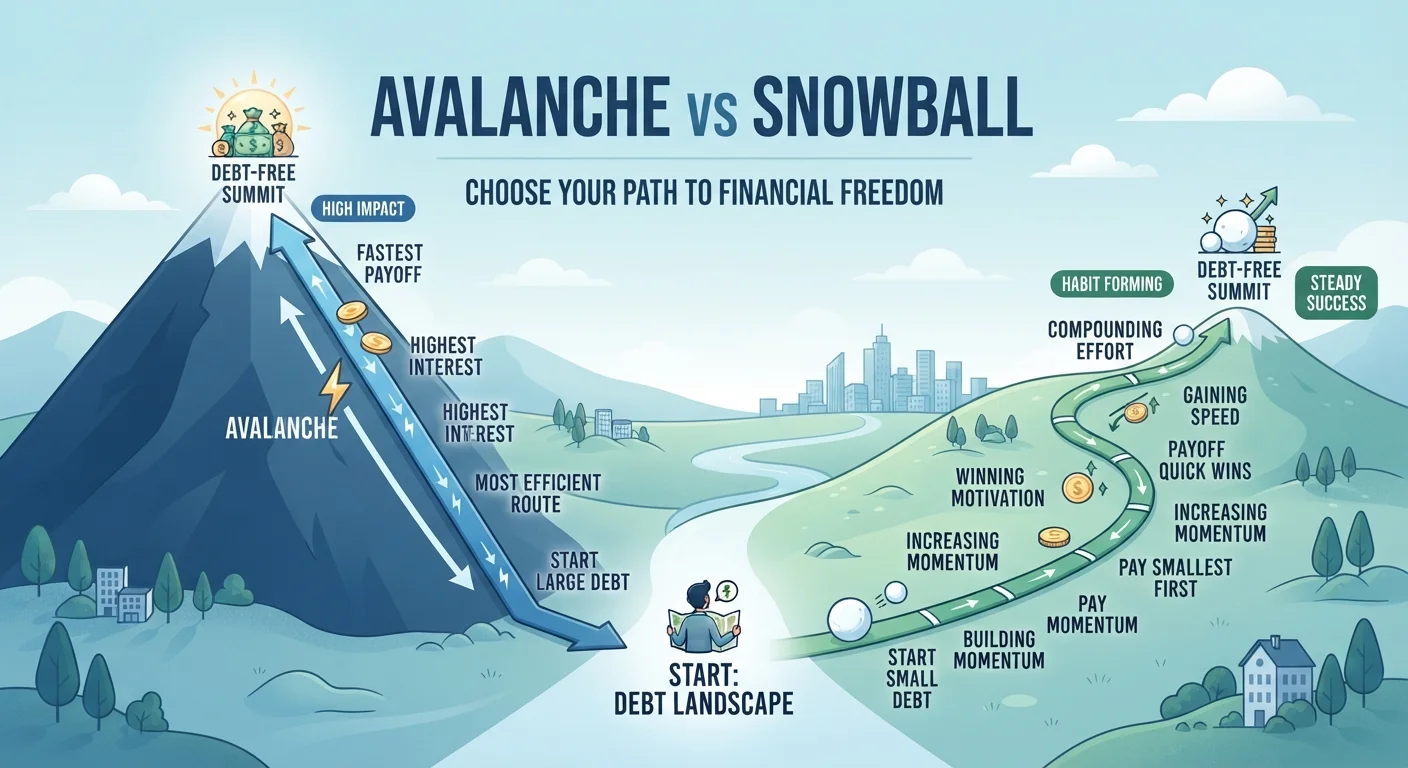
Both methods share a common foundation: you make minimum payments on all your debts, then put any extra money toward one targeted account each month. The difference lies entirely in which debt gets that extra payment first.
Debt Avalanche: You rank your debts from highest annual percentage rate (APR) to lowest. Every extra dollar goes to the highest-rate balance until it's gone, then cascades to the next. Because interest compounds daily on most consumer debt, this approach limits how much new interest accrues across the full portfolio. Understanding how compound interest works makes it clear why targeting the highest rate first has such a meaningful long-term effect.
Debt Snowball: You rank debts from smallest balance to largest, regardless of interest rate. Extra payments go to the smallest balance until it's cleared, then that freed-up payment amount rolls into the next account. The method is built on behavioral momentum — each eliminated account signals tangible progress and reinforces the habit of paying more than the minimum.
| Criterion | Debt Avalanche | Debt Snowball |
|---|---|---|
| Payoff order | Highest interest rate first | Smallest balance first |
| Total interest paid | Lower (mathematically optimal) | Potentially higher |
| Time to first debt eliminated | Longer (if high-rate debt is large) | Shorter (quick early wins) |
| Motivational approach | Data-driven, long-view focus | Milestone-driven, momentum-based |
| Best rate environment | Wide spread between rates | Similar rates across debts |
| Behavioral risk | Higher — requires patience | Lower — frequent reinforcement |
| Complexity | Slightly higher (rate tracking) | Simple balance ranking |
The Math Behind the Methods
The avalanche method's mathematical edge is real and measurable. Consider a simple example: if you hold a $3,000 credit card balance at 22% APR alongside a $1,000 medical bill at 0% interest, directing extra payments to the credit card first clearly reduces total interest paid — even though the medical bill has a smaller balance.
The snowball's trade-off is a higher total interest cost in exchange for psychological benefits. In scenarios where the gap between interest rates is significant — say 22% versus 6% — the difference in total interest paid between the two strategies can be substantial. When rates are clustered closely together, the gap narrows considerably.
22%+
Average credit card APR in recent years
Federal Reserve data shows average credit card interest rates have risen significantly, making the cost of carrying balances steeper than in prior decades.
~$6,500
Average American credit card balance
According to Federal Reserve and TransUnion consumer credit data, average revolving credit card balances have remained in the mid-thousands for most U.S. households.
33%
Adults who carry credit card debt monthly
Surveys by the American Bankers Association and related research suggest roughly one in three American adults carries a credit card balance from month to month.
It's also worth recognizing that the optimal mathematical strategy only delivers value if you follow through. A plan abandoned six months in saves nothing. Research in consumer behavior consistently finds that motivation and perceived progress are key predictors of debt repayment completion — which is the underlying case for the snowball.
If you're also weighing whether to direct money toward savings rather than extra debt payments, the guide to saving and paying off debt simultaneously can help you think through competing priorities.
Choosing the Right Fit for Your Situation
Before selecting a strategy, take stock of your full debt picture: list every balance, its interest rate, and its minimum payment. This inventory is the foundation for either method. From there, a few factors can guide your choice.
Your interest rate spread matters. If your highest-rate debt carries an APR significantly above your others, the avalanche's advantage grows. If rates are similar, the snowball's motivational edge may outweigh the small mathematical difference.
Your track record with financial goals matters too. If you've struggled to maintain momentum on past plans, eliminating a small balance early could be the reinforcement that keeps you going. On the other hand, if you're detail-oriented and driven by data, seeing the interest-cost savings from the avalanche can serve the same motivating function.
It's also worth separating fact from assumption before you begin. The article on credit card debt myths addresses common misconceptions — like the idea that carrying a balance improves your credit score — that sometimes distort how people approach repayment decisions.
If your debt feels too large or complex for either method to address alone, debt consolidation is another option to explore, though it carries its own trade-offs. And if you're seeing warning signs that debt is becoming unmanageable, recognizing those signs early is the critical first step.
Both Methods Require a Defined Extra Payment
Neither the avalanche nor the snowball works without a consistent extra payment beyond minimums. Even a modest additional amount — applied every month without exception — creates the compounding effect that makes either strategy successful. Before choosing a method, identify a realistic extra-payment amount that your budget can sustain long-term. Sporadic large payments are less effective than steady smaller ones.
This article is for general informational purposes only and does not constitute personalized financial advice. Readers should consult a qualified, licensed financial adviser before making decisions about their own debt repayment strategy or financial situation.