
Why This Decision Is Harder Than It Looks
Most personal finance advice frames saving and paying off debt as competing priorities — but for the majority of American households carrying some form of debt, a binary choice isn't realistic. Mortgage balances, student loans, auto payments, and credit card debt often coexist with genuine savings needs: an emergency fund, retirement contributions, or a near-term financial goal. Choosing one exclusively over the other can leave you financially exposed in different ways.
The real challenge is that money directed at debt repayment is doing double duty: it reduces a liability and eliminates the interest cost on that liability. Money directed at savings earns a return but doesn't reduce what you owe. Deciding which action is more valuable in your situation depends primarily on one variable: the interest rate attached to your debt compared to what your savings can realistically earn. Understanding that relationship is the foundation of any sound approach to prioritizing both goals. For broader context on managing your overall spending plan, explore our budgeting basics hub.
This Is General Education, Not Personal Advice
The guidance in this article is for general informational and educational purposes only. It does not constitute personalized financial, tax, or legal advice. Your specific situation — income, debt type, interest rates, tax status — will affect which strategy is right for you. Consider consulting a qualified financial adviser before making significant changes to your financial plan.
Tools and Information You'll Need
Having the right inputs on hand makes every step below faster and more accurate. Gather these before you begin.
What you will need
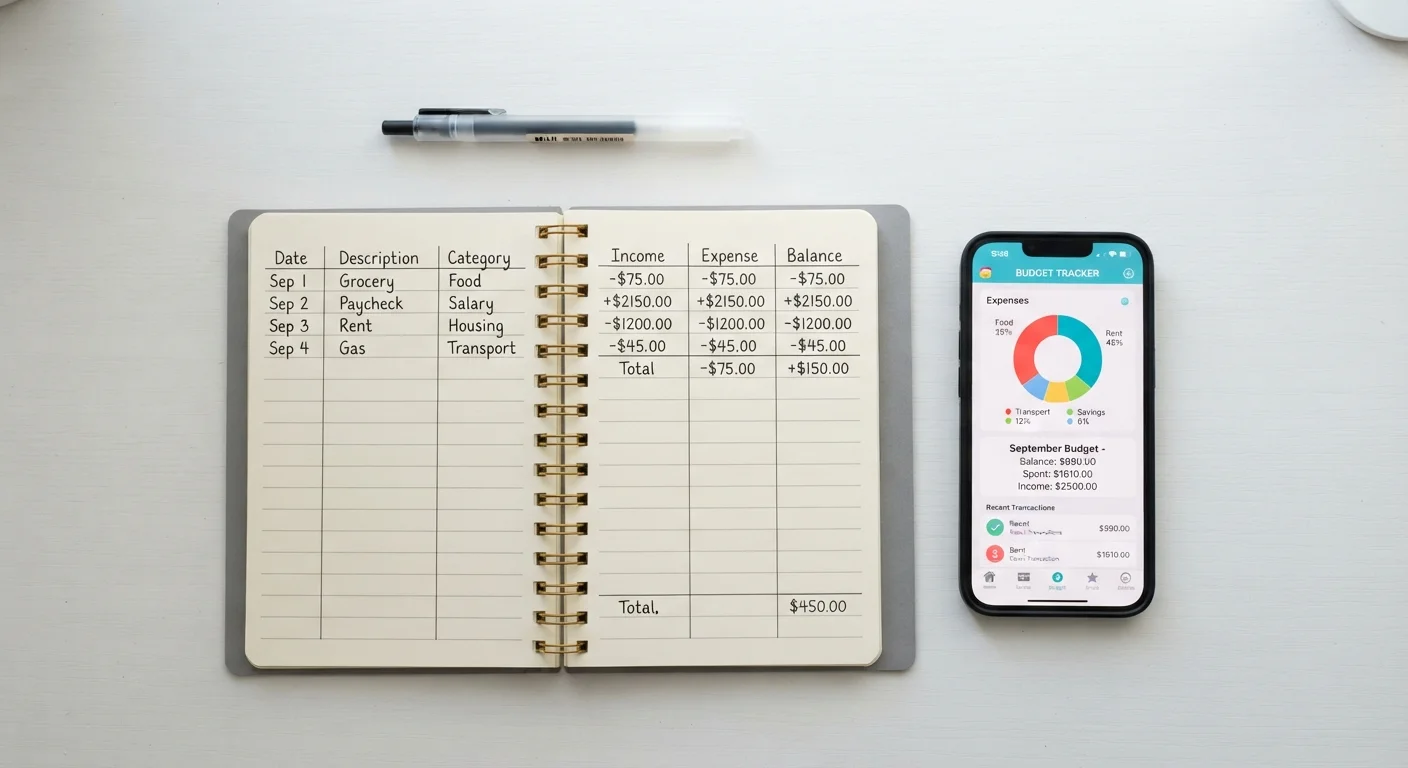
Monthly budget or spending tracker
Identifies how much discretionary income is available to split between savings and debt payments.
List of all debts with interest rates and balances
Allows you to rank debts by cost so you can target the most expensive ones first.
High-yield savings account
Earns a competitive return on your emergency fund while keeping funds accessible.
Debt payoff calculator
Projects how quickly balances decline under different payment scenarios, helping you see the impact of extra payments.
Step-by-Step: How to Prioritize Saving and Debt Repayment
Map Your Full Financial Picture
Before allocating a single dollar, gather concrete numbers. List every debt — credit cards, student loans, auto loans, personal loans — along with each balance, minimum payment, and annual percentage rate (APR). Separately note your monthly take-home pay and fixed essential expenses. The gap between income and essentials is your discretionary margin: the pool you'll divide between saving and debt repayment. Without this baseline, any prioritization decision is a guess.
Establish a Starter Emergency Fund
Before directing extra money aggressively at debt, set aside a modest cash reserve — commonly suggested at $500 to $1,000 — in a liquid account. This buffer prevents a single unexpected expense from sending you back to high-interest borrowing. Once this minimum cushion exists, you can redirect surplus income toward debt with more confidence. Building it first is not a delay tactic; it is a risk management step.
Compare Interest Rates to Savings Returns
The core decision rule is straightforward: if a debt's interest rate exceeds what your savings could realistically earn, paying down that debt first produces a better financial outcome. High-interest credit card debt — where APRs commonly range from 20% to 30% — is almost always more costly than any savings vehicle's return. Lower-rate debt, such as federal student loans or fixed-rate mortgages, may fall below what a diversified savings or investment approach might generate over time, though that comparison involves risk and is not guaranteed. Use this rate comparison as your primary tiebreaker when allocating extra funds.
Choose a Debt Payoff Order
Once you've identified which debts carry the highest cost, choose an approach to sequence your payments. Two widely discussed methods are the debt avalanche — targeting the highest-interest balance first to minimize total interest paid — and the debt snowball — paying off the smallest balance first for motivational momentum. Either can work; the better method is the one you'll stick with. Our companion article on debt avalanche vs. debt snowball walks through the trade-offs in detail. Continue making at least minimum payments on all other debts to protect your credit and avoid penalty rates.
Set a Split Allocation and Automate It
Divide your discretionary margin between your chosen debt target and savings using a deliberate split — for example, 70% toward debt and 30% toward savings, or another ratio that reflects your priorities and timeline. There is no universally correct ratio; it depends on your debt's cost, your job stability, and how close you are to a savings goal such as a fully funded emergency reserve. Once you decide on a split, automate both transfers so they happen without active intervention each month. This consistency compounds over time and eliminates the friction of repeated decisions. For guidance on how much to save overall, see our reference on savings rate benchmarks.
Monitor Progress and Adjust
Track balances and savings totals at least monthly. Celebrate milestones — a paid-off card, a savings threshold reached — to maintain motivation. If you receive a windfall such as a tax refund or bonus, direct it deliberately rather than letting it disappear into general spending. Once high-interest debt is eliminated, redirect those former payment dollars entirely into savings and longer-term financial goals. If at any point your debt feels unmanageable rather than simply challenging, it may be time to reassess — our article on signs your debt load is becoming unmanageable outlines warning signals and next steps.
Skipping an Emergency Fund Carries Real Risk
Putting every spare dollar toward debt without any liquid savings can backfire. An unexpected car repair or medical bill may force you back onto high-interest credit, erasing recent progress. Most financial educators recommend establishing at least a minimal cash buffer — often cited as $500–$1,000 — before shifting full focus to debt payoff.
Automate Both Goals From Day One
Set up automatic transfers to a savings account and automatic extra debt payments on the same day your paycheck clears. Automation removes the temptation to redirect funds and builds both habits simultaneously. See our guide to savings automation for practical setup steps.