What Is Compound Interest?
Compound interest is interest calculated not just on your original deposit or loan balance — called the principal — but also on any interest that has already accumulated. In plain terms: your interest earns interest.
Here's a simple illustration. Suppose you deposit $1,000 in a savings account with a 5% annual interest rate. After year one, you earn $50 in interest, bringing your balance to $1,050. In year two, that 5% is applied to $1,050 — not the original $1,000 — so you earn $52.50. This cycle repeats, and the gap between what you'd earn with simple interest versus compound interest widens meaningfully over time.
Principal
The original sum of money deposited or borrowed, before any interest is added. Compound interest is calculated on the principal plus accumulated interest.
Compound Interest
Interest calculated on both the original principal and the interest already earned or charged. This causes balances to grow faster than simple interest over time.
Simple Interest
Interest calculated only on the original principal, not on accumulated interest. Less common in modern savings and lending products.
APY (Annual Percentage Yield)
The real annual rate of return on a savings account after accounting for compounding frequency. A more accurate comparison figure than a stated interest rate alone.
Compounding Frequency
How often interest is calculated and added to the balance — daily, monthly, quarterly, or annually. More frequent compounding accelerates growth.
Rule of 72
A quick estimate tool: divide 72 by an annual interest rate to find roughly how many years it takes a balance to double at that rate.
This contrasts with simple interest, which only ever applies to the original principal. Compound interest is the standard mechanism behind most savings accounts, certificates of deposit, retirement accounts, and also most consumer debt products. Understanding how it behaves is foundational to managing both savings and debt wisely.
For a broader grounding in the vocabulary used here, the financial terms beginner's glossary covers key definitions like APR, principal, and amortization in plain English.
How Compounding Frequency Changes the Math
The rate at which interest compounds — daily, monthly, quarterly, or annually — meaningfully affects how quickly a balance grows. More frequent compounding means interest is being added to the principal more often, creating a larger base for the next calculation cycle.
Consider $10,000 earning 5% annually over 10 years:
- Compounded annually: grows to approximately $16,289
- Compounded monthly: grows to approximately $16,470
- Compounded daily: grows to approximately $16,487
The differences may seem modest at first glance, but they become more pronounced at higher balances, higher rates, and over longer periods. When evaluating savings products, the Annual Percentage Yield (APY) — not just the stated interest rate — reflects the true annual return after accounting for compounding frequency. Always compare APY figures when assessing savings accounts.
Use APY — Not Just the Interest Rate — to Compare
When comparing savings accounts, focus on the APY rather than the stated rate. The APY already factors in compounding frequency, giving you a true apples-to-apples number. Two accounts with the same stated rate but different compounding schedules will produce different results over time.
A useful mental shortcut is the Rule of 72: divide 72 by the annual interest rate to estimate the number of years it takes a balance to double. At 6%, a balance doubles in roughly 12 years; at 9%, in about 8 years.
Compound Interest Working Against You: Debt
The same mechanics that grow savings also accelerate debt. Credit card balances, personal loans, and other consumer debt products typically charge compound interest — and often at rates far higher than any savings account pays.
Credit card interest, for example, is typically calculated daily based on your average daily balance. If you carry a $3,000 balance at a 22% APR and make only minimum payments, the compounding effect means a significant portion of each payment goes toward interest rather than reducing the principal. Your balance shrinks slowly while the lender collects substantially more than the original amount borrowed.
Minimum Payments Extend Debt — And Cost More
Paying only the minimum on a high-interest credit card dramatically extends the repayment timeline and increases total interest paid. Because interest compounds daily, even a few extra dollars above the minimum payment each month can meaningfully reduce the total cost of debt. Always review your card statement's payoff projection, which federal law requires issuers to disclose.
Mortgages work differently from revolving credit. Most U.S. mortgages use an amortizing structure where each payment covers both principal and interest — and because they are typically fixed-rate, the compounding dynamic is more predictable. The American mortgage explainer walks through how home loan repayment is structured in detail.
When managing multiple debts, understanding the interest rates on each is essential. The debt avalanche vs. debt snowball guide explains two structured approaches to payoff and when each may make sense for your situation.
How to Make Compound Interest Work for You
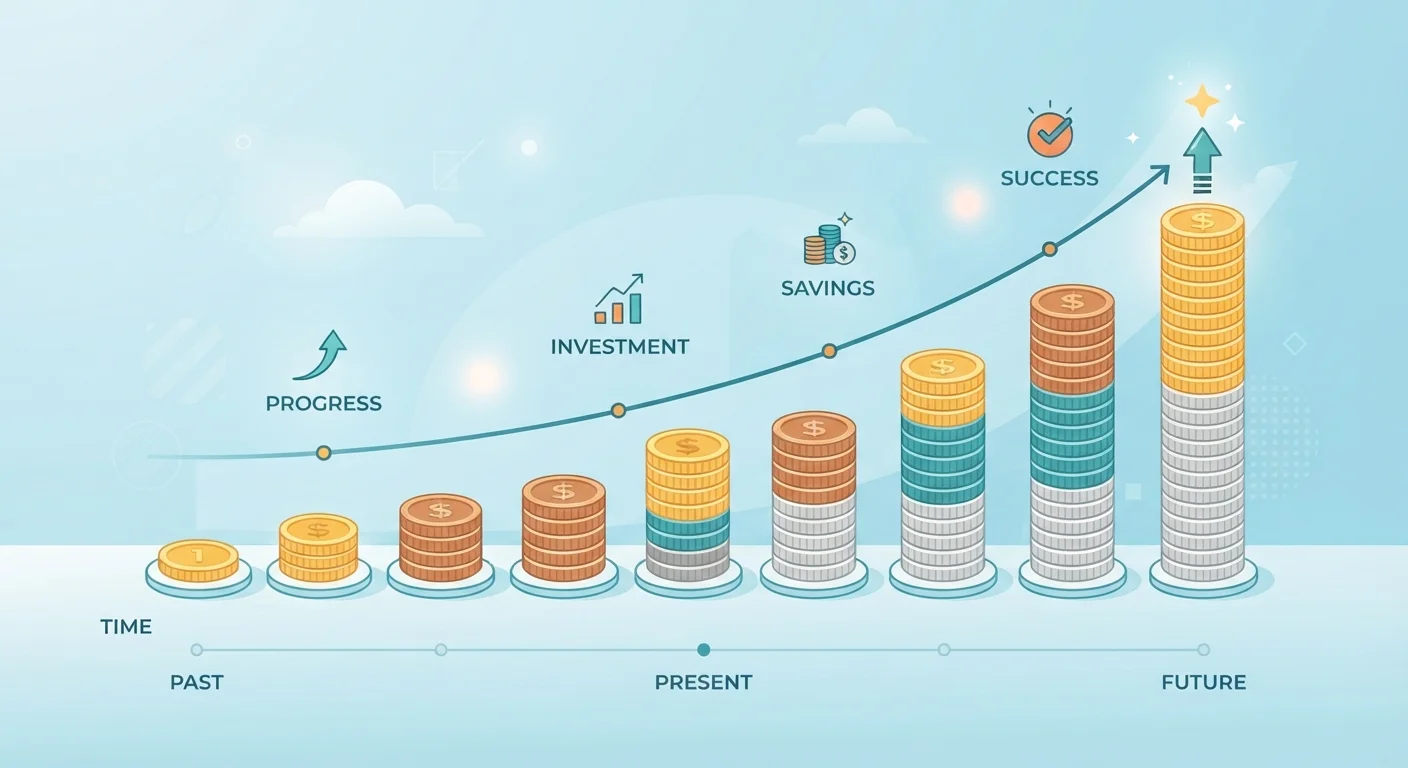
The most powerful variable in compounding is time. Starting to save earlier — even with smaller amounts — gives compound interest more cycles to operate, producing results that are difficult to replicate by saving larger sums later. This is why financial education consistently emphasizes beginning savings habits as early as practical.
A few principles help maximize compounding on the savings side:
- Contribute consistently. Regular deposits increase the principal, giving compounding a larger base to work from. Automating transfers removes the friction of remembering to save each month. The savings automation guide explains how to set this up effectively.
- Reinvest earnings. In savings accounts, interest is typically credited automatically. In investment accounts, ensure dividends and distributions are reinvested rather than withdrawn.
- Minimize high-interest debt. Paying down high-rate balances is effectively a guaranteed return equal to the interest rate — often higher than most savings products offer. Balancing both goals simultaneously is addressed in the saving and debt payoff prioritization guide.
Building financial habits around compounding — both leveraging it in savings and neutralizing it in debt — is a core component of long-term financial stability. For broader context on managing everyday finances, the Budgeting Basics hub and the Credit & Banking hub offer additional foundational resources.
This article is for general informational and educational purposes only and does not constitute personalized financial, investment, or tax advice. Consult a licensed financial professional for guidance specific to your circumstances.