Why Credit Card Myths Persist
Credit cards are one of the most widely used financial tools in the United States, yet misconceptions about how they work — particularly around carrying balances — remain stubbornly common. These myths aren't harmless. Acting on bad information can cost hundreds or even thousands of dollars in unnecessary interest, and can undermine credit scores rather than protect them.
This article examines the most widespread myths about credit card debt, corrects the record with accurate information, and explains what the evidence actually shows. For a broader look at how budgeting interacts with debt management, see The Truth Behind Common Budgeting Myths.
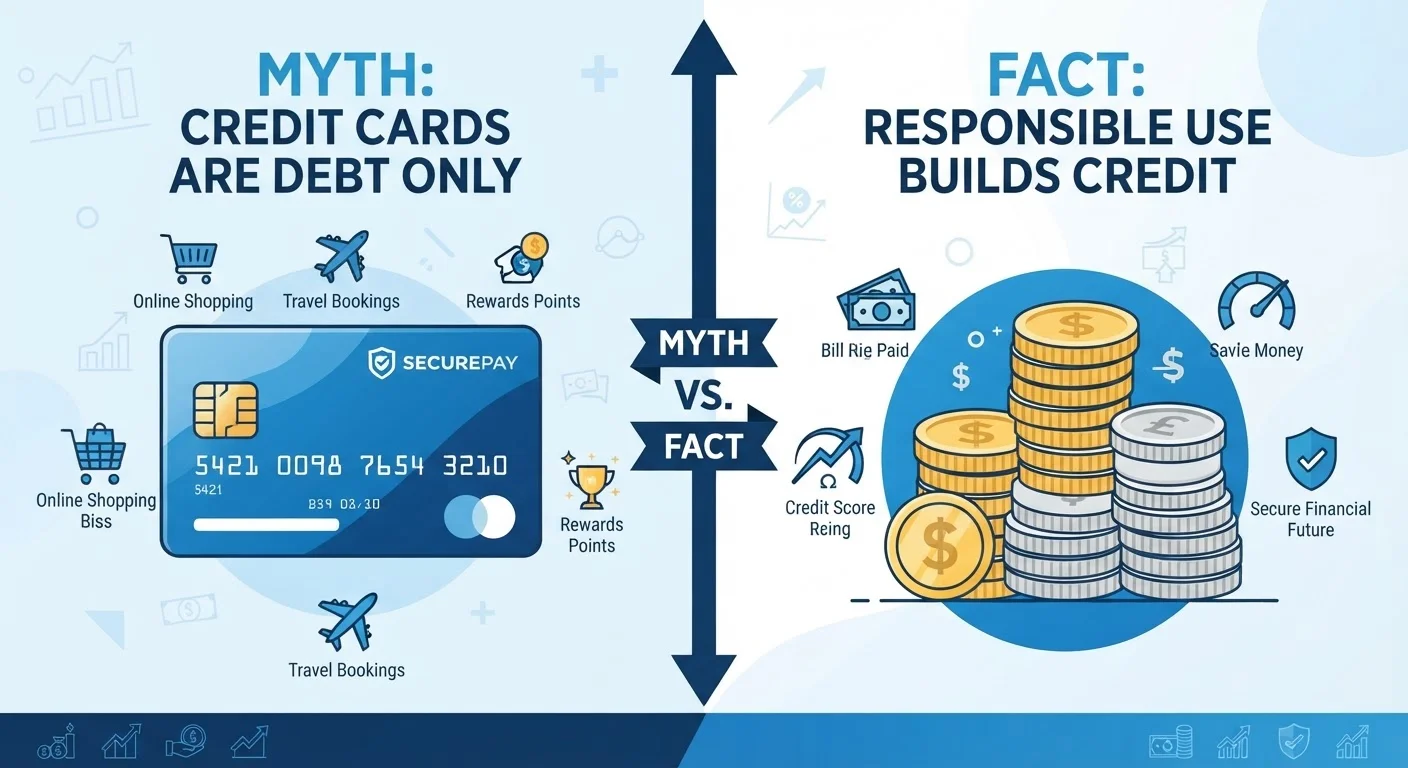
Myth
Carrying a balance from month to month helps build your credit score.
Fact
Carrying a balance costs you interest and provides no credit score benefit over paying in full.
This is perhaps the most costly credit card myth in circulation. Credit scoring models — including FICO and VantageScore — reward utilization (how much of your available credit you're using) and payment history (whether you pay on time). Neither metric requires an unpaid balance. Paying your statement balance in full each month demonstrates responsible use, keeps utilization low, and avoids any interest charges entirely. The myth likely originates from confusion between using a card and carrying a balance — you need to do the former, not the latter. See Things People Get Wrong About Credit Scores for more score-related misconceptions.
Myth
A small amount of credit card debt is essentially harmless because the interest is minimal.
Fact
Credit card APRs are typically far higher than other forms of consumer credit, making even modest balances expensive over time.
Average credit card interest rates in the US have frequently exceeded 20% APR in recent years — significantly higher than auto loans, mortgages, or federal student loans. A $500 balance that takes 12 months to pay off at 22% APR results in meaningful extra cost, and many consumers underestimate how quickly interest compounds. The perception that small balances are inconsequential often leads to gradual balance growth rather than disciplined payoff. High-interest revolving debt should generally be treated as a financial priority, not a manageable background expense.
Myth
All debt is equally bad, so there's no strategic reason to prioritize credit cards over other loans.
Fact
Debt varies significantly in interest rate, tax treatment, and repayment flexibility — credit card debt is typically the most expensive and least flexible.
Financial planning distinguishes between different types of debt based on their cost and structure. Mortgages often carry lower rates and may offer tax considerations. Federal student loans come with income-driven repayment options and potential forgiveness programs. Credit card debt, by contrast, tends to carry the highest APR and offers no such protections. Prioritizing higher-interest debt first — sometimes called the debt avalanche method — is a mathematically sound approach for reducing total interest paid. Treating all debt as identical can lead to suboptimal repayment decisions. For a broader comparison, The Pros and Cons of Debt Consolidation Loans explores one common strategy for managing multiple obligations.
Myth
You should avoid using credit cards altogether if you want to stay out of debt.
Fact
Responsible credit card use — paying in full each month — can build credit history without incurring interest or growing debt.
Avoiding credit cards entirely can actually work against you in the long run by limiting your credit history, which is one of the factors scoring models evaluate. The issue isn't the card itself — it's unpaid balances. Used within your budget and paid off monthly, a credit card functions as a short-term interest-free loan with added consumer protections that debit cards often lack. Debit Cards and Credit Cards: How They Actually Differ covers these distinctions in detail. The goal is disciplined use, not avoidance.
Myth
Making the minimum payment keeps your finances in good shape.
Fact
Minimum payments satisfy lender requirements but extend repayment timelines dramatically and maximize total interest paid.
Minimum payment requirements — often around 1–2% of the outstanding balance or a small fixed dollar amount — are designed by lenders to keep accounts current, not to help cardholders pay down debt efficiently. At a typical minimum payment on a $4,000 balance, a borrower could remain in repayment for well over a decade, paying more in interest than the original principal. Meeting the minimum is better than missing a payment, but it should be understood as a floor, not a strategy. Paying as much above the minimum as your budget allows significantly shortens the repayment period and reduces total interest cost.
Understanding the Real Cost of Revolving Debt
Credit card debt is classified as revolving debt — meaning you can borrow, repay, and borrow again up to your credit limit. Unlike installment loans with fixed repayment schedules, revolving balances accrue interest daily based on your average daily balance, compounding the cost the longer a balance remains.
20%+
Typical US credit card APR
Federal Reserve data has shown average credit card interest rates frequently exceeding 20% APR in recent years, making this among the highest-cost consumer borrowing categories.
$6,000+
Average US household credit card balance
Industry research consistently estimates the average American household carrying a balance holds several thousand dollars in revolving credit card debt.
The math makes a compelling case for payoff urgency. If you carry a $3,000 balance at a 22% annual percentage rate (APR) and make only minimum payments, you could spend several years — and hundreds of dollars in additional interest — before the balance clears. Our article Why Paying Only the Minimum on Credit Cards Costs More Than You Think walks through the numbers in detail.
If you're managing balances across multiple accounts, structured approaches like those outlined in Debt Avalanche vs. Debt Snowball can provide a practical framework. And it's worth noting that not all debt behaves the same way — Student Loan vs. Credit Card Debt compares the key differences that affect your repayment strategy.
High-Interest Debt Compounds Quickly
Credit card interest accrues daily on your average daily balance. Even a modest unpaid balance at a high APR can grow faster than many consumers expect. Prioritizing payoff — and understanding exactly how much carrying a balance costs — is a foundational step in sound personal financial management. If you are unsure how to approach existing debt, a nonprofit credit counselor or licensed financial adviser can provide guidance tailored to your situation.
This article is for general informational purposes only and does not constitute personalised financial or legal advice. Consult a qualified financial professional for guidance specific to your situation.