How Minimum Payments Work — and Why They're Designed the Way They Are
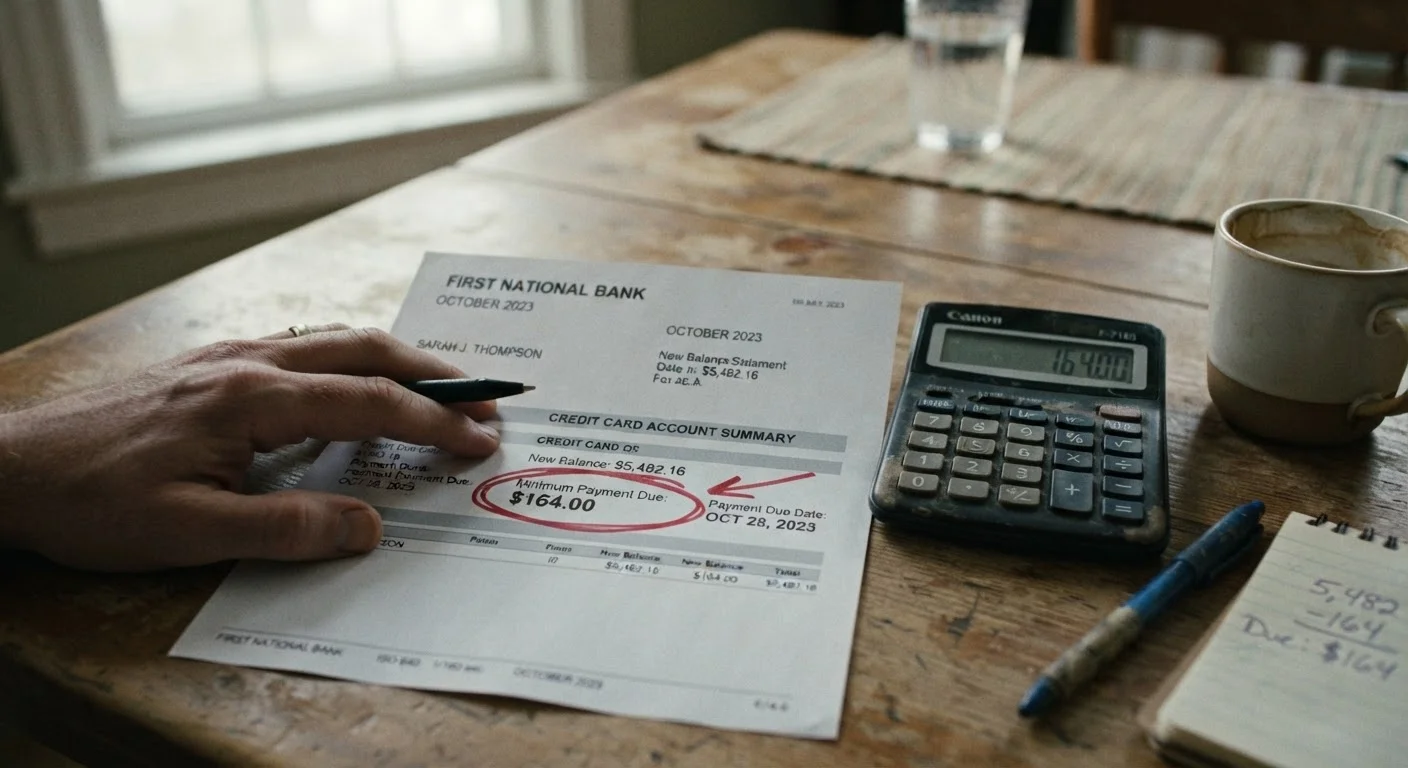
Credit card issuers calculate minimum payments using one of two common formulas: either a flat dollar floor (often $25–$35) or a small percentage of the statement balance — typically 1% to 3% — whichever is greater. Some issuers add the current month's interest and fees on top of that percentage. The result is a number that keeps the account current while maximizing the time — and therefore the interest — the issuer earns on your balance.
Federal law requires issuers to include a minimum payment warning on every statement. This disclosure shows how many years it will take to clear the balance paying only the minimum, and the total interest cost. These numbers are often striking: a $3,000 balance at 22% APR paid at minimum-only rates can take more than a decade to retire and cost well over $3,000 in interest alone — exceeding the original debt.
Minimum Payments Are Not a Payoff Plan
Making the minimum payment keeps your account in good standing and protects your credit score from late-payment damage — but it is not a debt reduction strategy. On a high-APR card, the minimum payment may barely exceed the monthly interest charge, meaning your principal balance shrinks by only a few dollars each month. Treating the minimum as a finish line rather than a floor is one of the costliest habits in personal finance.
Understanding this math is the foundation of smarter repayment. Once you see the true cost, the case for paying more becomes difficult to ignore.
Common Mistakes That Keep You Trapped in the Minimum-Payment Cycle
Treating the minimum payment as the intended monthly payment amount.
Why it happens: Card statements prominently display the minimum due, and issuers design minimums to be affordable — which makes them feel like the 'right' amount to pay.
Ignoring how a high APR compounds interest on the remaining balance every billing cycle.
Why it happens: Annual percentage rates are quoted yearly, making a 22% APR feel abstract rather than an immediate monthly cost of roughly 1.8% on every dollar owed.
Continuing to charge new purchases on a card while paying only the minimum on an existing balance.
Why it happens: Cardholders often mentally separate 'old debt' from 'current spending,' not realizing that new charges accrue interest at the same rate and extend the payoff timeline further.
Skipping a structured payoff strategy and making random extra payments with no system.
Why it happens: Without a clear plan, extra cash gets absorbed by other expenses or saved inconsistently, and debt reduction stalls.
Assuming that carrying a balance helps your credit score.
Why it happens: A persistent myth holds that lenders like to see active balances, leading some cardholders to intentionally avoid paying in full.
Each of these errors compounds the others. A cardholder who treats minimums as normal payments, adds new charges, and has no repayment plan can remain in revolving debt indefinitely — paying thousands of dollars in interest without meaningfully reducing principal.
A Faster Path Out: What Paying More Actually Looks Like
Consider a $4,000 balance at a 21% APR with a minimum payment starting around $80 per month. Paying only the minimum, it can take roughly 20 or more years to pay off and generate thousands in interest charges. Increasing the monthly payment to $150 can cut the payoff timeline to under three years and reduce total interest dramatically. That math illustrates why even modest payment increases matter.
21.6%
Average credit card interest rate in the US
The Federal Reserve has reported average credit card interest rates above 20% in recent years, making revolving balances especially costly.
~47%
Cardholders who carry a balance month to month
According to Federal Reserve consumer finance surveys, roughly half of US credit card holders do not pay their full balance each billing cycle.
Once high-interest card debt is reduced, the cash previously consumed by interest can be redirected toward an emergency fund or other financial goals. For guidance on balancing these competing priorities, see how to save and pay off debt simultaneously.
The same principle — that shorter repayment timelines reduce total interest — applies across debt types. Our analysis of 15-year vs. 30-year mortgage costs shows an identical dynamic at much larger scale.
This article is for general informational and educational purposes only and does not constitute personalized financial or legal advice. Consult a qualified financial professional regarding your specific circumstances.