How Each Debt Type Is Structured
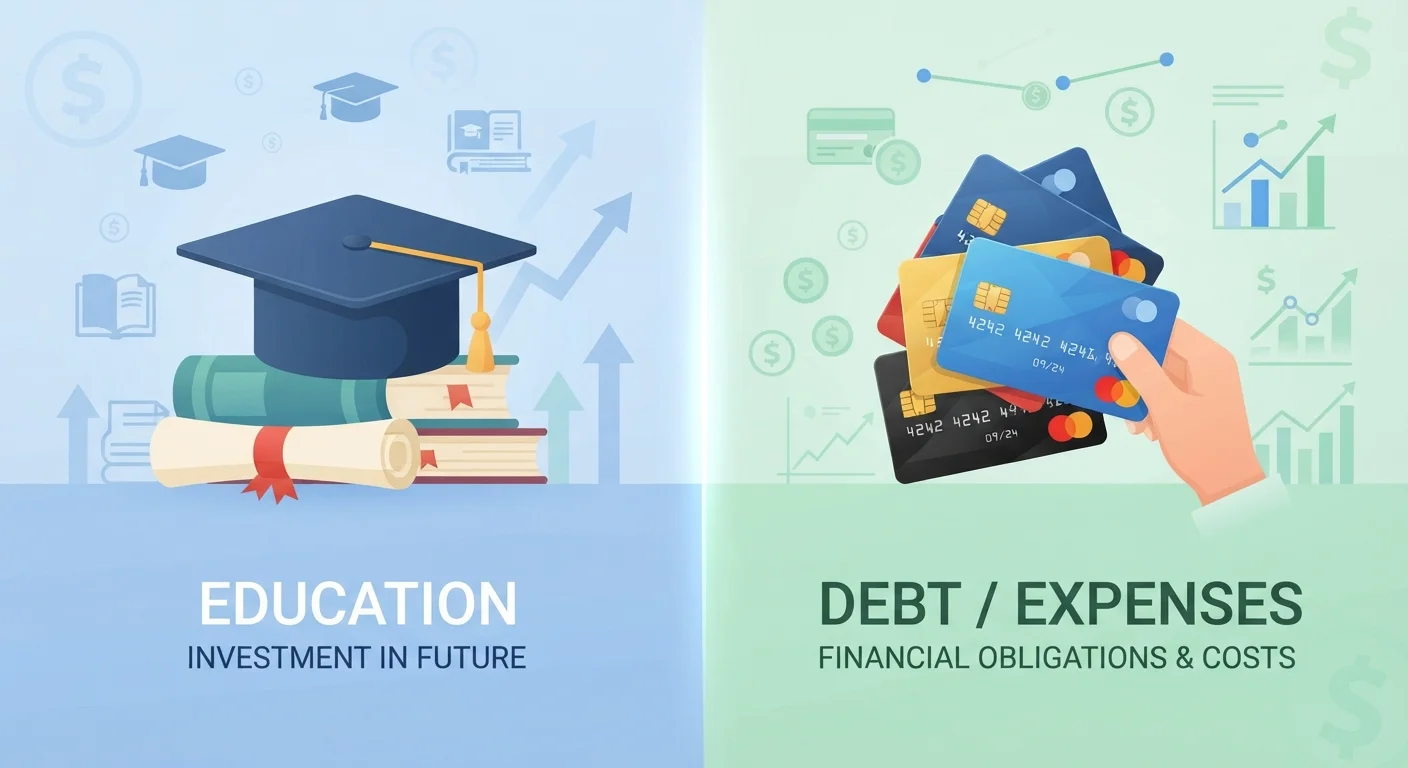
Student loans and credit card debt are fundamentally different products. Student loans are installment debt — you borrow a fixed amount and repay it in scheduled monthly payments over a set term, typically 10 to 25 years. Credit cards are revolving debt, meaning your available credit restores as you pay down the balance, and you can carry a balance month to month with no fixed payoff date.
Federal student loans are issued by the U.S. Department of Education and come with standardized terms set by Congress. Private student loans are issued by banks or lenders and vary by institution. Credit cards are issued by financial institutions under terms that can change — interest rates on credit cards are often variable and can rise with market conditions.
| Student Loans | Credit Card Debt | |
|---|---|---|
| Debt Type | Installment (fixed repayment schedule) | Revolving (flexible, ongoing balance) |
| Typical Interest Rate | 4%–8% (federal); higher for private | 20%–30% APR is common |
| Secured or Unsecured | Unsecured | Unsecured |
| Repayment Flexibility | Income-driven plans, deferment, forbearance | Minimum payment only; no structured relief |
| Forgiveness Options | Available for federal loans (e.g., PSLF) | None |
| Tax Deductibility | Interest may be deductible (subject to limits) | Generally not deductible |
| Credit Score Impact | Adds installment credit history | Affects credit utilization ratio |
| Default Consequences | Wage garnishment, credit damage, tax refund offset | Lawsuits, collections, severe credit damage |
Interest Rates: A Critical Difference
One of the most important distinctions between the two is the cost of borrowing. Federal student loan rates are set annually by Congress and have generally ranged between 4% and 8% for undergraduate borrowers in recent years. Private student loan rates vary but can be higher, especially for borrowers without strong credit histories.
Credit card interest rates are substantially higher. Average APRs have routinely exceeded 20%, meaning a balance carried month to month accumulates interest rapidly. Unlike student loan interest, which accrues on a fixed principal, credit card interest compounds on the outstanding balance — including previously charged interest — making it harder to eliminate if only minimum payments are made.
~$1.77T
Total U.S. student loan debt outstanding
According to Federal Reserve data, student loan balances represent one of the largest categories of consumer debt in the United States.
20%+
Average credit card APR in the U.S.
The Consumer Financial Protection Bureau has reported average credit card interest rates consistently exceeding 20% in recent years.
43 million
Americans with federal student loan debt
The U.S. Department of Education estimates over 43 million borrowers hold federal student loans.
For borrowers managing both obligations, the interest rate gap alone is often the most compelling reason to direct extra cash toward credit card balances first. For guidance on doing both simultaneously, see how to prioritize saving and debt payoff.
Repayment Options and Borrower Protections
Federal student loans come with repayment protections that credit cards simply don't offer. Borrowers can access income-driven repayment (IDR) plans, which cap monthly payments as a percentage of discretionary income. Deferment and forbearance options allow borrowers to pause payments during financial hardship, though interest may continue to accrue. Programs like Public Service Loan Forgiveness (PSLF) can cancel remaining federal loan balances after qualifying employment and payments — no equivalent exists for credit card debt.
Credit card issuers are not required to offer structured hardship programs, though some may provide temporary relief voluntarily. If you stop paying a credit card, the account moves to collections relatively quickly, and the issuer may pursue legal action to recover the balance.
Match Your Strategy to the Interest Rate
A practical starting point for managing both debt types is to compare their interest rates directly. Credit card debt at 24% APR costs far more per dollar owed than a federal student loan at 5%. Directing extra payments toward the highest-rate debt first — often called the debt avalanche method — typically minimizes total interest paid over time. See our debt avalanche vs. snowball comparison for a deeper breakdown.
Private student loans occupy a middle ground — they lack the federal safety net but may offer limited deferment or forbearance at the lender's discretion. Borrowers with private loans should review their specific loan agreement carefully.
Credit Score and Financial Health Implications
Both debt types appear on your credit report, but they affect your score differently. Student loans contribute to your credit mix and payment history — consistent on-time payments build a positive track record over time. Because they're installment loans, they don't affect your credit utilization ratio, which measures revolving debt relative to credit limits.
Credit card balances directly impact utilization. Carrying a high balance relative to your credit limit — even if you pay on time — can drag down your score. Keeping utilization below 30% is a commonly cited guideline. There are also misconceptions worth addressing; see our piece on common myths about carrying credit card debt for more context.
Both debt types factor into your debt-to-income (DTI) ratio, which lenders use to assess your ability to handle new borrowing. A high DTI from student loans or credit cards can affect mortgage eligibility and other major financial decisions. Learn more about why your DTI ratio matters to lenders.
Don't Ignore Either Debt Type
Some borrowers focus entirely on student loans and let credit card balances grow, or vice versa. Credit card interest compounds quickly — a $5,000 balance at 25% APR can grow significantly if only minimum payments are made. Letting either debt go unmanaged can damage your credit profile and strain your debt-to-income ratio, limiting your ability to borrow for major goals like a home.
Choosing a Payoff Approach
There's no universal rule for which debt to pay off first, but interest rate math provides a strong starting framework. Because credit card APRs typically far exceed student loan rates, eliminating high-interest revolving debt tends to reduce your overall cost of borrowing faster. However, if a private student loan carries a rate comparable to — or higher than — a credit card, that changes the calculus.
Borrowers struggling with multiple obligations may also consider whether debt consolidation makes sense. Combining balances can simplify payments and potentially lower interest costs, though trade-offs exist. Our overview of the pros and cons of debt consolidation loans walks through what to weigh before consolidating.
The right strategy ultimately depends on your income, loan terms, and broader savings goals. Consulting a licensed financial adviser or a nonprofit credit counselor can help you build a plan suited to your specific situation.
This article is for general informational and educational purposes only and does not constitute personalized financial or legal advice. Readers should consult a qualified financial professional for guidance tailored to their individual circumstances.