
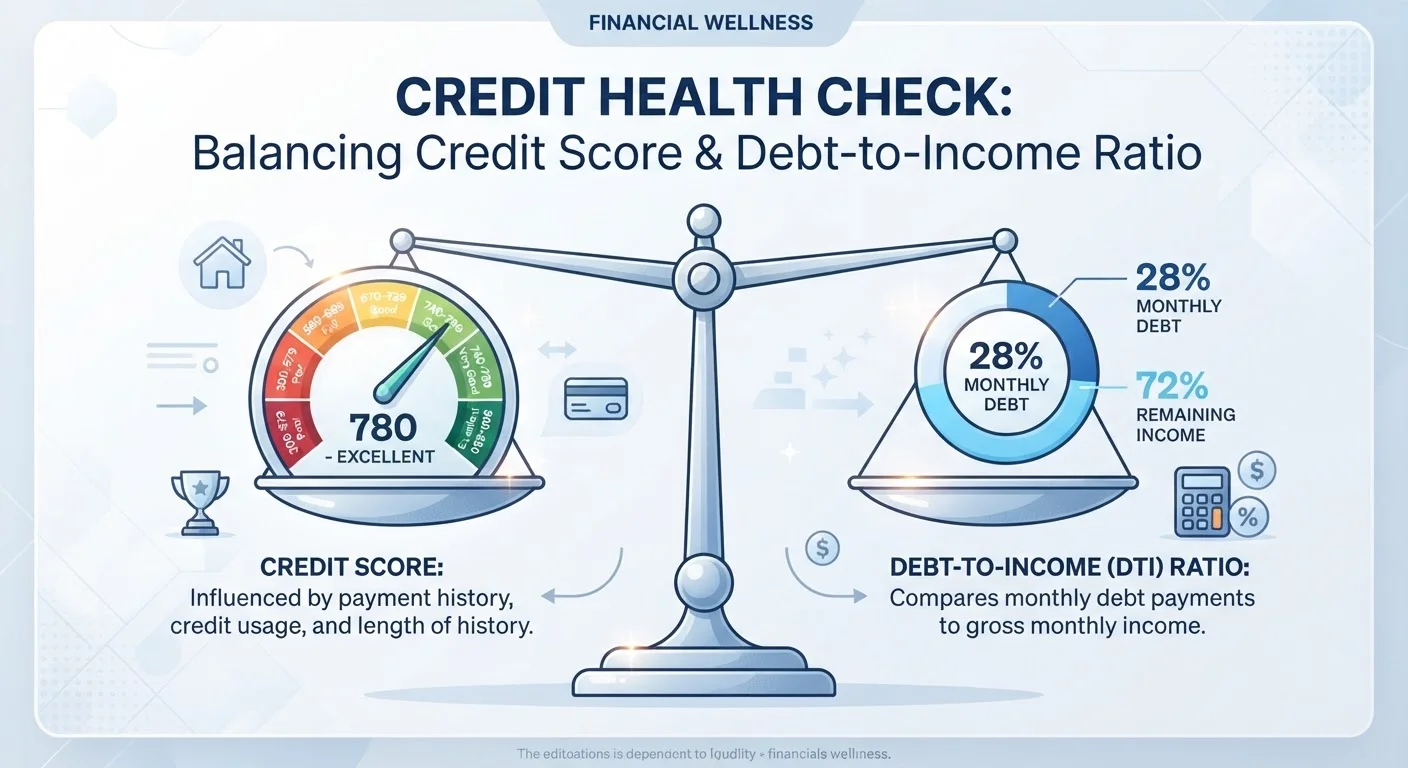
How DTI and Credit Score Work Together
When you apply for a mortgage, lenders are asking one fundamental question: can this borrower reliably repay this loan? Your credit score answers part of that question — it reflects your history of managing debt responsibly. But history alone doesn't tell a lender whether you have enough room in your current budget to handle a new monthly payment.
That's where your debt-to-income ratio steps in. DTI measures the present, not the past. A borrower can have an excellent credit score while simultaneously carrying so many existing obligations that adding a mortgage payment would strain their finances considerably. Lenders use DTI to detect exactly that risk.
To understand what goes into your credit score and why lenders value it, see Credit Scores Explained. But recognize that lenders treat DTI as a separate and equally important filter — one that a high credit score cannot simply override.
43%
Common DTI ceiling for conventional mortgages
Fannie Mae and Freddie Mac guidelines have historically used 43% as a general back-end DTI threshold for conventional loan eligibility.
2-in-1
Metrics lenders evaluate simultaneously
Most mortgage lenders review both credit score and DTI as complementary — not interchangeable — measures of borrower risk.
28%
Typical front-end DTI guideline for housing costs
Many lenders prefer that housing-related expenses alone (the front-end ratio) not exceed roughly 28% of gross monthly income.
How to Calculate Your DTI
The math is straightforward. Add together every recurring monthly debt obligation: minimum credit card payments, auto loan payments, student loan payments, personal loan installments, alimony or child support, and — critically — the estimated monthly payment for the mortgage you're applying for. Divide that sum by your gross monthly income (your income before taxes and deductions). Multiply by 100 and you have your DTI percentage.
Example: If your total monthly debt payments come to $2,000 and your gross monthly income is $6,000, your DTI is 33%. That number sits comfortably within most lenders' preferred range.
It's worth knowing that different debt types carry different weight on your financial profile. Student loans and credit card debt behave differently in terms of repayment structure, but both count in full when a lender tallies your monthly obligations for DTI purposes.
Check Your DTI Before House Hunting
Before you begin seriously shopping for a home, calculate your current DTI using your actual monthly debt payments and gross income. This gives you a realistic picture of what loan amount you may qualify for and how much reducing existing debt could expand your options. Many mortgage lenders offer free pre-qualification consultations that include a DTI review.
Why Lenders Set DTI Thresholds
Lenders don't choose DTI cutoffs arbitrarily. Regulatory guidelines and loan program standards — including those established for conventional, FHA, and VA loans — set parameters that reflect decades of lending data about default risk. A borrower committing more than 43% of gross income to debt repayment is statistically more likely to struggle when an unexpected expense arises.
For conventional mortgages backed by Fannie Mae and Freddie Mac, lenders historically used 43% as a general ceiling, though automated underwriting systems can sometimes approve loans above that threshold when other factors are strong. FHA loans may permit higher DTIs in specific circumstances. The exact threshold varies by loan type, lender, and borrower profile.
Understanding what a DTI ratio is and why it matters beyond the mortgage context can also help you manage your broader financial health — not just your home loan eligibility.
Improving Your DTI Before Applying
Because DTI is a ratio, you can improve it in two ways: reduce the numerator (your monthly debt payments) or increase the denominator (your gross income). In practice, reducing debt is often the more immediately actionable path for most borrowers preparing to buy a home.
Paying down or eliminating a car loan, a personal loan, or high-balance credit cards can meaningfully lower your monthly obligations before you apply. Even small reductions add up when a lender is evaluating your capacity to carry a mortgage. For a comprehensive view of how lenders assess your full application — beyond DTI alone — see Building a Strong Mortgage Application.
On the income side, documented increases — such as a raise, a new job with higher pay, or verifiable secondary income — can shift your ratio favorably. Lenders generally require consistent, documented income history, so last-minute changes may not factor in. Working with a licensed mortgage professional can help you identify the most effective approach for your specific situation.
This article is for general informational purposes only and does not constitute personalized financial, mortgage, or legal advice. Consult a licensed mortgage professional or financial adviser for guidance tailored to your circumstances.