What Unit Pricing Actually Tells You
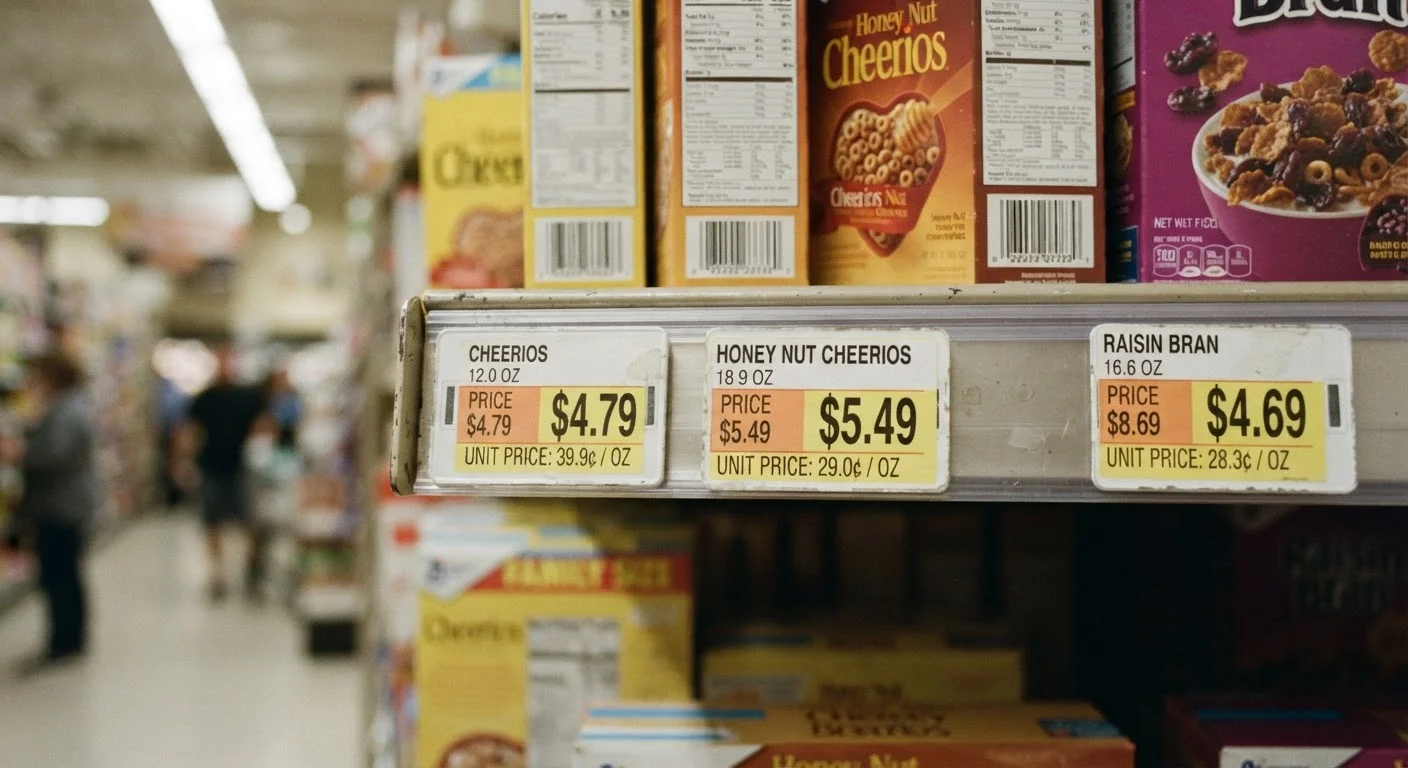
Every shelf tag in a grocery or big-box store carries two numbers: the total price and, usually in smaller print, the unit price. The total price tells you what you'll pay at checkout. The unit price tells you what you're actually getting for your money.
Unit pricing converts a product's cost into a consistent, comparable measure - per ounce, per count, per square foot, per load. That conversion matters because manufacturers use countless package sizes, and a direct price comparison between a 12-oz jar and an 18-oz jar tells you almost nothing useful on its own.
For example, a $3.49 jar and a $4.29 jar sitting side by side look like an easy choice. But if the $3.49 jar works out to $0.29 per ounce and the $4.29 jar is $0.24 per ounce, you're paying more per ounce for the cheaper-looking option. Unit pricing surfaces that reality instantly.
Unit Pricing Regulations Vary by State
The U.S. has no single federal law requiring unit pricing across all retail categories. State laws differ on which product types must display unit prices, which store sizes are exempt, and how the information must be formatted. If you shop in a state without a strong unit-pricing mandate, or at a smaller retailer exempt from requirements, you may need to calculate unit prices yourself using the package weight or count.
Why Shoppers Miss It - and Why That's Understandable
Shelf tags are designed to show the sticker price prominently. The unit price is typically smaller, sometimes in a different color, and positioned where the eye doesn't naturally land. In a busy aisle with dozens of competing products, it's easy to grab the item with the lowest-looking number and move on.
Retailers aren't required to make unit prices visually dominant, and some formatting choices - inconsistent typefaces, varying label layouts across store departments - make comparison harder than it needs to be. Retail pricing tactics often lean on package size and visual presentation to shift attention away from per-unit costs.
There's also a unit mismatch issue: two competing products might display their unit prices in different measures. One lists cost per ounce; another lists cost per pound. You'd need to convert to compare, and most shoppers won't do that math mid-aisle.
Use Your Phone's Calculator in the Aisle
If a store doesn't display unit prices - or uses different units across competing products - a quick phone calculation takes about 10 seconds. Divide the total price by the total quantity (ounces, count, pounds) listed on the package. This single habit can surface meaningful cost differences that visual scanning alone will miss.
When Unit Price Comparisons Get Complicated
Unit pricing works cleanly when both products use the same unit. Complications arise in several common situations:
- Mixed units: Paper towels might show cost per sheet while a competing brand shows cost per roll. Check whether "sheet" sizes are equivalent before concluding one is cheaper.
- Sale pricing: A product on promotion may show a unit price based on the sale price - which disappears next week. What a sale price actually means is worth understanding before you stock up based solely on a temporary unit price.
- Bulk quantities: Warehouse clubs and bulk sections often show attractive unit prices, but buying 48 rolls of paper towels ties up cash and storage space. Bulk buying math involves more than just the per-unit number.
- Quality differences: A lower unit price on a thinner garbage bag or a more diluted cleaning product may not represent better value in practice. Unit pricing measures cost per quantity, not cost per performance.
~30%
Shoppers who regularly use unit pricing
Research published in the Journal of Retailing has found that only a minority of shoppers consistently consult unit prices when making purchase decisions, despite their availability on most shelf tags.
Up to 40%
Potential unit-price gap between sizes
Studies of grocery pricing have documented cases where a smaller package of the same product costs up to 40% more per unit than the larger size of the same item in the same store.
How to Build Unit Price Comparison Into Your Shopping Habit
Making unit pricing a default part of your shopping process doesn't require extra time - it requires a quick habit shift. When picking between two sizes or brands, locate the unit price on both shelf tags before putting anything in the cart. Most phones have calculators if a store doesn't display unit prices: divide the total price by the number of ounces, counts, or other listed units.
Keep units consistent. If one tag shows per ounce and another shows per pound, multiply the per-ounce figure by 16 to get a per-pound equivalent. A few seconds of arithmetic prevents the kind of shopping error that compounds across dozens of weekly purchases.
Unit pricing also pairs naturally with reading product labels. Knowing that two cereals cost the same per ounce is useful; knowing that one has substantially more added sugar per serving adds another layer of context. See how to read a nutrition label if that's a habit you want to build alongside smarter unit price comparisons.
Finally, be skeptical of assumptions. Store brands don't always win on unit price. Large sizes don't always win. Sale items don't always win. Unit pricing is the tool that replaces assumptions with actual numbers.