The Physics Problem a Crash Creates
To understand why restraint systems matter, start with Newton's first law: an object in motion stays in motion until acted upon by an external force. When a vehicle strikes an obstacle and stops suddenly, the car decelerates rapidly - but the occupants inside keep moving at the vehicle's original speed. In a 35 mph crash, an unbelted driver travels forward at 35 mph until something stops them: the steering wheel, windshield, or dashboard.
The severity of injury depends not just on speed but on deceleration distance. The more distance over which a body can be slowed, the lower the peak force on bones and organs. A crumple zone gives the vehicle's structure roughly 12-24 inches of controlled collapse. A seat belt adds another 4-6 inches of forward movement for the occupant. An unrestrained person has effectively zero managed deceleration distance.
~45%
Reduction in passenger car fatality risk with seat belt use
According to NHTSA data, seat belts reduce the risk of death for front-seat passenger car occupants by approximately 45%.
~60%
Reduction in fatality risk for light truck occupants
NHTSA estimates seat belts reduce fatality risk for light truck occupants by approximately 60% compared to unrestrained occupants.
30 ms
Time for frontal airbag to fully inflate
Frontal airbags are designed to inflate in roughly 20-30 milliseconds after crash sensor activation - faster than a blink.
How Seat Belts Manage Force
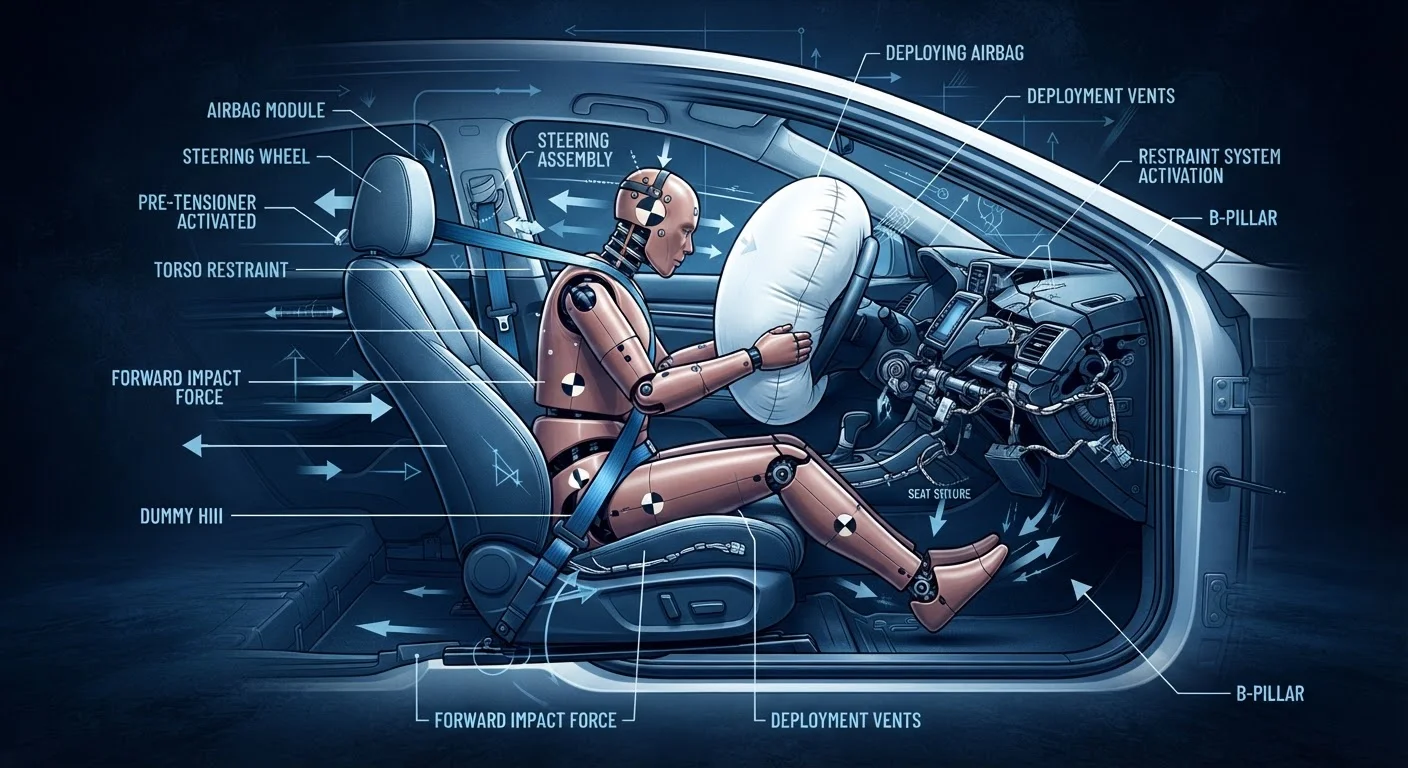
A modern three-point seat belt does several things simultaneously. The lap belt anchors the pelvis - one of the body's strongest structures - preventing the lower body from sliding forward under the dashboard. The shoulder belt distributes crash forces across the ribcage and clavicle rather than concentrating them at a single point.
Critically, the belt is not a rigid chain. A load limiter (also called a force limiter) built into the retractor allows a small amount of controlled belt pay-out once chest load exceeds a set threshold. This prevents rib fractures while still keeping the occupant away from hard surfaces. Working upstream of this, the pretensioner fires within milliseconds of crash detection - before you consciously register the impact - to remove any slack from the belt and lock the occupant in position.
Check Your Belt Fit Before Every Drive
Run a quick check each time you buckle up: shoulder belt across the center of your chest (not your neck), lap belt snug and low across your hip bones. If the shoulder belt sits on your neck, adjust the height anchor on the B-pillar - most modern vehicles include this adjustment. Pregnant drivers should position the lap belt below the abdomen across the hips, not across the belly.
Proper fit matters. The shoulder belt should cross the center of the chest, never the neck. The lap portion should sit low across the hips, not the soft abdomen. An ill-fitting belt still offers significant protection over no belt, but correct positioning reduces the risk of internal injury.
Airbags: Supplemental, Not Standalone
The "S" in SRS stands for supplemental - airbags are designed to work in addition to a worn seat belt, not as a replacement. When crash sensors detect a deceleration signature consistent with a severe collision, they trigger inflators that fill airbag cushions with nitrogen gas in approximately 20-30 milliseconds. The bag is already beginning to deflate by the time the occupant's face contacts it, which is by design: a rigid inflated bag would cause its own injuries.
Modern vehicles deploy multiple airbags - frontal, side-curtain, knee, and seat-mounted thorax bags - each calibrated for a specific impact direction and body region. Side-curtain airbags are particularly effective in rollover events, where they help keep occupants from being partially or fully ejected.
Airbag Warning Lights Deserve Attention
An illuminated SRS or airbag warning light means the system has detected a fault and may not deploy correctly in a crash. This warrants a prompt diagnostic scan by a qualified technician. Driving with a known SRS fault effectively reduces your crash protection to the seat belt alone - or less, if the pretensioner circuit is also affected.
An unbelted occupant who relies on airbags alone faces a dangerous scenario: the airbag is timed to meet a properly positioned, seat-belted occupant. Without a belt, the occupant slides forward before the bag is fully inflated and may strike it at a dangerous angle, or may be too far forward for it to be effective at all.
Child Seats, Booster Seats, and Growing Passengers
Vehicle restraint systems are engineered around adult body proportions. Children require dedicated restraints because their skeletal structure, weight distribution, and head-to-body ratio are fundamentally different. Rear-facing infant seats keep the crash force distributed across the child's entire back. Forward-facing seats with harnesses hold the child at multiple points. Booster seats position a standard three-point belt correctly across a child's smaller frame.
The American Academy of Pediatrics and the National Highway Traffic Safety Administration (NHTSA) both publish guidance on transitioning between seat types based on height and weight. Following the specific guidelines for each stage - rather than advancing to the next stage early - is the key principle. Consult those resources and your vehicle owner's manual for compatibility with specific seat models.
Building safe habits around seat belt use fits within a broader framework of defensive driving. Our guide on road safety habits covers complementary practices worth revisiting at any experience level.
After a Crash: What Needs Inspection
Restraint components are consumable safety items, not permanent fixtures. After any moderate or severe collision, both seat belts and airbag modules require professional inspection and likely replacement. Pretensioners fire once and cannot be mechanically reset - a belt that looks intact after a crash may no longer provide meaningful restraint in a second event. Deployed airbags obviously require replacement, but so do the inflator modules and sensors connected to undeployed bags that activated during the crash sequence.
Insurers typically cover restraint system replacement as part of collision claims. Understanding your coverage - particularly what collision insurance actually pays for - is worth reviewing. Our explainer on collision and comprehensive coverage breaks down what each policy type addresses.
For a broader look at which vehicle components have defined service lives, see our article on the real lifespan of car parts.