Why These Three Coverages Are Not the Same Thing
Many drivers treat auto insurance as a single, monolithic protection. In reality, a standard policy bundles several distinct coverages - each designed to pay for a specific category of loss. Confusing them is one of the most common reasons people discover gaps after an accident. Understanding the major insurance coverage categories is a useful first step before diving into the auto-specific details.
The three coverages that form the backbone of most personal auto policies are liability, collision, and comprehensive. They answer three different questions: Whose losses does this pay for? What kind of incident triggers a payment? And whose vehicle is covered?
| Minimum required coverage (most U.S. states) | Liability only (Insurance Information Institute) |
| Collision deductible range (typical) | $250-$2,000 (Insurance Information Institute) |
| Comprehensive events covered | Theft, fire, hail, flooding, animal strikes, falling objects |
| Lender/lessor requirement | Both collision and comprehensive usually required on financed or leased vehicles |
| Liability limit format | Split limits (e.g., 25/50/25) or combined single limit |
Liability Coverage: Protecting Others From Your Mistakes
Liability coverage pays for harm you cause to other people and their property when you are at fault in an accident. It does not reimburse you for your own vehicle damage or your own medical bills.
Most policies split liability into two sub-limits:
- Bodily Injury Liability (BIL): Covers medical expenses, lost income, pain-and-suffering claims, and legal defense costs for people you injure. Limits are typically expressed as two numbers - for example, 50/100 means $50,000 per person and $100,000 per accident.
- Property Damage Liability (PDL): Covers repairs to the other driver's vehicle, a fence, a storefront, or any other property you damage. Expressed as a single dollar amount, such as $25,000.
Liability is the only coverage most states legally require. Minimum limits vary by state and are often too low to cover a serious accident fully. If a judgment exceeds your limits, you are personally responsible for the difference - which is why many drivers carry limits well above the state minimum.
Liability Coverage
Pays for bodily injury and property damage you cause to others in an at-fault accident. It does not cover damage to your own vehicle or your own injuries.
Collision Coverage
Pays to repair or replace your vehicle after it collides with another vehicle or object, regardless of who is at fault. Subject to a deductible you choose at policy purchase.
Comprehensive Coverage
Pays for damage to your vehicle from non-collision events such as theft, fire, hail, flooding, fallen trees, and animal strikes. Also subject to a deductible.
Deductible
The out-of-pocket amount you pay before your insurer covers the remaining repair or replacement cost. Higher deductibles typically lower your premium.
Premium
The amount you pay - monthly, semi-annually, or annually - to keep your insurance policy active.
Bodily Injury Liability (BIL)
The portion of liability coverage that pays medical expenses, lost wages, and legal costs for other people injured in an accident you caused.
Property Damage Liability (PDL)
The portion of liability coverage that pays to repair or replace another person's vehicle or property damaged in an accident you caused.
Coverage Limit
The maximum dollar amount an insurer will pay for a covered claim. Any costs above this limit become the policyholder's responsibility.
Collision Coverage: Repairing Your Own Vehicle After an Impact
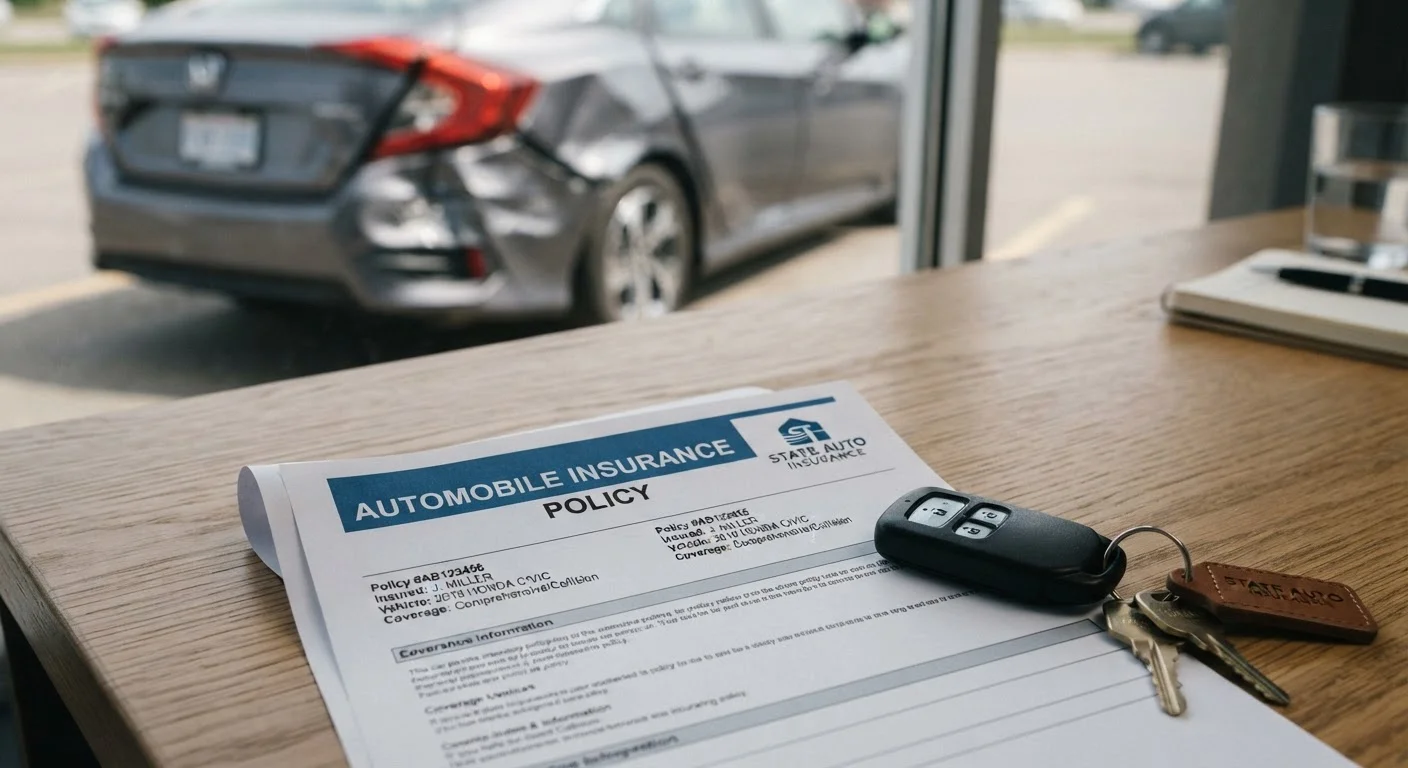
Collision coverage pays to repair or replace your own vehicle when it is damaged in an accident involving another vehicle or a stationary object - a guardrail, a pole, or even a pothole that causes significant damage. Fault does not determine whether collision pays; it applies whether you caused the crash or another driver did.
Key characteristics of collision coverage:
- Always subject to a deductible you select when purchasing the policy. A higher deductible lowers your premium but increases what you pay out of pocket at claim time.
- Pays the actual cash value (ACV) of your vehicle, not necessarily what you paid for it - depreciation is factored in.
- Not legally required by any state, but typically required by lenders and lessors on financed or leased vehicles.
For older vehicles with low market value, some drivers opt to drop collision, reasoning that the premium cost outweighs potential payouts. That decision depends on your vehicle's current value and your ability to self-insure a total loss. For a broader look at how these coverage decisions interact, see our plain-language auto coverage reference.
Comprehensive Coverage: Non-Collision Damage and Theft
Comprehensive coverage - sometimes called "other than collision" - pays for damage to your vehicle from events unrelated to a driving impact. Common covered perils include:
- Theft or vandalism
- Fire or explosion
- Hail, flooding, and other weather events
- Falling objects (trees, debris)
- Animal strikes (hitting a deer, for example)
- Civil disturbances
Like collision, comprehensive is subject to a deductible and pays actual cash value rather than replacement cost. It is also typically mandated by lenders and lessors alongside collision coverage.
One important distinction: if you collide with a deer, some insurers classify that as a collision claim rather than comprehensive. The specific wording of your policy governs - another reason to read your declarations carefully.
Coverage Terms Vary by Policy and Provider
The descriptions in this article reflect standard industry definitions. Actual coverage terms, exclusions, and claim procedures depend on your specific policy documents and your state's regulations. Always review your declarations page and consult a licensed insurance agent for questions about your own coverage. See what your declarations page is really telling you for help reading those documents.
Drivers who want a side-by-side comparison of how liability and comprehensive differ in practice can also consult our liability vs. comprehensive breakdown.
~13%
U.S. drivers estimated to be uninsured
According to the Insurance Research Council's most recent estimates, roughly 1 in 8 drivers on American roads carries no insurance.
48 states
States mandating some form of liability insurance
Nearly every U.S. state requires drivers to carry minimum liability limits; New Hampshire and Virginia have historically used alternative frameworks.
How the Three Coverages Work Together
In a typical at-fault accident scenario, multiple coverages may activate at once. Suppose you rear-end another vehicle at an intersection:
- Liability pays for the other driver's medical treatment and vehicle repairs.
- Collision pays to repair your own vehicle (minus your deductible).
- Comprehensive does not apply - this was a collision event, not a theft or weather incident.
Conversely, if a hailstorm destroys your hood and roof while your car sits in a parking lot, only comprehensive responds. Liability and collision are irrelevant because no driving incident occurred and no third party was harmed.
Understanding these boundaries helps you evaluate whether your current coverage aligns with your actual financial risk. For drivers newer to the topic, our beginner's orientation to insurance coverage provides foundational context. You can also explore the full range of insurance costs and claims processes through the Claims & Costs hub.
This article provides general educational information about auto insurance coverage types and is not personalized insurance, financial, or legal advice. Coverage terms, exclusions, and requirements vary by state and provider. Consult a licensed insurance agent or adviser to evaluate the options appropriate for your situation.