Tire Rotation: Evening Out the Wear
Your vehicle's weight isn't distributed equally across all four tires, and neither is the mechanical load. Front tires on a front-wheel-drive car, for example, handle steering, braking, and power delivery simultaneously - meaning they wear faster than the rears. Tire rotation addresses this by periodically moving tires to different positions on the vehicle so that wear is spread more evenly over time.
The most common rotation patterns include front-to-rear, cross-rotation, and the X-pattern, depending on whether you have directional tires, a full-size spare to incorporate, or an all-wheel-drive system. Your owner's manual specifies the recommended pattern and interval for your vehicle - generally every 5,000 to 7,500 miles.
Skipping rotation doesn't produce dramatic immediate consequences, but tires that wear unevenly reach the end of their safe life sooner. Replacing all four tires prematurely is a far larger expense than a routine rotation service. For a broader view of how this fits into your overall service schedule, see your vehicle's maintenance intervals explained.
Pair Rotation With Oil Changes
A practical way to keep up with tire rotation is to schedule it at every other oil change - which aligns well with the typical 5,000-7,500 mile interval for both services. Many shops will perform the rotation while the vehicle is already lifted for the oil service, reducing time and sometimes cost.
Wheel Balancing: Eliminating the Wobble
Even a brand-new tire isn't perfectly uniform in weight around its circumference, and the wheel it's mounted on adds its own imperfections. When a wheel-and-tire assembly spins at highway speeds, even a small weight imbalance - sometimes just a few grams - creates a wobble that travels through the axle and into the cabin.
Wheel balancing is performed on a specialized machine that spins each wheel, measures where the imbalance exists, and guides a technician to attach small counterweights at precise points on the rim to compensate. The result is a smoother ride at speed and less stress on wheel bearings, suspension components, and the tires themselves.
Signs that balancing is overdue include steering wheel vibration at 55-70 mph, unusual tire wear in a cupping or scalloping pattern, and a ride that feels rougher than normal on the highway. Tires typically need rebalancing whenever they're dismounted and remounted (such as during a seasonal tire swap), after a significant road impact, or about every 12,000 to 15,000 miles under normal conditions.
~$20-$50
Typical cost of a wheel balance per axle
Industry service pricing varies by region and shop type; this range reflects commonly cited national averages for passenger vehicles.
10-25%
Potential tire life reduction from skipped rotation
Tire industry guidance consistently notes that irregular rotation accelerates uneven wear, reducing the usable life of a set of tires by a meaningful margin.
Every 5,000-7,500 mi
Recommended tire rotation interval
This range reflects guidance commonly found in vehicle owner's manuals and automotive service recommendations across major manufacturers.
Wheel Alignment: Getting the Angles Right
Wheel alignment - more precisely, wheel geometry adjustment - refers to setting the angles at which your tires contact the road. Three primary angles matter: camber (the inward or outward tilt of the tire when viewed from the front), toe (whether the fronts of the tires point inward or outward relative to each other), and caster (the steering axis angle, which affects straight-line stability).
When these angles drift outside the manufacturer's specifications - typically after hitting a pothole, a curb, or through gradual wear of suspension components - tires scrub against the road at an incorrect angle. This produces characteristic uneven wear patterns: one edge of the tread wears faster than the other, the car pulls to one side without steering input, or the steering wheel sits off-center on a straight road.
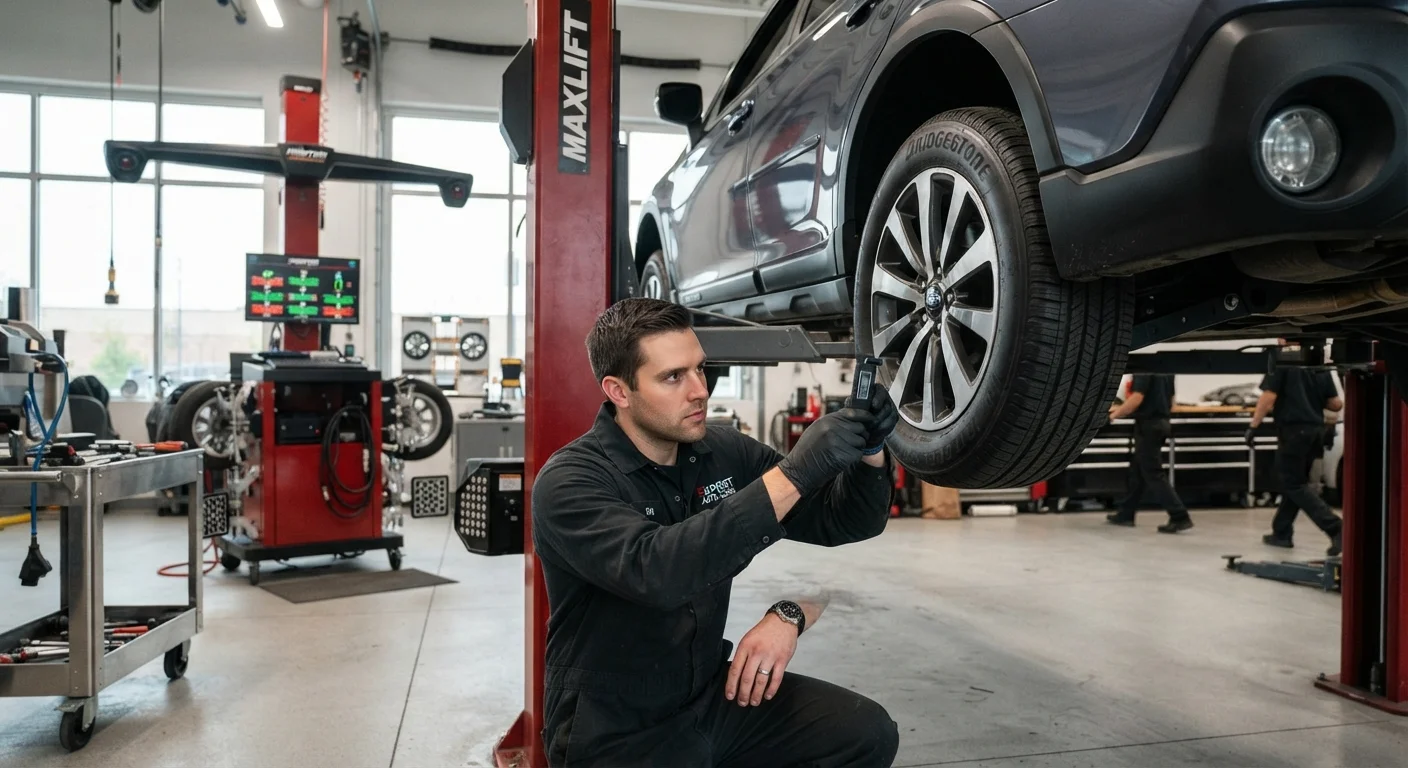
Alignment is performed using laser or camera-based equipment that measures each wheel's angles and compares them to factory specifications. Adjustments are made at specific suspension attachment points. Unlike rotation or balancing, alignment is not a fixed-interval service - it should be checked after any significant suspension impact and whenever symptoms appear. Tire pressure also plays a role in how tires wear, so keeping that in check alongside alignment helps maximize tire longevity.
Putting It Together: Which Service Do You Actually Need?
Because shops sometimes bundle these services, it's worth knowing what each one addresses before you walk in. Here's a practical way to read your car's symptoms:
- Uneven tread depth front-to-back: Likely overdue for rotation.
- Vibration at highway speeds: Points to wheel balancing.
- Car pulls left or right, or tread is worn more on one edge: Alignment is the likely culprit.
None of these services fixes what another is designed to address. Balancing won't correct a pull caused by misalignment. Rotation won't stop vibration caused by an imbalanced wheel. Understanding the distinction helps you communicate clearly with a service advisor and avoid paying for work your vehicle doesn't need.
For a full picture of how tire services fit into the cost of vehicle ownership, the article on ongoing maintenance costs most drivers underestimate is worth reviewing. Tire-related services are among the recurring expenses that catch many owners off guard when they're skipped too long.
Alignment Isn't Always a Scheduled Service
Unlike oil changes or tire rotation, alignment doesn't have a universal mileage interval. It's an as-needed service triggered by symptoms or a suspension impact event. Some manufacturers suggest checking it every two to three years as a precaution, but consulting your owner's manual and paying attention to how your car drives is the most reliable guide.