What Each Policy Type Actually Covers
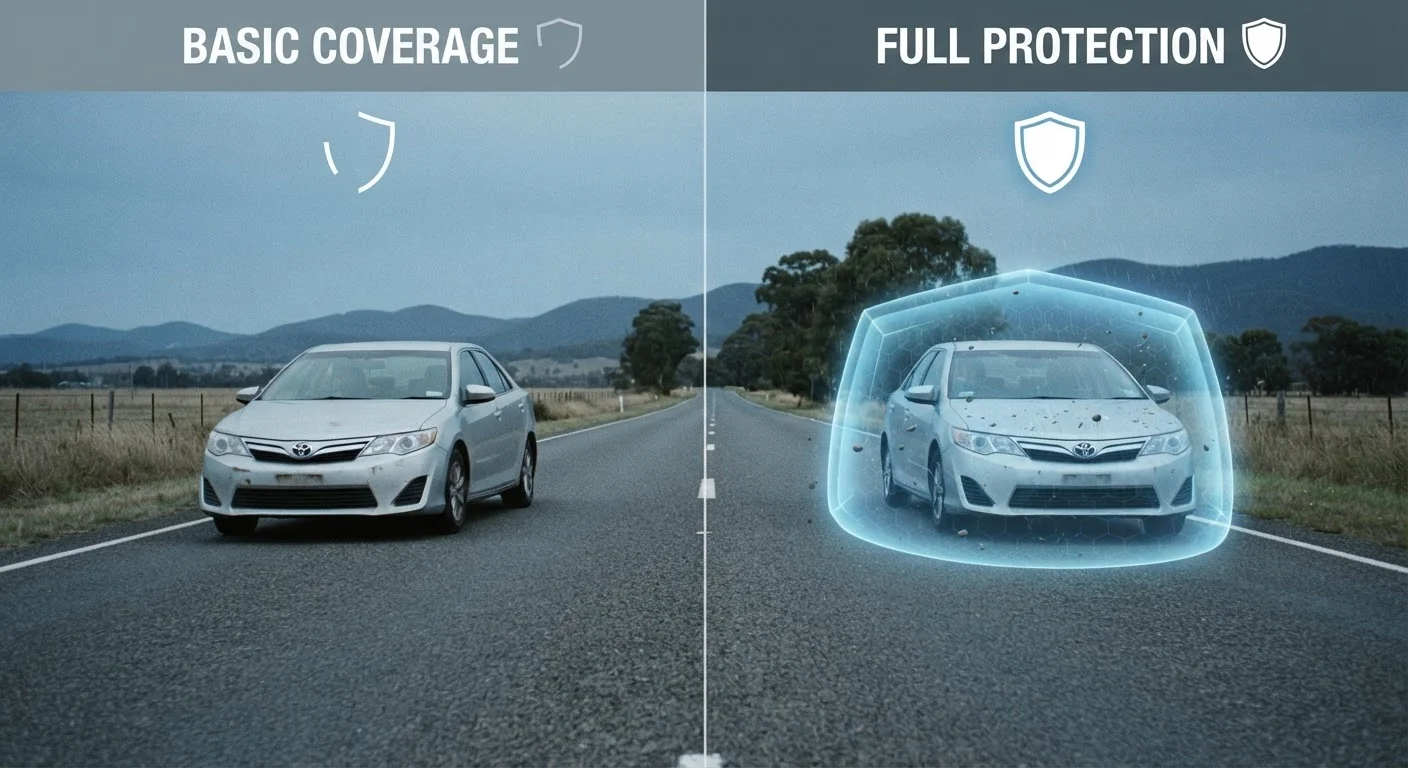
Minimum liability coverage is exactly what its name implies: the legal floor set by each state that allows you to operate a vehicle on public roads. It pays for bodily injury and property damage you cause to other people in an accident where you are at fault. It does not pay for your own injuries, your own vehicle's repairs, or any losses that exceed the policy's stated dollar limits.
Full coverage is not a single standardized product but a common shorthand for a policy that combines liability, collision, and comprehensive coverages. Collision pays for damage to your vehicle from an impact - whether with another car or a stationary object. Comprehensive covers non-collision losses such as theft, vandalism, hail, flood, and animal strikes. Together, these three layers address a far wider range of real-world scenarios. For a deeper look at how each layer works, see what each coverage type actually does.
| Criterion | Minimum Liability | Full Coverage |
|---|---|---|
| Covers other party's injuries | Yes (up to state limits) | Yes (up to policy limits) |
| Covers other party's property | Yes (up to state limits) | Yes (up to policy limits) |
| Covers your vehicle after a crash | No | Yes (collision) |
| Covers theft, weather, or vandalism | No | Yes (comprehensive) |
| Required for financed vehicles | No | Yes |
| Typical monthly premium | Lower | Higher |
| Out-of-pocket risk after at-fault crash | High | Lower (subject to deductible) |
The Financial Gap in a Real Accident
State minimum liability limits are often surprisingly low. A typical structure might be expressed as 25/50/25 - meaning $25,000 per injured person, $50,000 per accident for bodily injury, and $25,000 for property damage. In a moderate collision involving medical treatment, vehicle repair, and lost wages for another party, these limits can be exhausted quickly. Any amount beyond your policy limit becomes your personal financial responsibility.
$24,000+
Average cost of a moderate injury claim
Insurance Research Council data indicates that bodily injury claims frequently exceed typical state minimum liability limits, particularly when hospitalization is involved.
1 in 8
Uninsured drivers on U.S. roads
According to the Insurance Research Council, roughly one in eight U.S. drivers carries no auto insurance at all, compounding the financial risk for everyone involved in a collision.
The gap is especially stark when your own vehicle is damaged. A driver carrying only minimum liability who causes a collision walks away owing nothing to the other party beyond the policy limit - but receives zero from their own insurer for their vehicle. If that vehicle is worth $18,000, the repair or replacement comes entirely from their own pocket.
Understanding how coverage limits interact with actual claims is essential context here. The difference between coverage limits, actual cash value, and replacement cost directly affects how much you would receive - and how much you might still owe.
Key Factors to Weigh When Choosing Your Level
No single coverage level is right for every driver. Several factors shape the decision:
- Vehicle value: The lower a vehicle's market value, the less financial benefit collision and comprehensive provide relative to their cost. A general guideline is to compare the annual premium for those coverages against what the insurer would actually pay after a deductible.
- Loan or lease status: If you finance or lease your vehicle, you typically have no choice - full coverage is contractually required.
- Personal financial reserves: Drivers who could comfortably absorb a $10,000-$20,000 loss may rationally carry less coverage. Those without that cushion face serious risk.
- Driving environment: High-traffic areas, regions prone to severe weather, or neighborhoods with elevated theft rates all increase the practical value of comprehensive coverage.
For a balanced look at the trade-offs, the pros and cons of carrying minimum required coverage is worth reviewing before making a decision. And if you are unsure how coverage categories are defined in your policy language, the coverage types hub provides foundational context.
Also be aware that gaps in coverage can surface at the worst possible time. Coverage blind spots people discover only after filing a claim illustrates how drivers often learn about missing protections too late to act.
This article is for general informational and educational purposes only and does not constitute personalized insurance, financial, or legal advice. Coverage terms, limits, exclusions, and regulations vary by state and insurer. Always read your actual policy documents and consult a licensed insurance agent or adviser before making coverage decisions.