
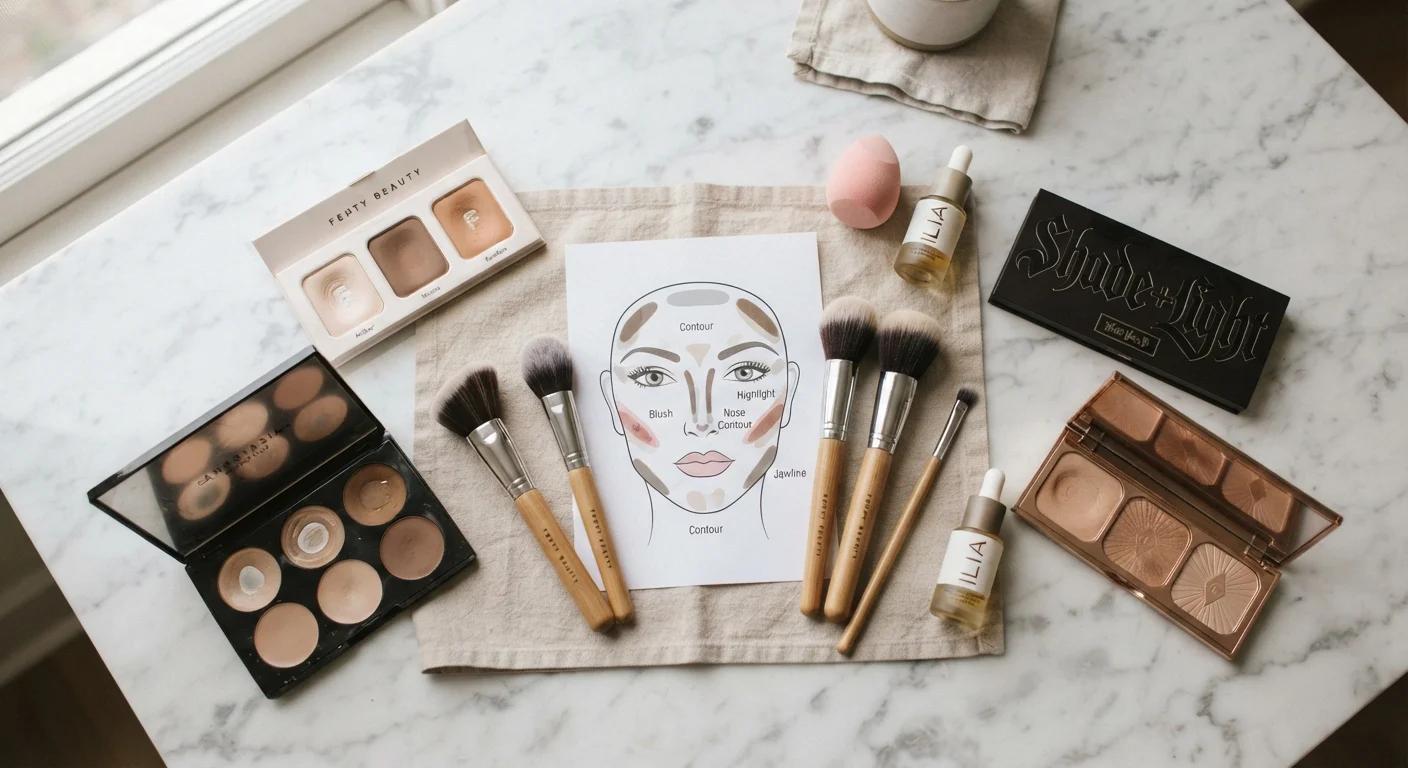
Why Face Shape Changes Everything
Contouring tutorials often show a single "before and after" that implies one placement works universally. In reality, what slims one face shape can add bulk to another. The key variable is proportion — how your forehead, cheekbones, jawline, and chin relate to one another.
Think of contour as working with your existing structure rather than fighting it. A person with a round face has different balance goals than someone with a more angular, square face. Understanding that difference is what separates a contour that looks intentional from one that simply looks muddy.
For context on how placement decisions extend beyond contouring, see our guide on getting blush placement right for your features — the logic overlaps in meaningful ways.
5
Common face shapes recognized in makeup application
Makeup artists and beauty educators generally categorize faces into five primary shapes: oval, round, square, heart, and oblong, though most faces are a blend of more than one.
2 types
Main contour product formats available
Powder and cream are the two primary contour formats; each has a distinct finish, blendability, and best-use scenario depending on skin type and desired result.
A Shape-by-Shape Breakdown
Oval Face
Oval faces are considered the most proportionally balanced, with a forehead slightly wider than the jaw and gently rounded edges. The goal here isn't dramatic reshaping — it's adding subtle definition. Light contour along the sides of the forehead and hollows of the cheeks is usually sufficient. Avoid heavy application, which can over-define a shape that's already well-balanced.
Round Face
Round faces have similar width and length measurements, with soft, curved edges. Contouring aims to create the illusion of length and more defined edges. Apply contour along the outer sides of the forehead, beneath the cheekbones, and along the jawline. Blending vertically (up and down) rather than horizontally helps elongate the appearance of the face.
Square Face
Square faces have a strong, angular jawline that's roughly as wide as the forehead. Contouring is most effective at the corners of the jaw and forehead temples to soften those sharp angles. Avoid contouring the sides of the face too broadly, as this can make the face look wider.
Heart Face
Heart-shaped faces are widest at the forehead and taper toward a narrower chin. Contour the outer temples to reduce the appearance of a broad forehead, and consider a small amount of contour along the sides of the chin to add visual balance at the lower face.
Oblong (Long) Face
Oblong faces are notably longer than they are wide. The priority is adding width rather than length. Contour along the hairline at the top of the forehead and beneath the chin to visually shorten the face. Avoid vertical contour placement, which can emphasize length.
Application Tips That Work Across All Shapes
Regardless of face shape, a few principles consistently produce better results:
- Start light. It's easier to build up a contour than to remove excess product. Begin with a small amount and layer gradually.
- Use the right tools. An angled brush is well-suited for precise placement; a fluffy blending brush helps diffuse edges for a seamless finish.
- Blend in natural light. Artificial lighting — especially bathroom lighting — can distort how contour reads. Check your work near a window when possible.
- Match product undertone to skin tone. Cool-toned contour shades can look ashy on deeper skin tones. Warm brown shades tend to read more naturally across a broader range of complexions.
Test Your Contour Shade in Natural Light
Before committing to a full application, swatch your contour shade along your jawline and step outside or near a window. A shade that looks natural in sunlight will almost always read well in photos and other lighting environments too. This quick check can save you from realizing mid-day that your contour reads too dark or ashy.
Contouring also pairs naturally with thoughtful choices in other areas. Just as clothing proportions affect how your silhouette reads — see fitted vs. oversized proportion guidance — makeup placement choices interact with your overall look in similar ways.
For a full picture of how face-specific makeup choices layer together, understanding your skin undertone is worth reviewing before choosing a contour shade.