
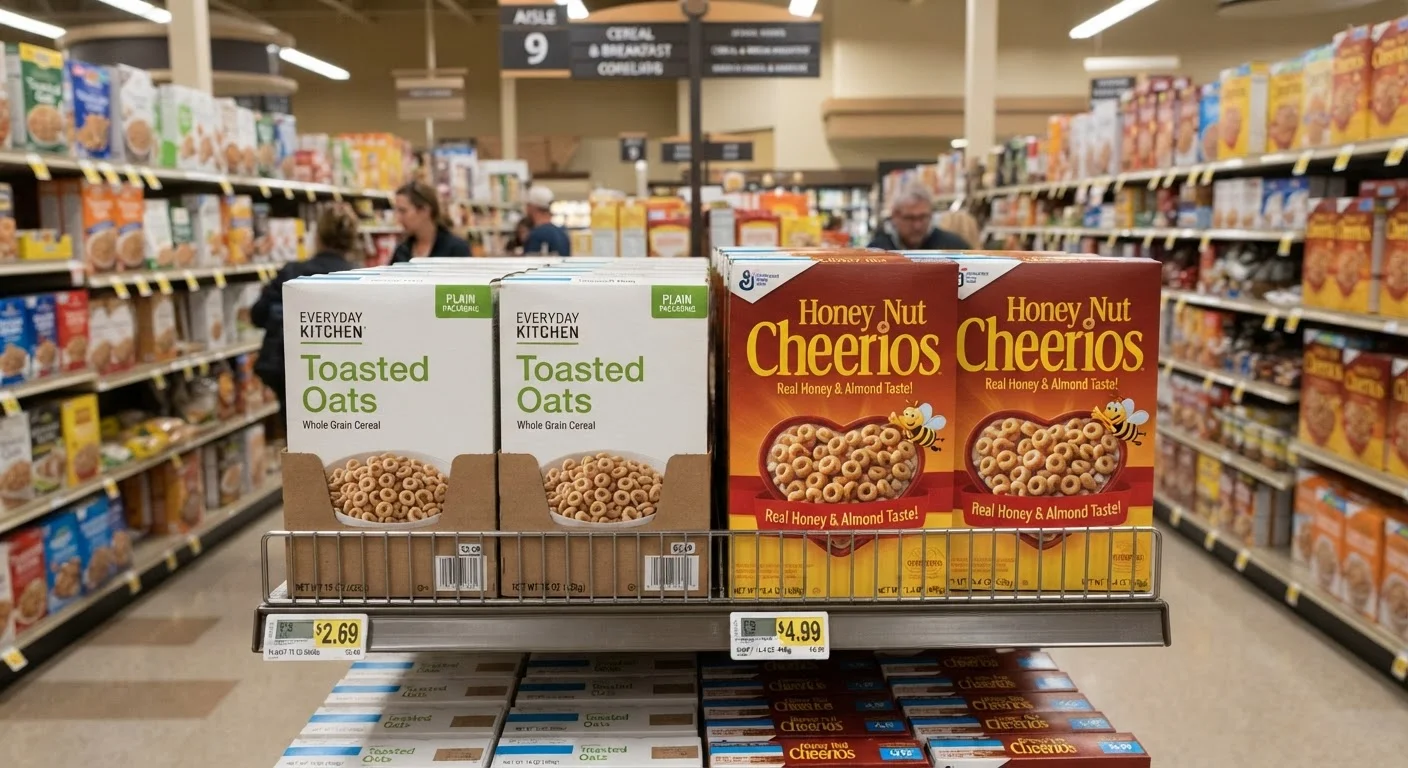
The Manufacturing Reality Behind the Label
One of the most persistent myths in retail shopping is that a higher price tag reflects a fundamentally better product. The reality is more nuanced. A significant portion of store-brand products - across grocery, personal care, and household goods - are produced in the same manufacturing facilities as name-brand items. The retailer contracts directly with the manufacturer, alters the packaging, and sells the result at a lower margin.
This practice, known as private-label manufacturing, is widespread. Manufacturers often operate at excess capacity and welcome retailer contracts as a way to fill production lines. The result is that two nearly identical products can sit on the same shelf at substantially different prices. Understanding how products move through supply chains can help you spot where that price gap originates - and whether it reflects real value.
That said, "made in the same factory" doesn't automatically mean "identical product." Retailers and manufacturers negotiate the specific formulation, ingredients, and tolerances. A store-brand version may use a slightly different recipe or lower-cost ingredient substitutes. The question is whether those differences are detectable and meaningful to you.
| Criterion | Name Brands | Store Brands (Private Label) |
|---|---|---|
| Price | Typically higher (20-50%+ premium) | Generally lower |
| Marketing spend reflected in price | High - advertising costs passed to consumer | Minimal - no independent ad budget |
| Manufacturing source | Brand-owned or contracted facility | Often same contracted facility |
| Formulation consistency | Tightly controlled by brand | Negotiated with manufacturer; may vary |
| OTC medications (active ingredients) | FDA-regulated standard | Same FDA-regulated standard |
| Electronics/appliances support | Established warranty and service network | Varies; often more limited |
| Packaging and shelf appeal | High investment in design | Functional, minimal design |
| Availability across retailers | Broadly available | Retailer-specific |
Where the Price Difference Actually Goes
Name-brand pricing reflects more than production costs. A substantial portion of what you pay covers advertising budgets, slotting fees paid to retailers for premium shelf placement, celebrity endorsements, and brand equity built over decades. Store brands carry none of those costs - they rely on the retailer's own shelf space and reputation rather than independent marketing.
~25%
Average price premium for name brands over store brands
Industry research consistently finds name brands carry a roughly 20-30% average price premium across comparable grocery and household categories.
~1 in 5
Grocery items purchased that are store brands
Private-label products have grown to represent a significant share of U.S. grocery sales, reflecting broader consumer acceptance of store-brand quality.
100%
Active ingredient equivalence required for OTC generic drugs
The FDA requires that store-brand OTC medications contain the same active ingredients at the same strength as their name-brand equivalents.
This cost structure is why name brands typically price 20-30% higher on average across comparable categories, and sometimes significantly more in heavily advertised segments like breakfast cereals, cleaning products, and personal care. The ingredients themselves are often a smaller driver of that gap than shoppers assume.
A practical approach: compare ingredient lists and, for food products, nutrition labels side by side. If the first several ingredients are identical, you have a concrete basis for evaluating whether the price difference is justified for your household.
Category-by-Category: Where It Matters and Where It Doesn't
Not every product category behaves the same way. Here's a practical breakdown:
- OTC medications: Store-brand generics are federally regulated to contain the same active ingredients at the same concentrations as name brands. This is one of the clearest cases where the private-label choice is straightforward for most consumers.
- Pantry staples: Sugar, flour, salt, canned beans, and similar commodities have little room for meaningful quality variation. Store brands perform well here.
- Dairy and eggs: These are often sourced from the same regional suppliers regardless of the label on the carton or package.
- Cleaning products: Formulations vary more in this category, but store-brand options have improved substantially. Reading the active ingredient list is your best guide.
- Electronics and appliances: This is where store brands face a legitimate disadvantage. Warranty support, firmware updates, parts availability, and long-term reliability records favor established name brands in most cases.
- Specialty or artisan foods: If a name brand's appeal is a specific recipe, sourcing practice, or proprietary process, the store-brand alternative may be genuinely different in flavor or quality.
For more context on evaluating products at different price tiers, see our look at outlet stores, clearance sections, and off-price retailers.
A Note on Food Labeling and Health Claims
Marketing language on name-brand packaging - terms like "natural," "wholesome," or "premium" - is largely unregulated and carries no standardized meaning. Store-brand products are subject to the same FDA labeling rules for ingredients and nutrition facts. Evaluating the actual nutrition label gives you more reliable information than front-of-package claims on either type of product. For a broader look at food quality distinctions, see our article on whole foods vs. processed foods.
How to Make the Call at the Shelf
A few practical habits can sharpen your judgment on any shopping trip:
- Read the ingredient list, not the brand name. Ingredients are listed in descending order by weight. If the first five ingredients are identical between a store brand and a name brand, the formulations are substantively similar.
- Check the unit price, not the package price. Store brands sometimes come in different sizes. Unit pricing, displayed on most shelf tags, puts both options on a fair footing.
- Start with low-stakes tests. Try a store-brand version of a staple you buy regularly. If it performs well, you've found a durable substitution. If it doesn't, you've risked a small amount on a single purchase.
- Factor in return policies. Many retailers stand behind their store-brand products with satisfaction guarantees, which lowers the risk of trying unfamiliar options.
Pairing a store-brand strategy with smart bulk-buying decisions can compound your savings on staples without meaningfully changing what you're consuming. And before making purchases online, our checklist for evaluating product listings can help you assess whether a store-brand item is accurately represented.