How Each Channel Sources Its Merchandise
The word "discount" describes the price tag, not the path a product took to reach the shelf. That path matters considerably when evaluating what you're actually getting.
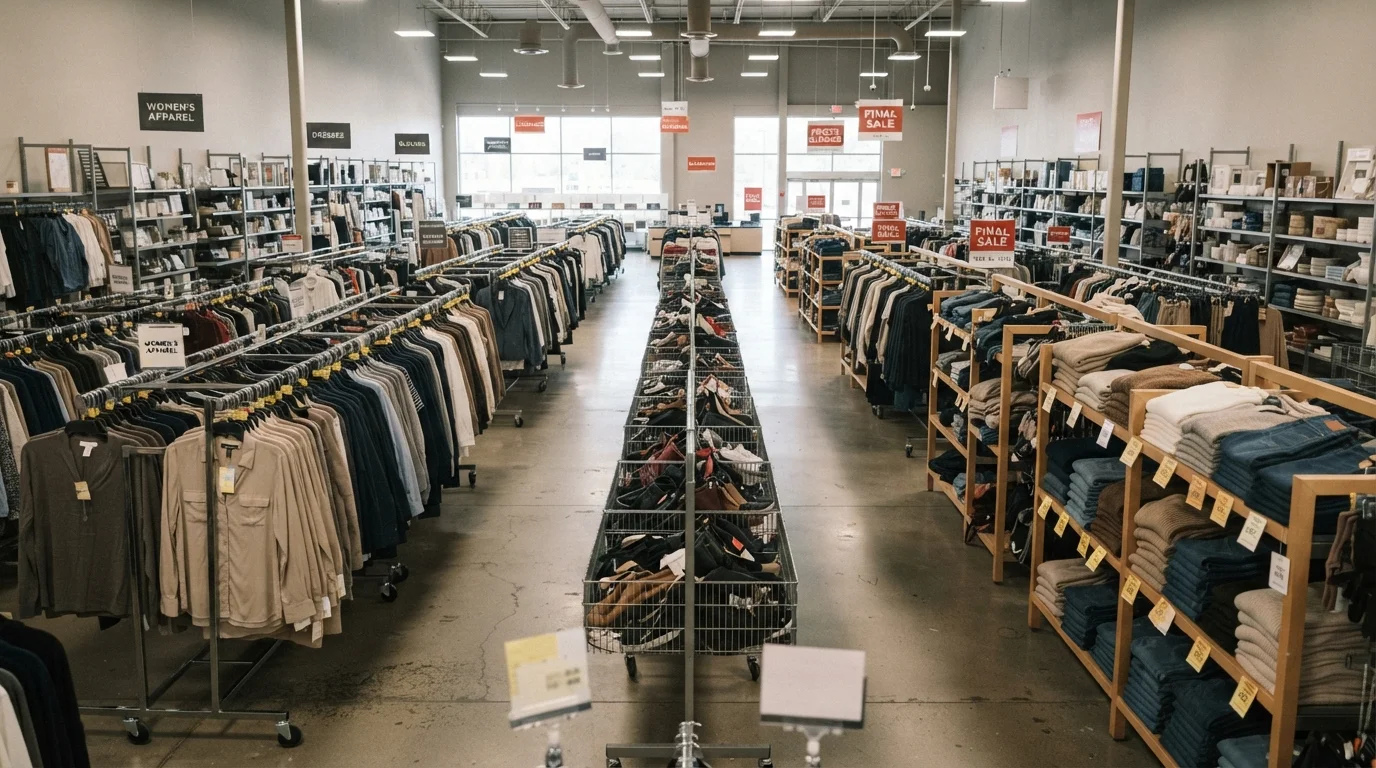
Outlet stores were originally a way for manufacturers to sell factory seconds and unsold seasonal inventory directly to consumers. That model has evolved significantly. Today, industry observers and consumer advocates widely note that a large share of merchandise at outlet locations - particularly in apparel and home goods - is manufactured expressly for the outlet channel. These items are produced to different cost specifications than their full-price counterparts, sometimes with different materials or construction, and they may carry the same brand label without being equivalent to what's sold in flagship stores.
Clearance sections operate on a different logic entirely. When a retailer needs to move inventory - because a season is ending, a product line is being discontinued, or shelf space is required for new arrivals - items get marked down progressively until they sell. These products are identical to what was on the floor at full price; the discount reflects the retailer's need to liquidate, not a change in the goods themselves. To understand more about how products move through these channels, see how products move through supply chains and retail markups.
Off-price retailers - warehouse-format chains and discount department stores - typically buy excess inventory, production overruns, or canceled orders directly from manufacturers and brands. Because they purchase opportunistically and in bulk, they can pass genuine savings to consumers. The trade-off is limited and inconsistent selection; what's available depends entirely on what deals the retailer secured.
Side-by-Side: Key Differences at a Glance
The table below compares the three channels across the criteria most relevant to everyday shoppers evaluating value.
| Outlet Stores | Clearance Sections | Off-Price Retailers | |
|---|---|---|---|
| Typical merchandise origin | Often outlet-exclusive production | Unsold full-price store inventory | Overruns, excess stock, canceled orders |
| Product spec vs. full-price equivalent | May differ; varies by brand | Identical to full-price version | Typically identical; brand-name goods |
| Selection consistency | Consistent, curated by brand | Depends on what didn't sell | Unpredictable; changes frequently |
| Discount depth | Moderate; varies widely | Moderate to steep, increases over time | Moderate to significant |
| Return policy flexibility | Outlet-specific; often restricted | Often final sale on clearance | Varies by chain |
| Price transparency | Reference prices harder to verify | Clear markdown from store price | Comparison pricing may be limited |
One dimension the table can't fully capture is return policy variation. Clearance items at department stores often have restricted or final-sale return terms. Outlet stores may follow their own policies distinct from the main brand's. Off-price chains vary widely. Always check before purchasing, particularly for higher-ticket items.
Quality Signals Worth Checking
Price alone doesn't tell you whether you're getting value - context does. A few practical checks can help you evaluate any discounted purchase more clearly.
Check for Model-Number Differences
When comparing an outlet or off-price item to the same apparent product online, look up the exact model number rather than relying on product name alone. Outlet-exclusive versions of appliances, electronics, and home goods sometimes carry a distinct suffix that distinguishes them from full-price variants. A quick search on the manufacturer's website can tell you whether the spec sheets match.
Look at materials and construction, not just the label. In apparel, examine seams, fabric weight, and hardware like zippers. In home goods, check for any markings that indicate a different product line or specification. Some brands use distinct naming conventions (slightly different model numbers, for instance) on outlet-exclusive items.
Compare the markdown to a verifiable original price. Clearance sections show a concrete "was/now" markdown from a price the item actually carried at that store. Outlet "original" prices can be harder to verify, and some have faced regulatory scrutiny for reference prices that were never the actual selling price at full-price stores. The Federal Trade Commission has published guidance on price comparison advertising that's worth understanding as a consumer.
For perspective on how pricing psychology operates more broadly in retail environments, see retail tactics that influence spending.
Factor in durability expectations. If an item from a clearance or off-price channel is going to be used heavily - like storage products - lower initial cost can be offset by shorter lifespan. Discounted storage products, in particular, often involve hidden replacement costs.
Making the Channel Work for Your Actual Needs
Each channel has legitimate uses. The question is whether the context fits your goal.
Clearance sections work well when you already know and trust a specific product and are simply waiting for the retailer to need to move it. The item is the same; only the urgency of the seller has changed. The limitation is timing - selection is whatever happens to be left.
Off-price retailers reward flexible shoppers. If you don't require a specific item on a specific date, browsing these stores for household goods, clothing, or linens can surface genuine brand-name quality at real reductions. The sourcing model - buying overruns and excess stock - means the goods are generally the same spec as full-price channels, just unpredictably available.
Outlet stores offer reliability of selection, which has value if you need a specific brand's product line and want consistent access to it. The informed approach is to go in knowing that merchandise may be outlet-specific, and to evaluate the item on its own merits rather than assuming parity with full-price equivalents.
For a related angle on how private-label and name-brand goods compare at the product level, see how name-brand and store-brand quality actually compare.