Why Meal Timing Matters More Than Most Owners Realize
Many pet owners focus heavily on what they feed — ingredient lists, protein percentages, wet versus dry — but give little thought to when and how often food is offered. Research in veterinary nutrition increasingly shows that feeding structure has meaningful effects on metabolism, gut health, and even behavior. Part of building a consistent routine for your pet is treating mealtime as a deliberate event rather than a passive availability.
The two dominant approaches are timed (or scheduled) feeding, in which measured portions are offered at set times and removed after 20–30 minutes, and free-choice (or ad libitum) feeding, in which food remains available around the clock. A third option, portion-controlled timed feeding, combines a fixed daily caloric allotment with one or more scheduled meal windows. For most companion animals, veterinary guidance generally favors timed or portion-controlled approaches over unrestricted access.
“Structured meal feeding is one of the simplest and most effective tools we have for preventing obesity in companion animals. It also transforms the meal into an opportunity to observe appetite — which is one of the earliest and most reliable indicators of a pet's overall health.”
— American Animal Hospital Association, Veterinary standards and nutrition guidance organization
The Evidence-Informed Practices Vets Recommend
The following practices reflect current consensus from veterinary nutrition specialists and behavioral researchers. Individual pets vary, so always confirm changes with your veterinarian — particularly for animals managing chronic conditions, recovering from surgery, or in growth or senior life stages. For more on how requirements shift over time, see how feeding should change across your pet's life stages.
Offer meals at the same times each day, not whenever convenient.
Pets have internal circadian clocks that regulate hunger hormones, gastric acid secretion, and digestive enzyme activity. Consistent timing keeps these systems calibrated, reducing digestive upset and supporting stable energy levels throughout the day.
Measure every meal by weight or a calibrated cup rather than estimating by eye.
Studies repeatedly show that owners who estimate portions visually tend to overfeed, often by 20–30%. Even small daily surpluses accumulate into significant weight gain over months. Obesity is one of the most prevalent and preventable health conditions in companion animals.
Remove uneaten food after 20–30 minutes rather than leaving it out.
Prompt removal prevents bacterial growth in moist food, discourages grazing behaviors that are linked to weight gain, and — critically — preserves appetite as a health indicator. A pet that consistently leaves food or skips a meal is telling you something.
Match meal frequency to your pet's species and life stage.
Puppies and kittens have small stomach capacity and faster metabolisms; they generally require three to four meals per day. Healthy adult dogs typically do well with two meals; adult cats often benefit from two to three smaller meals. Senior pets or those with certain medical conditions may need adjusted schedules.
Recalculate portion sizes as your pet's weight or activity level changes.
Feeding guidelines on pet food packaging are starting points, not permanent prescriptions. A dog that transitions from daily hikes to suburban walks needs fewer calories. Failing to reassess over time is a leading cause of gradual weight creep.
Quick Actions You Can Take Today
If your current routine is inconsistent or primarily free-choice, small adjustments can produce meaningful results quickly. The changes below require no special equipment and can be started without a vet visit, though a check-in is always worthwhile when overhauling a pet's diet.
Multi-Pet Households Need Separate Feeding Stations
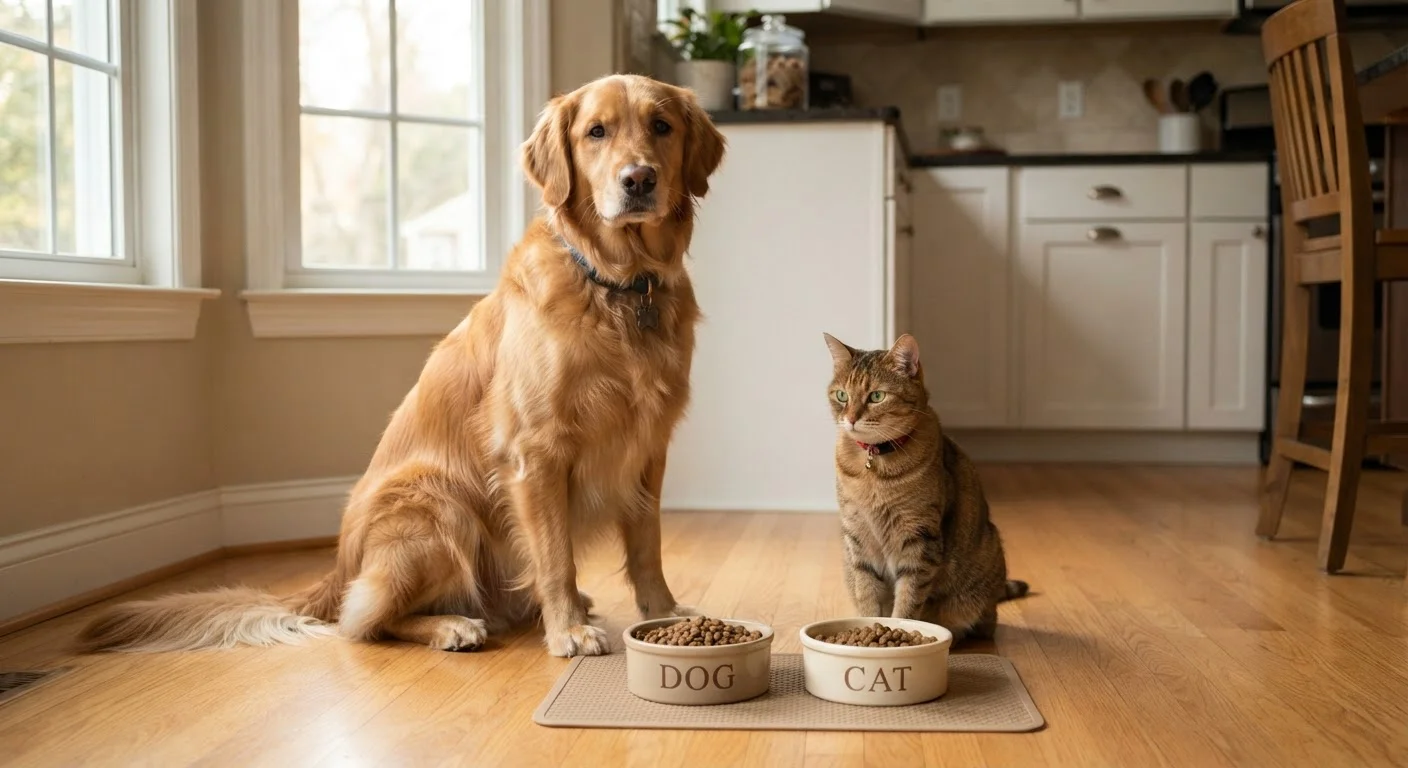
When multiple pets eat from the same bowl or are fed in the same space without supervision, dominant animals often consume more than their share while anxious ones eat less. Feed pets in separate rooms or use physical barriers to ensure each animal receives — and finishes — their own measured portion. This also makes it far easier to monitor individual appetite changes.
If you notice low energy, coat changes, or digestive irregularities after adjusting your schedule, those could signal a nutritional gap. Our guide on signs your pet's diet may not be meeting their nutritional needs walks through what to watch for and when to call your vet.
This article is for general informational and educational purposes only and does not constitute veterinary advice. Always consult a licensed veterinarian before making significant changes to your pet's diet or feeding schedule.