Two Different Concepts, Often Confused
Many Americans use the terms interchangeably, but an emergency fund and a savings account are not the same thing — one is a purpose, the other is a product. A savings account is a bank account type that earns interest on deposited funds. An emergency fund is a dedicated financial reserve meant to cover unplanned, urgent expenses. You can hold an emergency fund inside a savings account, but simply having a savings account does not mean you have an emergency fund.
The confusion matters in practice. Without this distinction, money earmarked for a vacation or a new appliance can get raided during a car breakdown or a medical bill — and suddenly both goals are derailed. Understanding what each concept does differently is the first step toward building a more resilient financial structure. For a broader look at how account types work together, see Checking vs. Savings Accounts.
What Each One Is — and Isn't
Emergency Fund: This is money set aside exclusively for genuine financial emergencies — unexpected job loss, urgent medical costs, essential home or car repairs. The defining characteristic is its purpose: you do not touch it for planned expenses, routine bills, or discretionary spending. Financial educators commonly suggest a target of three to six months of essential living expenses, though the right amount varies by individual circumstance. If you're just starting out, building a starter emergency fund on a tight budget is a realistic first step even on a modest income.
Savings Account: This is a deposit account offered by banks and credit unions that earns interest on your balance. It's a versatile tool — people use savings accounts for emergency funds, vacation funds, down payment savings, and more. Standard savings accounts are federally insured (up to applicable FDIC or NCUA limits) and allow limited monthly withdrawals. High-yield savings accounts offer significantly higher interest rates than standard accounts, making them a popular vehicle for emergency reserves and longer-term goals alike.
| Criterion | Emergency Fund | Savings Account |
|---|---|---|
| What it is | A financial purpose/goal | A bank account product |
| Primary function | Cover unexpected crises | Earn interest on deposits |
| Withdrawal rules | Only for true emergencies | Flexible, limited by bank policy |
| Recommended size | 3–6 months of expenses | Varies by goal |
| Where it's held | Usually in a savings account | At a bank or credit union |
| Earns interest | Yes, if in an interest account | Yes, rate varies by account |
| Suitable for goals | No — emergencies only | Yes — vacations, down payments, etc. |
Why Separation Matters
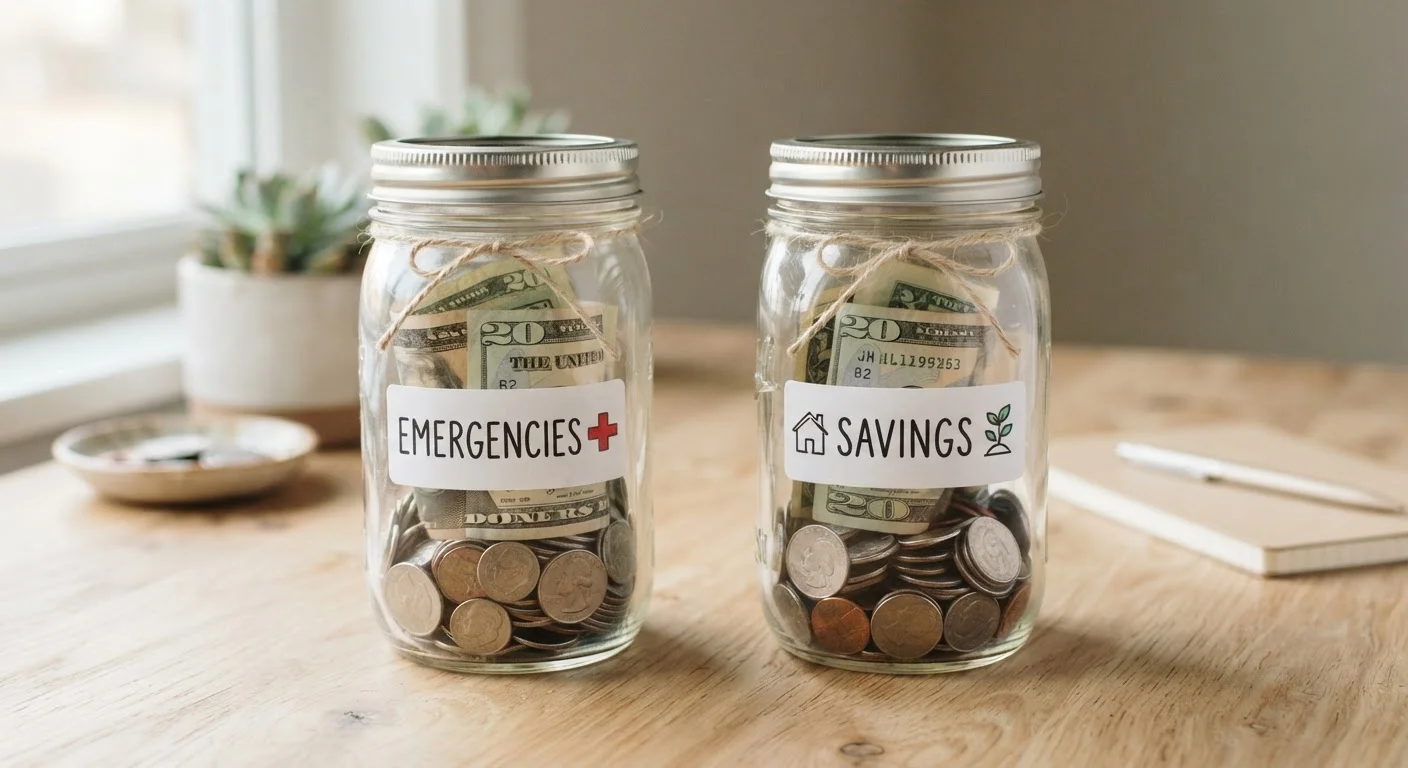
Behavioral finance research consistently shows that labeling and separating money by purpose reduces unintended spending. When your emergency fund and vacation savings share the same account — and the same running balance — the psychological boundary that protects your reserves essentially disappears.
A practical approach many financial educators recommend is maintaining at least two distinct savings accounts: one strictly for emergencies, one for planned goals. Some banks allow you to create sub-accounts or savings buckets within a single institution, making this easier to manage without juggling multiple logins. Automating your savings — setting up automatic transfers to each account on payday — removes the friction of manual decisions and reinforces both habits simultaneously.
Don't Confuse Planned Costs With Emergencies
A predictable expense — like annual car registration or holiday gifts — is not an emergency, even if it feels urgent. Treating foreseeable costs as emergencies depletes your reserve and leaves you exposed to genuine crises. Sinking funds are specifically designed to handle those predictable-but-irregular expenses, keeping your emergency fund intact for true surprises.
It's also worth distinguishing both of these from a sinking fund — a separate savings strategy for irregular but predictable costs like annual insurance premiums or holiday spending. Learn more in Sinking Funds Explained.
Where to Keep Your Emergency Fund
Accessibility and stability are the two criteria that matter most for an emergency fund. The money needs to be reachable quickly — ideally within one to two business days — without penalty or risk of loss. That makes a high-yield savings account or a money market account (also FDIC-insured) the most commonly recommended homes for emergency reserves.
Investments such as stocks or mutual funds are generally not suitable for emergency funds. Market values fluctuate, and you could be forced to sell at a loss precisely when you need the funds most. Certificates of deposit (CDs) are also typically a poor fit because early withdrawal penalties reduce your available balance. The goal is not maximum return — it's reliable, penalty-free access to a stable amount. For guidance on how much to aim for, savings rate benchmarks can offer useful reference points, keeping in mind that no single figure suits every household.
~57%
Americans unable to cover a $1,000 emergency
A Bankrate survey found that fewer than half of U.S. adults could pay for a $1,000 emergency expense from savings without borrowing.
3–6 months
Commonly suggested emergency fund target
Many personal finance educators and consumer financial agencies suggest covering three to six months of essential living expenses in an emergency reserve.
This article is for general informational and educational purposes only and does not constitute personalized financial or investment advice. Consult a licensed financial professional for guidance specific to your situation.