Where the Rule Comes From
The 50/30/20 framework was popularized by Elizabeth Warren — then a Harvard law professor specializing in bankruptcy — and her daughter Amelia Warren Tyagi in their 2005 book All Your Worth: The Ultimate Lifetime Money Plan. Their core argument was that most Americans get into financial trouble not because they splurge on luxuries, but because their fixed "must-have" costs grow too large relative to their income.
Warren and Tyagi used decades of bankruptcy research to identify a pattern: households in financial distress had often committed too much of their income to rigid, recurring expenses — mortgages, car payments, insurance — leaving little cushion when income dropped. The three-bucket framework was their proposed antidote: a simple ratio that keeps fixed costs manageable while still allowing for both enjoyment and financial progress.
The rule wasn't designed as a precise prescription. It was intended as a lifetime benchmark — a way to regularly check whether your spending structure, not just your spending amount, is sustainable. That origin matters, because it explains why the rule is better understood as a diagnostic tool than a strict monthly formula.
For a broader look at how budgeting systems compare, see this side-by-side comparison of popular budgeting frameworks.
How the Three Buckets Work in Practice
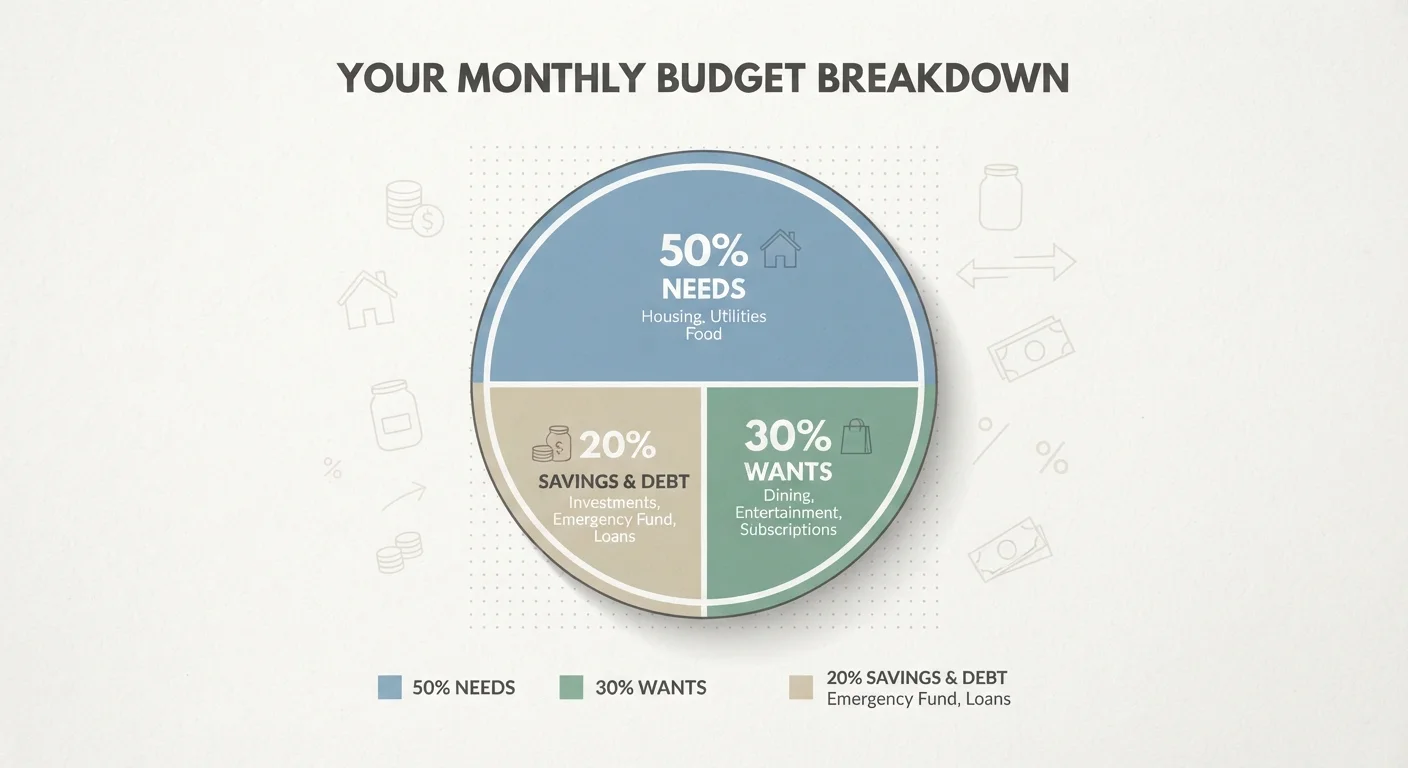
The rule operates on after-tax income — your actual take-home pay, not your gross salary. Each category has a distinct purpose:
- 50% — Needs: Essential expenses you cannot eliminate without harming your stability. This includes rent or mortgage payments, utilities, groceries, health insurance premiums, minimum debt payments, and basic transportation costs.
- 30% — Wants: Spending that improves quality of life but isn't strictly necessary — streaming services, restaurant meals, gym memberships, travel, and hobbies.
- 20% — Savings and debt repayment: Contributions toward an emergency fund, retirement accounts, and paying down debt beyond the minimum required payment.
The 50/30/20 split is deliberately broad. A phone bill could be a need or a want depending on your situation; a car payment might be essential if public transit isn't available in your area. The categories require honest self-assessment rather than rigid labeling.
37%
Americans who carry a monthly credit card balance
According to the American Bankers Association's consumer credit data, a substantial share of U.S. cardholders carry revolving balances, underscoring the importance of the debt-payoff component of the 20% bucket.
30%+
Income spent on housing by many U.S. renters
The U.S. Department of Housing and Urban Development considers households that spend more than 30% of gross income on housing to be 'cost-burdened,' a threshold many renters in major metros exceed.
~40%
Americans who couldn't cover a $400 emergency
Federal Reserve research on household economic well-being has repeatedly found that a large share of U.S. adults report difficulty covering unexpected expenses — highlighting why the savings component of the rule matters.
If you're building your first structured spending plan, this plain-English walkthrough for first-time budgeters offers a practical starting point before applying any framework.
Where the Rule Breaks Down
The 50/30/20 rule's simplicity is also its biggest limitation. Several common real-world situations expose the framework's gaps:
High-cost housing markets
In cities like San Francisco, New York, or Boston, rent alone can easily consume 40–50% of a moderate income — before factoring in utilities, groceries, or transportation. For these households, hitting the 50% needs cap isn't a discipline problem; it's a math problem. Forcing the other categories to shrink accordingly can leave little room for savings or emergencies.
Lower incomes and variable pay
Households with tighter margins often can't realistically devote 30% to discretionary wants — survival spending alone may exceed 60–70% of income. Gig workers and hourly employees with irregular pay also find it difficult to apply percentage-based rules to income that changes week to week.
Aggressive debt payoff goals
For someone carrying high-interest credit card debt, a 20% savings-and-debt allocation may be far too modest. Many financial educators recommend temporarily redirecting money from the "wants" category toward debt elimination until high-rate balances are cleared — a priority the 50/30/20 framework doesn't inherently signal.
Adjust the Percentages to Fit Your Reality
If your needs genuinely exceed 50% of take-home pay, consider temporarily reducing the wants category rather than cutting savings entirely. Maintaining even a small, consistent contribution to savings or debt payoff tends to produce better long-term outcomes than pausing it altogether. Small, steady progress compounds over time.
The rule is a floor, not a ceiling. Nothing prevents you from saving 30% or limiting wants to 15% if your circumstances allow or require it. For context on why even well-structured budgets can unravel, see why most budgets fall apart by week two.
Using the Rule as a Starting Point, Not a Finish Line
The most useful way to approach the 50/30/20 rule is as a diagnostic benchmark. Rather than treating it as a monthly checklist, use it periodically to assess whether your spending structure is reasonably balanced. If your needs are consuming 70% of income, that's a signal worth investigating — whether it means renegotiating fixed costs, increasing income, or revisiting housing choices over time.
For those exploring alternatives, zero-based budgeting assigns every dollar a specific job, offering more control at the cost of more effort. The comparison of zero-based budgeting and the 50/30/20 rule outlines how they differ in practice. The Budgeting Basics hub covers additional frameworks and strategies.
Whatever method you choose, the underlying goal is the same: spending intentionally so that savings and debt repayment aren't left to whatever happens to remain at month's end. The 50/30/20 rule doesn't guarantee that outcome — but used honestly, it can make the gap between where you are and where you want to be easier to see.
This article is for general informational and educational purposes only and does not constitute personalized financial advice. Consult a qualified financial professional for guidance tailored to your specific situation.