
Why Budgeting Matters Before Anything Else
A budget is simply a written plan that tells your money where to go before the month starts, rather than wondering where it went afterward. Without one, spending decisions happen reactively — and small leaks accumulate into real financial stress.
For a deeper look at how budgeting connects to longer-term financial health, see the complete guide to personal budgeting for American households. This article focuses specifically on building your very first budget from scratch.
Net income
The money you actually receive after taxes and deductions are taken out of your paycheck. This is your real budgeting starting point.
Fixed expense
A bill or payment that stays the same amount every month, such as rent or a car loan.
Discretionary spending
Money spent on wants rather than necessities — things like dining out, entertainment, or hobbies that you choose to purchase.
50/30/20 rule
A simple budgeting guideline that splits take-home pay into 50% for needs, 30% for wants, and 20% for savings or debt repayment.
Emergency fund
Money set aside specifically to cover unexpected expenses — such as a car repair or medical bill — without going into debt.
Variable expense
A necessary cost that changes in amount from month to month, such as groceries, utility bills, or gasoline.
Step 1: Find Your True Monthly Income
The foundation of any budget is your net income — the amount that actually lands in your bank account after taxes, Social Security, and any other payroll deductions. Using your gross salary leads to a plan built on money you never see.
- Salaried workers: Check your most recent pay stub for the net deposit amount, then multiply by the number of pay periods in a month (roughly 2 for biweekly).
- Hourly workers: Multiply your average weekly hours by your hourly rate, subtract estimated taxes, and multiply by 4.3.
- Variable or freelance income: Use the lowest monthly income you've received in the past three to six months as your baseline.
If you don't yet have a bank account set up, review what to expect when opening your first bank account before going further.
Step 2: List and Categorize Your Expenses
Pull up three months of bank or card statements and list every recurring charge and spending pattern you find. Then sort each expense into one of three categories:
- Fixed expenses
- Amounts that don't change month to month — rent, loan payments, insurance premiums, subscriptions at a set rate.
- Variable necessities
- Expenses you must pay but that fluctuate — groceries, utilities, gas, medications.
- Discretionary spending
- Wants rather than needs — dining out, streaming services, clothing beyond basics, entertainment.
This categorization matters because each type is managed differently. Fixed expenses are non-negotiable in the short term. Variable necessities can be trimmed with effort. Discretionary spending is where most first-time budgeters find immediate flexibility.
Use Real Statements, Not Memory
When listing expenses, always work from actual bank or credit card statements rather than trying to recall what you spend. Memory consistently underestimates discretionary categories like dining and entertainment by 20–40%. Accurate data is the only foundation a budget can hold.
Step 3: Choose a Simple Budgeting Framework
Rather than assigning exact dollar amounts to dozens of line items from day one, start with a framework that gives you guardrails. The most accessible option for beginners is the 50/30/20 rule:
| Category | Allocation | What It Covers |
|---|---|---|
| Needs | 50% | Rent, utilities, groceries, transport, insurance |
| Wants | 30% | Dining out, entertainment, subscriptions, hobbies |
| Savings / Debt | 20% | Emergency fund, retirement contributions, extra debt payments |
These percentages are starting points, not rigid rules. High-cost-of-living areas may require 60% or more for needs. If you're carrying significant debt, you might redirect more than 20% toward repayment. See the Saving & Debt hub for guidance on balancing those competing priorities.
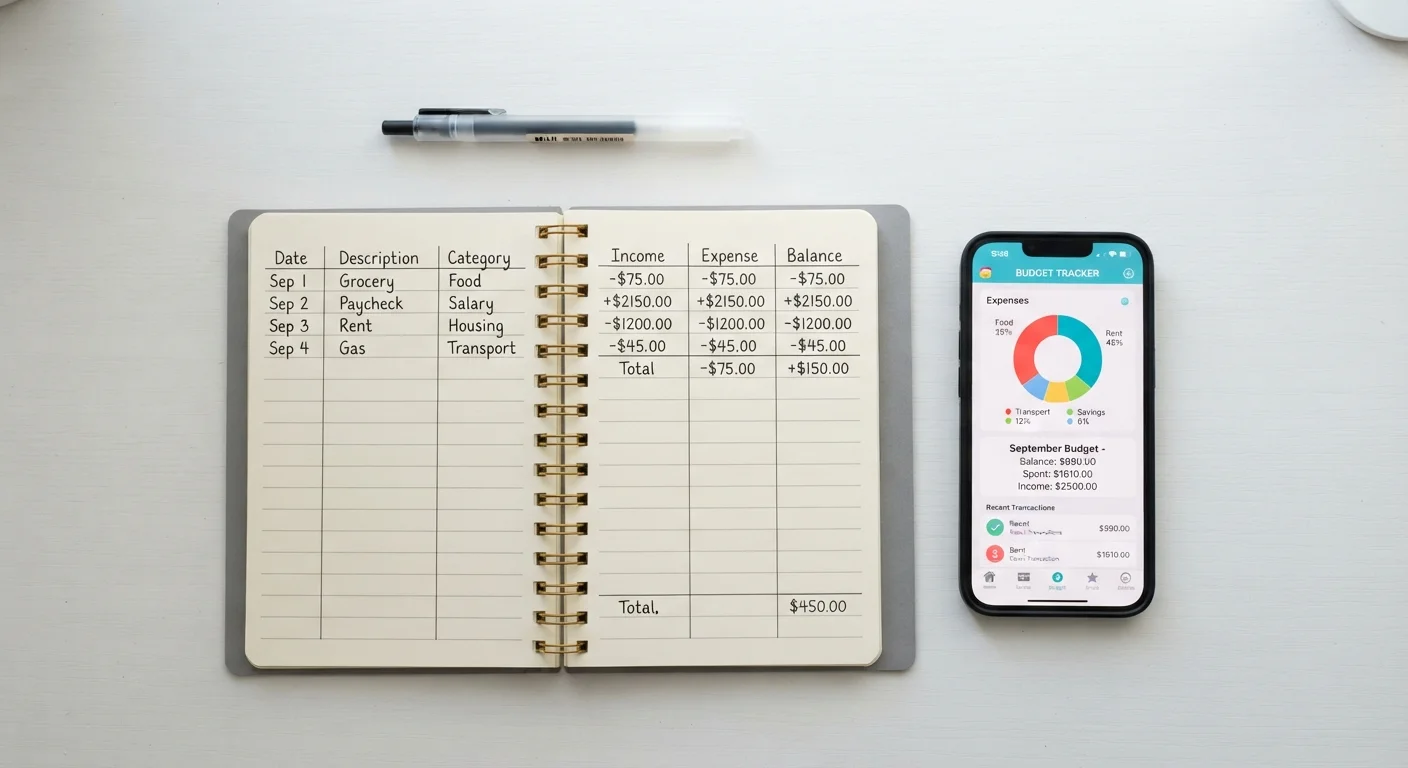
Not sure whether to track your budget in a notebook or an app? Compare both approaches to find the method that suits how you think.
The 50/30/20 Rule Is a Guide, Not a Rule
No single budgeting framework fits every household. Someone with significant student loans may need to direct more than 20% toward debt. Someone in an expensive city may find that needs consume 60% of take-home pay before any optimization. Treat percentage guidelines as a starting reference, then adjust to reflect your actual circumstances.
Step 4: Set Spending Limits That Are Actually Realistic
Here is where most first budgets go wrong: people set aspirational limits rather than realistic ones. If you spent $420 on groceries last month, a $200 grocery budget will collapse by week two — not because of a lack of discipline, but because the target was never grounded in reality.
A more effective approach:
- Calculate your three-month average for each variable and discretionary category.
- Set your initial limit at or just below that average, not dramatically lower.
- Identify one discretionary category where you'd like to reduce spending and lower that limit by 10–15%.
- Leave the rest at realistic averages for the first month.
This builds confidence and gives you a real baseline to improve from. If you're dealing with a very tight financial margin, the guide to budgeting paycheck to paycheck addresses that specific challenge directly.
Avoid Cutting Too Aggressively Too Soon
Slashing multiple spending categories in your first month creates an overly restrictive plan that's hard to sustain. Dramatic cuts often lead to frustration and abandonment of the budget entirely. Start with modest, achievable reductions and tighten gradually as the habit takes hold.
Keeping Your Budget Alive After Month One
A budget you set once and never revisit is just a wish list. The practice that separates functional budgets from forgotten ones is a brief monthly review — comparing what you planned against what actually happened.
At each monthly check-in, ask three questions:
- Which categories ran over, and was it a one-time event or a pattern?
- Did I meet my savings or debt target?
- Does anything in my life change next month that requires a budget adjustment?
Use the monthly budget review checklist to structure this process efficiently. And if your budget has already started slipping, understanding why budgets break down in week two can help you diagnose and fix the structural issue — it's rarely about willpower.
This article provides general financial education and is not personalized financial advice. For guidance tailored to your specific situation, consider consulting a licensed financial professional.