
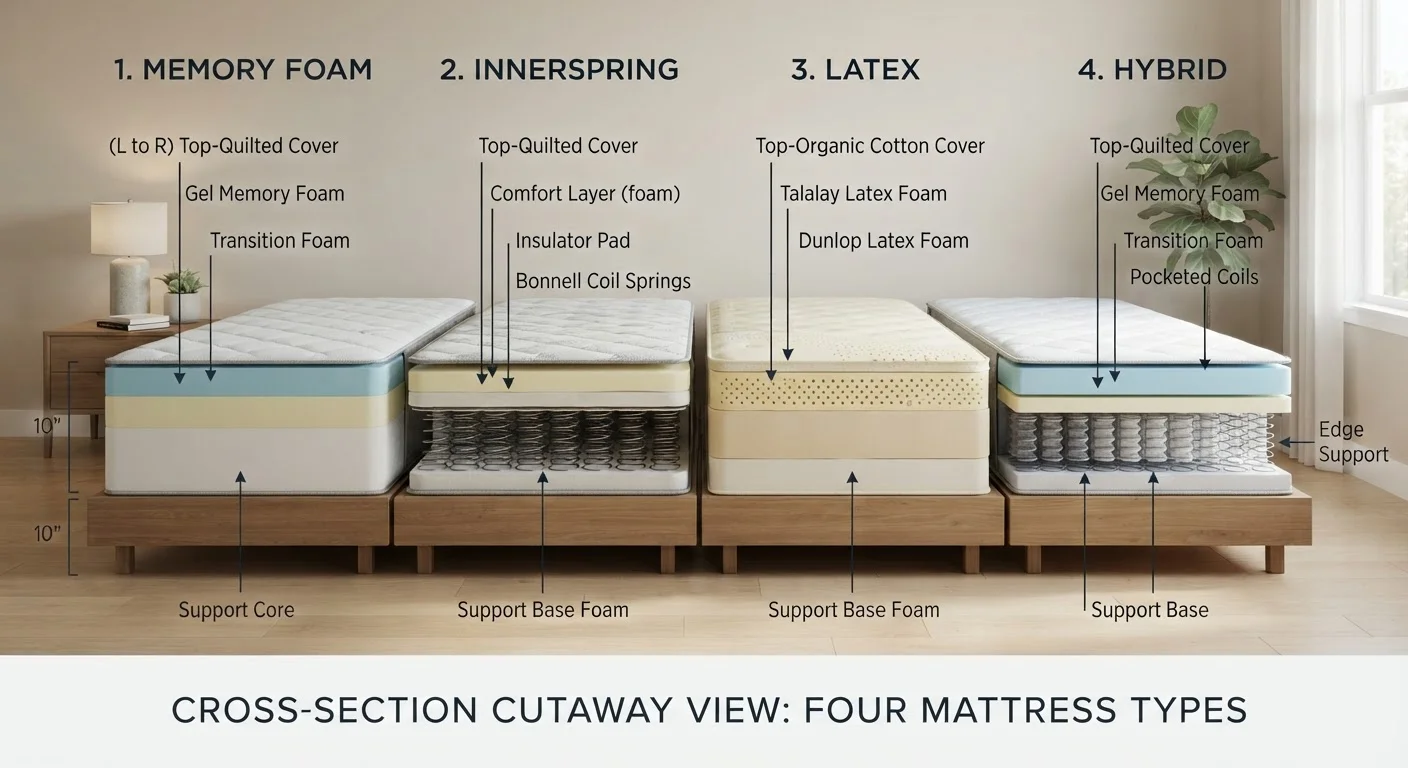
The Four Main Mattress Constructions at a Glance
Walk into any mattress retailer or scroll through an online catalog and you'll encounter four dominant construction types: memory foam, innerspring, latex, and hybrid. Each is built differently, and those differences translate directly into how the mattress feels, how long it lasts, and how well it suits different sleep positions and body types. Understanding the fundamentals helps you evaluate options on your own terms rather than relying solely on a sales pitch.
| Memory foam feel | Slow-response contouring; minimal bounce |
| Innerspring feel | Bouncy, responsive; sleeps cool |
| Latex feel | Buoyant contouring; quick response |
| Hybrid feel | Combined coil support with foam/latex comfort layers |
| Best motion isolation | Memory foam, followed by pocketed-coil hybrids |
| Best airflow | Innerspring; latex and hybrid also perform well |
| Natural material option | Natural latex (Dunlop or Talalay processed) |
| Typical heaviest type | Natural latex mattresses |
For a related look at how material construction shapes everyday products, see our article on what bedding labels actually mean - the same principle of reading construction details applies across your bedroom setup.
Memory Foam: Pressure Relief and Contouring
Memory foam (also called viscoelastic polyurethane foam) responds to body heat and weight by conforming closely to the sleeper's shape. This contouring effect distributes pressure across a broader surface area, which can reduce point pressure on hips and shoulders.
The tradeoff is heat retention - traditional memory foam traps warmth, though many manufacturers now add gel infusions, open-cell structures, or copper particles to improve airflow. Memory foam also absorbs motion well, meaning movement on one side of the bed is less likely to disturb a partner on the other side. It provides little to no bounce or responsiveness, which some sleepers find uncomfortable when changing positions.
Viscoelastic foam
The technical name for memory foam. It is designed to respond to both heat and pressure, allowing it to conform to body shape and slowly return to its original form when pressure is removed.
Pocketed coils
Individually fabric-wrapped coil springs that move independently of one another. This design reduces motion transfer compared to interconnected coil systems.
Dunlop process
A latex manufacturing method that produces a denser, heavier foam with a slightly firmer feel. The sediment in the liquid latex settles during molding, creating a bottom layer that is firmer than the top.
Talalay process
A latex manufacturing method involving vacuum-sealing and flash-freezing the foam before curing. The result is a more consistent, lighter, and typically softer latex compared to Dunlop-processed foam.
Coil gauge
A measurement of the thickness of the wire used in mattress coils. Lower gauge numbers indicate thicker wire, which generally means a firmer, more durable coil system.
Motion isolation
A mattress's ability to absorb movement so that one sleeper's repositioning does not disturb their partner. Memory foam and pocketed coil systems typically perform better than interconnected innerspring systems in this regard.
Best suited for: Side sleepers, couples with different sleep schedules, and people managing joint or pressure-point discomfort. Not ideal for sleepers who overheat easily unless a cooling construction is specifically built in.
Innerspring: Traditional Bounce and Airflow
Innerspring mattresses use a core of steel coils as their primary support system. The coil design has evolved considerably - Bonnell coils are hourglass-shaped and interconnected (affordable, but transfer motion readily), while pocketed coils (also called individually wrapped coils) operate independently, reducing motion transfer significantly.
Innerspring mattresses generally sleep cooler than foam-based options because air circulates freely through the coil layer. They also offer more surface responsiveness, making it easier to reposition during the night. The primary concern with innerspring construction is durability - coils can sag or lose tension over time, and the comfort layers above the coil system (typically thin foam or fiber) may compress faster than the coil core itself.
Best suited for: Stomach and back sleepers who need firm, even support, and sleepers who prioritize airflow and a traditional bouncy feel.
Latex: Responsive Support with Natural Origins
Latex mattresses come in two primary forms: natural latex, derived from rubber tree sap, and synthetic latex, made from petrochemical compounds. A third category, blended latex, combines both. Natural latex is processed using either the Dunlop method (denser, firmer) or the Talalay method (lighter, more consistent cell structure, and slightly softer feel).
Latex offers a buoyant, springy feel that's distinct from both foam and coil systems. It contours to the body without the deep sink of memory foam, responds quickly when you move, and tends to sleep cooler than traditional memory foam. Natural latex is also resistant to dust mites and mold, which matters for allergy-sensitive households. The main drawbacks are weight - latex mattresses are heavy and difficult to move - and cost, as natural latex commands a significant price premium.
Best suited for: Combination sleepers who want contouring without the slow-response feel of memory foam, and households prioritizing naturally sourced materials.
Hybrid: Combining Coil Support with Foam or Latex Comfort
Hybrid mattresses pair a pocketed coil support core with substantial comfort layers of foam, memory foam, or latex - typically at least two inches of comfort material above the coils. The goal is to capture the airflow and responsiveness of innerspring construction while adding the pressure relief and contouring of foam or latex.
~7-10 years
General mattress replacement guideline
Sleep foundation guidance commonly suggests replacing a mattress every 7-10 years, though actual longevity depends on construction quality, usage, and care.
2+ inches
Minimum comfort layer for a true hybrid
Industry convention generally holds that a mattress needs at least two inches of foam or latex comfort material above coils to qualify as a hybrid rather than a cushion-top innerspring.
Hybrids are generally heavier and more expensive than single-construction mattresses, and quality varies considerably based on the thickness and density of the comfort layers. A thin foam topper over a coil core may be marketed as a hybrid but performs more like a traditional innerspring. When evaluating a hybrid, look at the comfort layer depth and the coil gauge (lower gauge numbers indicate thicker, firmer wire).
Best suited for: Sleepers who want the benefits of multiple construction types - particularly those who found pure foam too hot or pure innerspring too firm. Also a reasonable option for couples with differing comfort preferences, since pocketed coil hybrids handle motion isolation reasonably well.
Just as flooring type determines how a room performs over time, mattress construction determines how your sleep surface holds up - see our comparison of flooring material tradeoffs for a parallel approach to evaluating home product durability.