Why the Operating Style Matters
When most people shop for window treatments, they focus on material, color, and light filtration - and all of those matter. But the operating mechanism determines daily usability, long-term safety, and how well a covering holds up over years of use. Choosing based on looks alone can mean constantly wrestling with a stiff mechanism or, more seriously, creating a hazard in a child's bedroom.
The three dominant operating styles - corded, cordless, and motorized - differ in cost, ease of use, safety profile, and suitability by room type. Understanding those differences upfront saves money and frustration later. This is especially true if you're outfitting multiple rooms at once, where a one-size-fits-all approach often falls short. For a broader look at how material and construction affect home products, see our guide to decoding product labels.
Corded Window Treatments
Corded blinds and shades use a looped or continuous cord to raise, lower, or tilt slats. They're widely available, generally less expensive than the alternatives, and compatible with heavier or wider window coverings that need more mechanical leverage.
Where they work well: Home offices, adult bedrooms, or utility rooms where children and pets have limited unsupervised access. Large windows, particularly those wider than 72 inches, may genuinely benefit from cord systems because the mechanical advantage makes adjustment easier.
The safety concern: The U.S. Consumer Product Safety Commission has documented corded window covering hazards as a leading cause of strangulation-related deaths in young children under 6. This is not a marginal risk - it's a well-documented, recurring hazard. Looped cords are considered more dangerous than single-strand cords, and no corded covering should be used in a room where a young child sleeps or plays unsupervised.
Corded Coverings Pose a Documented Child Hazard
The U.S. Consumer Product Safety Commission identifies corded window coverings as a recurring strangulation hazard for children under 6. Looped cords carry the highest risk. If your household includes young children or if a room is accessible to them unsupervised, cordless or motorized treatments are the appropriate choice - not a preference, but a safety standard.
For households without children or pets, corded treatments remain functional and cost-effective. Just ensure cords are kept taut against the wall using tie-down devices when not in use.
Cordless Window Treatments
Cordless blinds and shades operate by gripping the bottom rail and pushing or pulling it directly. They use an internal spring-loaded or tension mechanism to hold position. The result is a cleaner visual profile and the elimination of dangling cords.
Where they work well: Children's rooms, nurseries, bedrooms accessible to pets, and any living space where aesthetics are a priority. Cordless shades are widely considered the practical default for most residential rooms today.
Limitations to know: The internal tension mechanism can wear out over time, particularly with frequent use on heavier shade materials. Very wide or tall windows can be difficult to adjust because you're pushing against the full weight of the covering without mechanical help. Some cordless mechanisms also require both hands to operate smoothly, which can be awkward in tight spaces.
Cordless Options Cover Most Window Types
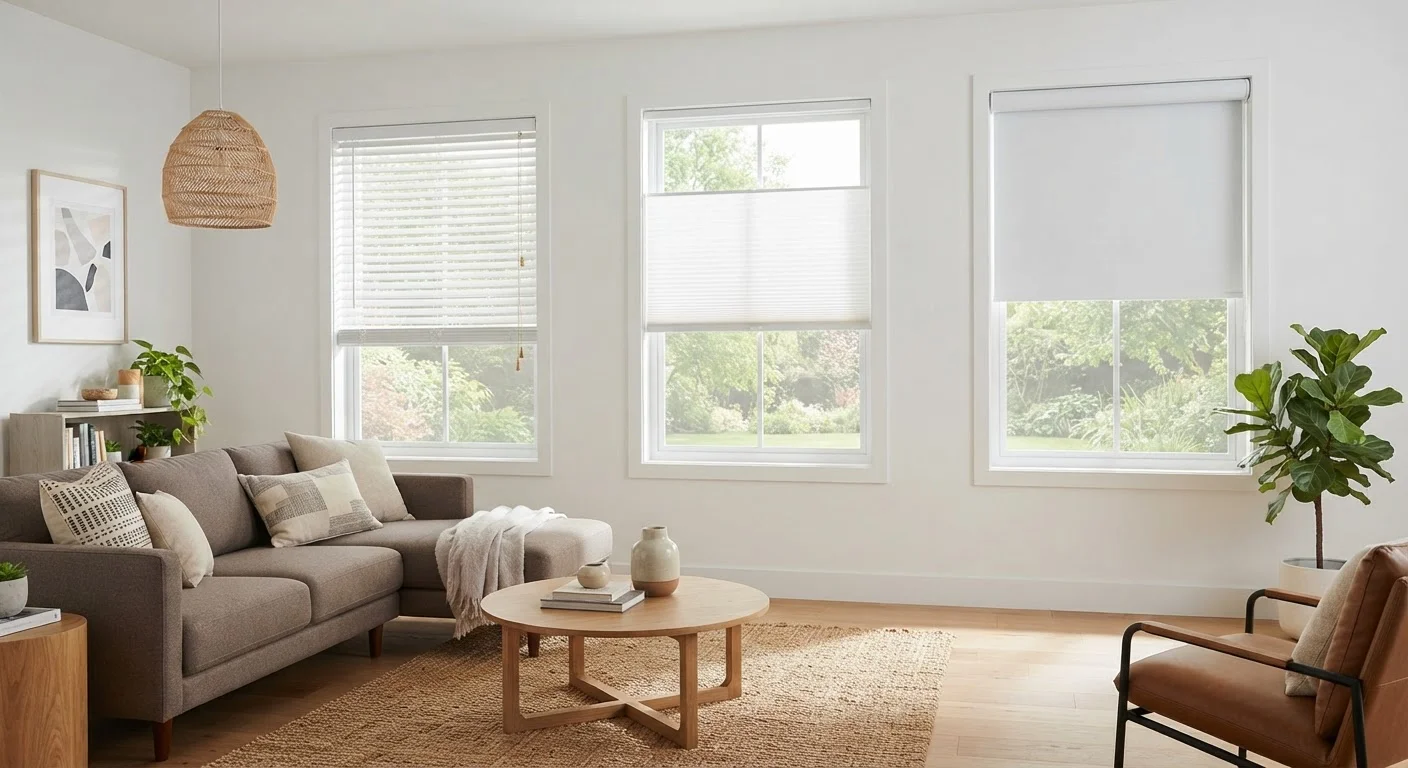
Cordless blinds and shades are now available across nearly every style category - cellular shades, roller shades, Roman shades, and faux-wood blinds all come in cordless versions. Prices have declined as demand has grown, making cordless a practical default for most rooms. When comparing options, check the weight of the specific shade material, as heavier fabrics put more strain on tension mechanisms over time.
Cordless options have expanded significantly and now cover most shade and blind types - cellular, roller, Roman, and faux-wood blinds are all widely available in cordless configurations. Pricing has come down considerably as the style has become the market standard.
Motorized Window Treatments
Motorized treatments use an electric motor - battery-powered, plug-in, or hardwired - to raise, lower, or tilt window coverings via a remote, wall switch, smartphone app, or voice assistant. They're increasingly compatible with smart-home platforms.
Where they work well: Skylights and transom windows that are physically out of reach; living rooms or bedrooms where you want to automate light schedules; spaces where a household member has limited mobility. They also suit home theaters where precise light control matters without interrupting the room's ambiance. If you're building out a connected home setup, see our electronics and gadgets hub for related context.
Cost and complexity: Motorized treatments carry a meaningful price premium over both corded and cordless options. Battery-powered motors avoid wiring but require periodic recharging or battery replacement. Hardwired motors offer reliability but typically require an electrician for installation - adding cost and permitting considerations depending on your jurisdiction. Integration with smart-home systems may also require a compatible hub or bridge device.
| Corded | Cordless | Motorized | |
|---|---|---|---|
| Upfront cost | Lowest | Moderate | Highest |
| Child/pet safety | High risk - avoid in child spaces | Safe - no dangling cords | Safe - no dangling cords |
| Ease of daily use | Easy on standard windows | Easy to moderate | Effortless with remote or app |
| Best window size | Large or heavy windows | Small to medium windows | Any size, including skylights |
| Installation complexity | Simple DIY | Simple DIY | Moderate to complex; may need electrician |
| Smart-home compatibility | None | None | Widely compatible |
| Mechanism durability | Generally durable | Spring can wear with heavy use | Motor longevity varies by brand |
When budgeting for motorized treatments, factor in the full installation cost, not just the product price. For renters, motorized options may not be practical without landlord approval for any electrical work. See our overview of lease types for guidance on what modifications typically require landlord consent.
Matching Operating Style to Room
A room-by-room approach cuts through the complexity. Here's a practical framework:
- Children's bedroom or nursery: Cordless or motorized only. No corded covering should be installed here under any circumstances.
- Primary bedroom: Cordless works well for most households; motorized adds value if blackout shades are frequently adjusted or the window is large.
- Living room: Any style works if children are supervised. Cordless or motorized tends to look cleaner in open-plan spaces.
- Home office: Corded or cordless are both practical. Glare control matters more than operating mechanism here.
- Kitchen: Cordless is easier to keep clean and avoids cord contamination near food prep areas.
- Skylights or high windows: Motorized is often the only genuinely usable option.
Pairing the right window treatment with seasonal maintenance habits also extends longevity. Our seasonal home maintenance checklist includes window-specific tasks worth adding to your routine.