
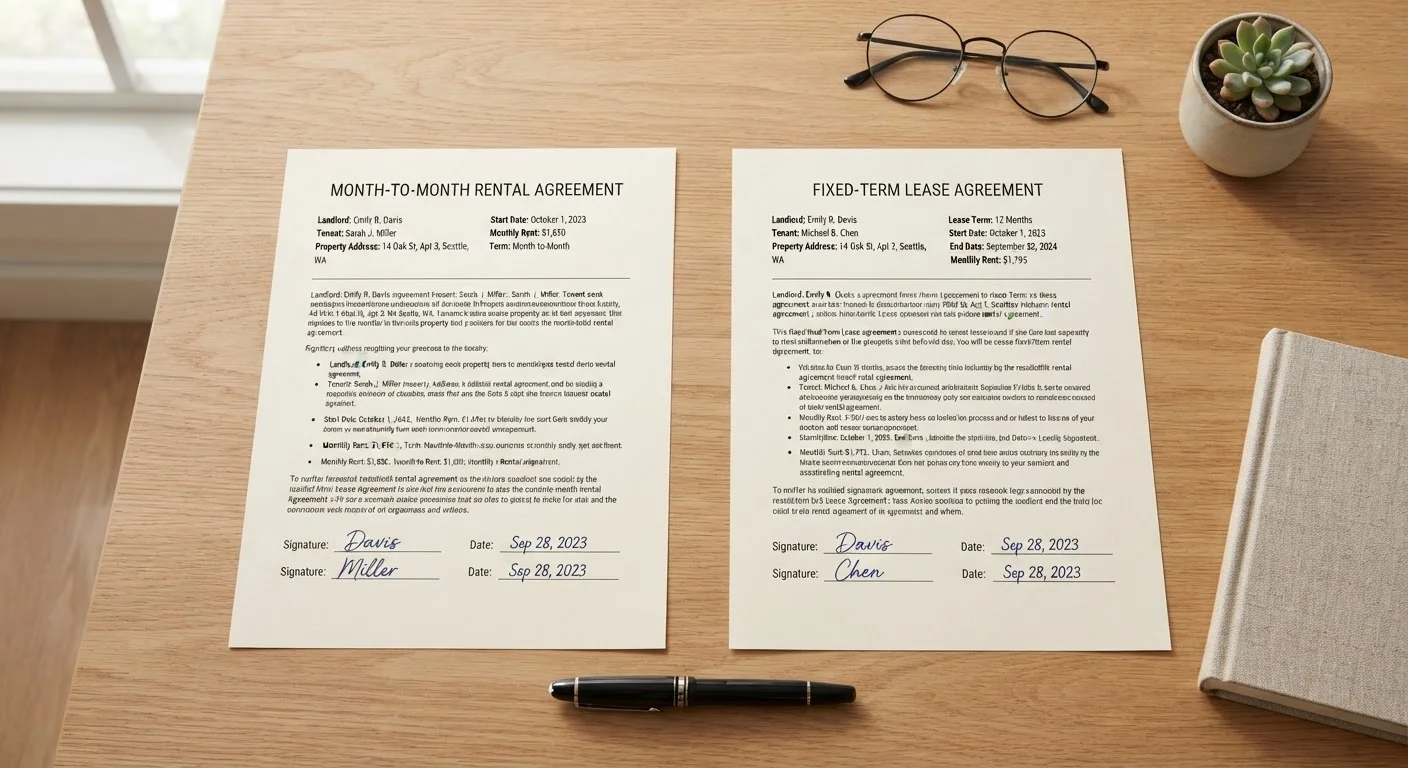
How Each Lease Structure Works
A fixed-term lease is a rental agreement that runs for a defined period — most commonly 12 months, though six-month and two-year terms exist. During that time, the rent amount and core lease conditions are generally locked in. Neither the landlord nor the tenant can unilaterally change the terms mid-lease without mutual agreement.
A month-to-month lease (also called a periodic tenancy) automatically renews each month unless either party gives written notice to end it. The notice period required varies by state, but 30 days is common for both parties. Some states require 60 days' notice from landlords depending on how long a tenant has occupied the unit.
Month-to-month arrangements often arise in two ways: a tenant signs one from the outset, or a fixed-term lease expires and transitions automatically to month-to-month if neither party acts. Understanding which situation applies to you matters, since the original lease terms may or may not carry over. See our explanation of common lease clauses for guidance on what language to look for.
| Criterion | Month-to-Month | Fixed-Term |
|---|---|---|
| Lease duration | Renews monthly until notice given | Set period (typically 6–12 months) |
| Rent predictability | Can change with proper notice | Locked in for the term |
| Typical rent level | Often higher than fixed-term | Often lower; stability premium |
| Notice to exit | Usually 30 days (varies by state) | Penalty or liability if early |
| Landlord income certainty | Lower — vacancy risk each month | Higher — guaranteed for term |
| Rent increase timing | Each renewal cycle (with notice) | Only at lease renewal |
| Best for tenants who... | Have uncertain timelines | Want stability and lower rent |
| Best for landlords who... | Want pricing flexibility | Want occupancy certainty |
Financial Implications for Tenants and Landlords
For tenants, a fixed-term lease typically means a lower monthly rent than a comparable month-to-month unit. Landlords often price the added flexibility of month-to-month arrangements into the rent — sometimes 10% to 20% higher, depending on the market — to offset the risk of short-notice vacancies. If rent predictability is a priority, fixed-term agreements generally offer a clearer picture for household budgeting.
Landlords, on the other hand, face a different calculus. A fixed-term lease locks in income but also locks in the rent rate, which can become a disadvantage if local rents rise significantly. Month-to-month arrangements allow landlords to adjust rent with proper notice at each renewal cycle, subject to local rent control ordinances. For a detailed look at how rent increases work legally, see our guide on what's normal and legal with rent increases.
~$1,500–$5,000
Estimated landlord cost per tenant turnover
Industry estimates from property management sources suggest vacancy, cleaning, and re-leasing costs commonly fall in this range, varying significantly by market and property size.
30 days
Most common notice period for month-to-month exit
The majority of U.S. states set 30 days as the minimum written notice required from either party to terminate a month-to-month tenancy, though some states require more.
Vacancy is a major cost for landlords. Turnover — cleaning, repairs, advertising, and weeks without rent — can easily cost thousands of dollars. Fixed-term leases reduce that risk significantly.
Flexibility and Exit Options
The clearest advantage of a month-to-month lease is exit flexibility. A tenant who receives a job offer in another city, or a landlord who wants to sell the property, can act relatively quickly within legal notice requirements. This is a meaningful advantage for anyone whose plans are uncertain.
Fixed-term leases are harder to exit early. Tenants who need to leave before the lease ends may face an early termination fee, liability for remaining rent until a new tenant is found, or both. Some leases include a buyout clause specifying the fee; others rely on state law defaults. Our article on breaking a lease early without making it worse walks through the typical legal pathways and how to minimize financial exposure.
State Law Governs Key Details
Notice requirements, allowable rent increase timelines, and early termination rules vary significantly by state and sometimes by city. What applies in California may differ sharply from Texas or New York. Always verify the rules in your jurisdiction before signing or terminating any lease agreement. Consulting a local tenant-rights organization or a licensed real estate attorney can help clarify your specific obligations.
Tenants considering subletting as a workaround should be aware that lease type affects subletting rights. See our coverage of what subletting involves for both parties for important caveats.
For the broadest view of the rental relationship — from signing to disputes — the complete guide to renting and leasing covers the full spectrum of landlord-tenant considerations.