What Each Term Actually Means
The two terms are often used interchangeably in casual conversation — even by some real estate professionals — but they describe very different processes with very different levels of reliability. Understanding the distinction is foundational to navigating the homebuying process confidently. For a broader primer on mortgage vocabulary, see our Home Loan Terminology Every Buyer Should Know.
Pre-Qualification
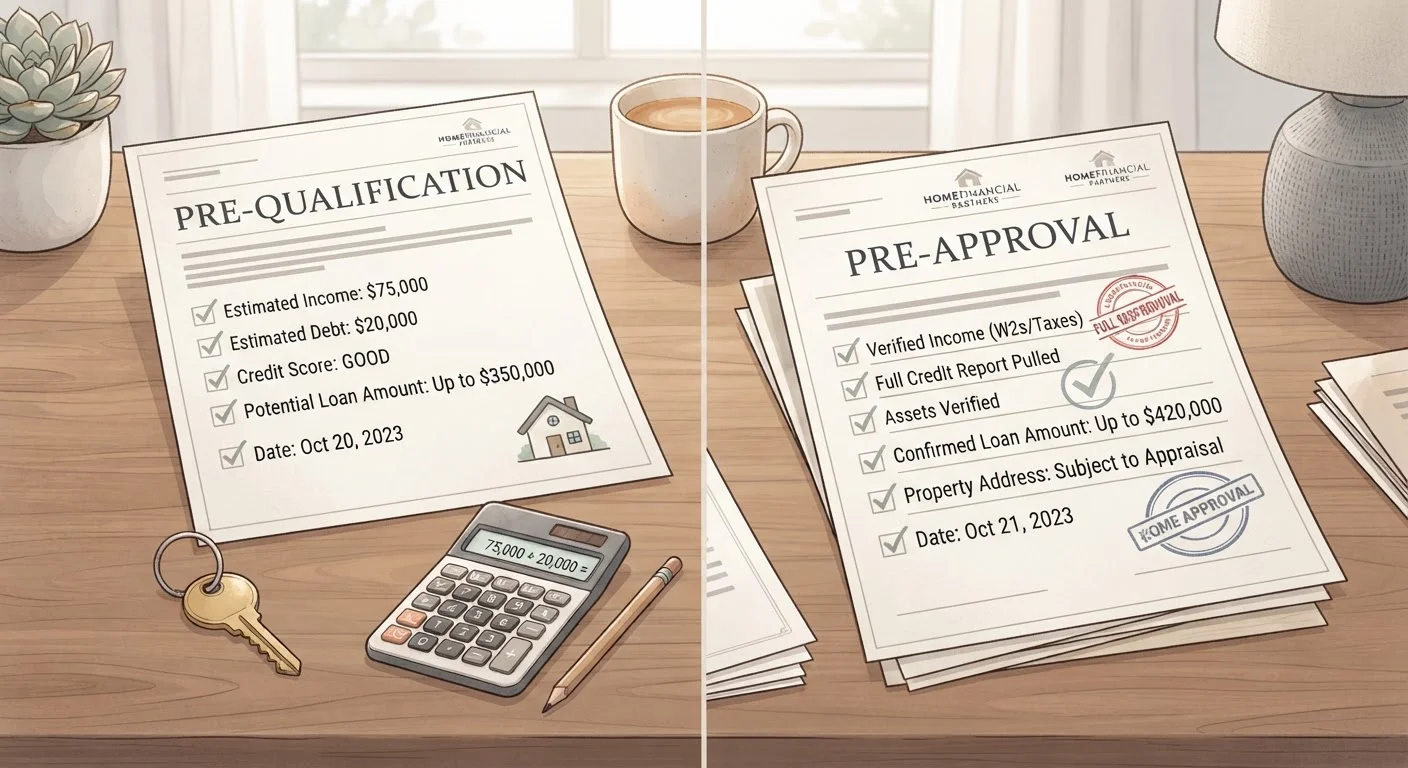
Pre-qualification is a preliminary estimate of how much you might be able to borrow. A lender asks you to self-report your income, assets, debts, and employment status — typically through a short online form or brief conversation. No documents are verified, and in most cases no credit report is pulled. The lender then gives you an estimate of a loan amount you may qualify for, based entirely on the information you provided.
Because nothing is verified, a pre-qualification letter carries limited weight. It signals that you've had a conversation with a lender, not that a lender has reviewed your finances.
Pre-Approval
Pre-approval is a more rigorous process. You submit documentation — pay stubs, W-2s or tax returns, bank statements, and authorization for the lender to pull your credit report — and a loan officer or underwriter reviews all of it. If the review is favorable, the lender issues a pre-approval letter stating a specific loan amount they are conditionally willing to lend you.
That word conditionally is important: pre-approval is not a guarantee of final loan approval. The lender will still need to evaluate the property you choose and complete full underwriting. But it does mean your financial profile has been reviewed and found credible.
How Sellers and Agents View Each One
From a seller's perspective, an offer accompanied by a pre-approval letter is materially different from one accompanied by a pre-qualification letter. Listing agents routinely advise their clients on this distinction, and in competitive markets, some sellers will not seriously consider offers that lack a verified pre-approval.
| Criterion | Pre-Qualification | Pre-Approval |
|---|---|---|
| Information Required | Self-reported income, assets, debts | Verified documents: pay stubs, tax returns, bank statements |
| Credit Check | Usually none (soft pull or no pull) | Hard credit inquiry required |
| Lender Review | Minimal — estimate only | Full financial review by loan officer |
| Time to Complete | Minutes to a few hours | Several days to one week, typically |
| Weight with Sellers | Low — shows buyer interest | High — shows buyer is financially vetted |
| Expiration | No formal expiration | Typically expires in 60–90 days |
| Guarantees Loan Approval? | No | No — underwriting still required |
The practical risk is straightforward: if you submit an offer with only a pre-qualification letter, the seller may accept a competing offer from a buyer with pre-approval — even if your price is similar. Pre-qualification says "I think I can borrow this much." Pre-approval says "A lender has reviewed my finances and agrees I likely qualify for this amount."
This dynamic is especially pronounced in markets with low inventory and multiple competing buyers. Our Mortgage Myths That Trip Up First-Time Buyers covers why many buyers mistakenly believe pre-qualification is sufficient — and how that assumption costs them deals.
The Trade-Offs: Credit, Timing, and Effort
Choosing which step to take first involves real trade-offs worth understanding.
60–90
Days a typical pre-approval remains valid
Most lenders require buyers to renew pre-approval documentation if the letter expires before a purchase contract is signed.
~5 pts
Typical temporary credit score impact of a hard inquiry
According to FICO, a single hard inquiry generally lowers a score by fewer than five points, and the effect typically fades within a few months.
Credit Impact
Pre-qualification generally involves no hard credit inquiry, so it won't affect your credit score. Pre-approval requires a hard pull, which can temporarily lower your score by a small number of points. However, multiple mortgage-related hard inquiries made within a short window — typically 14 to 45 days, depending on the credit scoring model — are often treated as a single inquiry. This means shopping multiple lenders during that window has minimal additional impact.
Timing and Expiration
Pre-approval letters are not open-ended. Most expire within 60 to 90 days, after which the lender will need to reverify your financial information. If you're searching in a slow market or not quite ready to make offers, it can make sense to pre-qualify first and then pursue pre-approval when you're closer to making a move.
Documentation Required
Gathering pay stubs, tax returns, bank statements, and other documentation takes time and effort. Buyers who start the pre-approval process early avoid last-minute scrambles when they find a home they want to pursue quickly. See our guide to The Home Buying Process, Explained from Offer to Closing for how pre-approval fits into the broader timeline.
Pre-Approval Is Conditional, Not Final
Even with a pre-approval letter in hand, your loan is not guaranteed. The lender must still evaluate the specific property you choose — including an appraisal — and complete full underwriting. Material changes to your finances (new debt, job change, large withdrawals) between pre-approval and closing can affect your eligibility. Avoid major financial moves during this period and stay in close contact with your loan officer.
This article is for general informational purposes only and does not constitute financial, mortgage, or legal advice. Consult a licensed mortgage professional or financial adviser for guidance specific to your situation.