
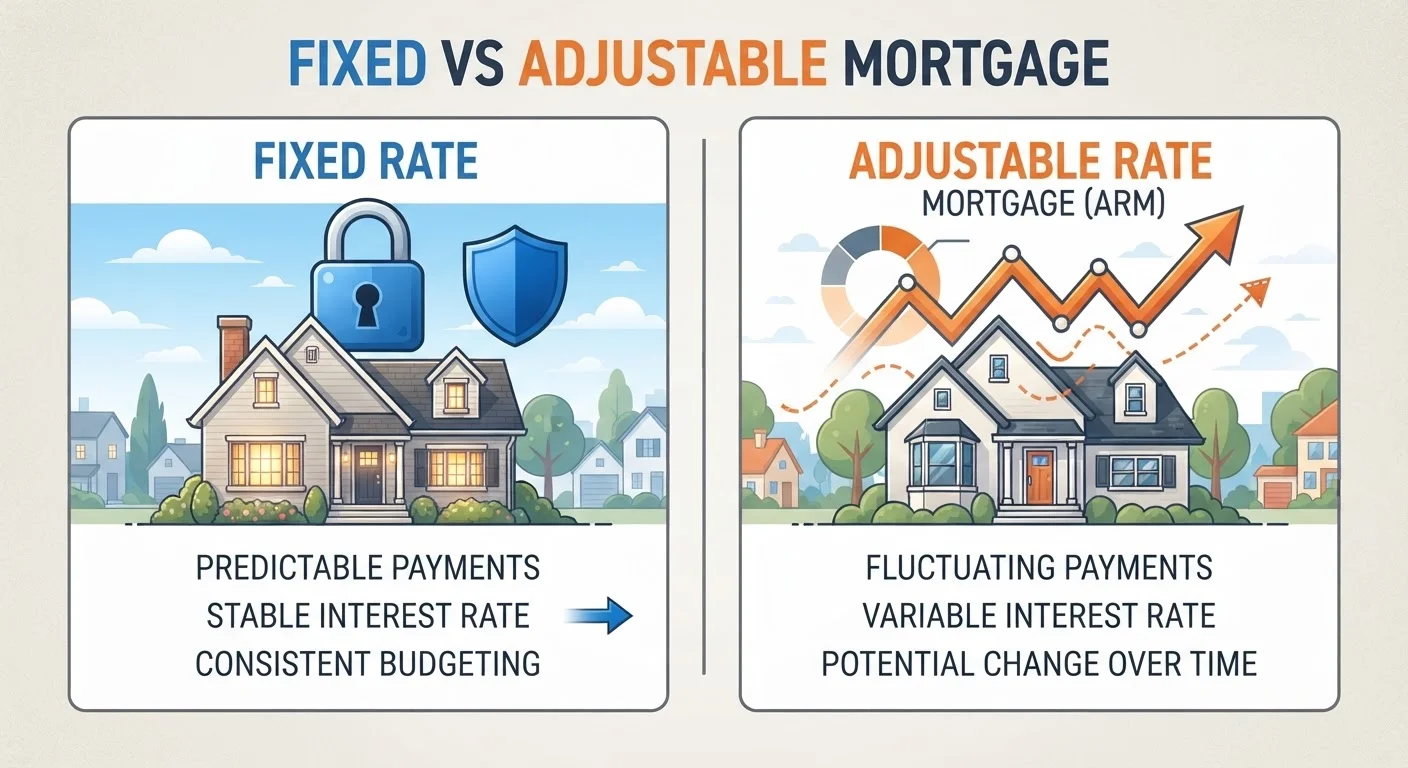
How Each Mortgage Type Is Structured
A fixed-rate mortgage sets your interest rate at closing and keeps it there for the life of the loan — whether that's 15, 20, or 30 years. Every monthly payment covers the same amount of interest and chips away at principal on a predetermined schedule. The only parts of your housing payment that can change over time are property taxes, homeowner's insurance, and (if applicable) private mortgage insurance — not the interest rate itself. For a deeper look at those additional costs, see what makes up a full mortgage payment.
An adjustable-rate mortgage (ARM) has two distinct phases. The first is a fixed introductory period — commonly 3, 5, 7, or 10 years — during which your rate does not change. After that, the rate adjusts at regular intervals (typically once per year) based on a published financial index, such as the Secured Overnight Financing Rate (SOFR), plus a lender-set margin. A 5/1 ARM, for example, holds its rate fixed for five years, then adjusts annually for the remaining loan term.
| Criterion | Fixed-Rate Mortgage | Adjustable-Rate Mortgage (ARM) |
|---|---|---|
| Interest rate over time | Locked for entire loan term | Fixed initially, then adjusts periodically |
| Monthly principal & interest | Never changes | Can rise or fall after initial period |
| Typical starting rate | Higher than ARM initial rate | Lower than fixed-rate equivalent |
| Rate risk | None — fully protected from increases | Rate can rise significantly after adjustment |
| Rate caps | Not applicable | Initial, periodic, and lifetime caps apply |
| Best holding period | Long-term (10+ years) | Short-to-medium term (3–7 years) |
| Payment predictability | Very high | Low after initial period ends |
What Determines Your ARM Rate After the Initial Period
When an ARM enters its adjustment phase, the new rate is calculated using a benchmark index plus a fixed margin your lender sets at origination. If the index rises, your rate rises; if it falls, your rate falls. To understand the broader economic forces at play, it helps to learn how mortgage rates are set and what borrowers can influence.
Lenders are required to disclose three key rate caps on every ARM:
- Initial adjustment cap: limits how much the rate can change at the first adjustment (often 2–5 percentage points).
- Periodic adjustment cap: limits how much the rate can change at each subsequent adjustment (commonly 2 percentage points).
- Lifetime cap: limits the maximum rate increase over the life of the loan (typically 5–6 percentage points above the initial rate).
These caps provide important protections, but they do not eliminate risk. A borrower who starts at 5% could legally see a rate as high as 10–11% if all caps are reached over time.
5/1
Most common ARM structure in the U.S.
According to Freddie Mac and industry mortgage data, the 5/1 ARM — fixed for five years, then annually adjustable — has historically been the most widely originated ARM product.
~5–6%
Typical ARM lifetime rate cap above start rate
Federal regulations and standard ARM disclosures generally show lifetime caps of 5–6 percentage points above the initial rate, though specific terms vary by lender and product.
30-Year Fixed
Most common U.S. mortgage product
The 30-year fixed-rate mortgage consistently accounts for the majority of mortgage originations in the United States, according to Freddie Mac's Primary Mortgage Market Survey data.
The Real Cost Difference: Starting Rate vs. Long-Term Certainty
ARMs are typically offered at a lower initial interest rate than comparable fixed-rate loans. That gap can translate into meaningful monthly savings during the introductory period — but those savings come with a trade-off. If you keep the home and the loan long enough for several adjustments to occur in a rising-rate environment, the total interest paid over the life of an ARM could substantially exceed what a fixed-rate loan would have cost.
Conversely, in a declining rate environment, an ARM borrower may benefit from lower payments without refinancing, while a fixed-rate borrower's payment stays the same regardless of what happens in the market. The fixed-rate loan functions much like a fixed expense in a household budget — its predictability makes planning easier, even if it isn't always the lowest-cost option in hindsight.
Some borrowers use mortgage discount points to lower the starting rate on a fixed loan, narrowing the gap with ARM pricing. Mortgage points involve upfront costs at closing in exchange for a reduced rate, so weigh break-even timelines carefully.
Refinancing Is an Option — But Not a Guarantee
Some borrowers choose an ARM intending to refinance before the adjustment period begins. This strategy can work, but it depends on your financial situation, prevailing rates, and lender requirements at the time you refinance. There is no guarantee that refinancing will be available or advantageous when you need it. Always plan for the possibility that you may keep the loan beyond its initial period.
Choosing Based on Your Situation, Not Just the Rate
Neither mortgage type is universally better. The right choice depends on how long you plan to hold the loan, your risk tolerance, and where rates stand relative to historical norms. A few practical questions to work through:
- How long will you realistically stay? If a relocation or life change is likely within five to seven years, the ARM's introductory savings may be fully captured before any adjustment occurs. If you're building long-term roots, a fixed rate's certainty generally wins.
- Can your budget absorb a higher payment? Stress-test yourself against the ARM's lifetime cap. If the maximum possible payment would strain your finances, a fixed rate eliminates that scenario.
- What is your overall loan term? The interaction between rate type and loan length matters. A 15-year vs. 30-year loan structure shapes total interest paid just as significantly as your rate type.
A licensed mortgage professional can model both scenarios using your specific loan amount, expected tenure, and current rate offerings. This article provides general educational context — not personalized financial advice. Consult a qualified lender or financial adviser before making a borrowing decision.