
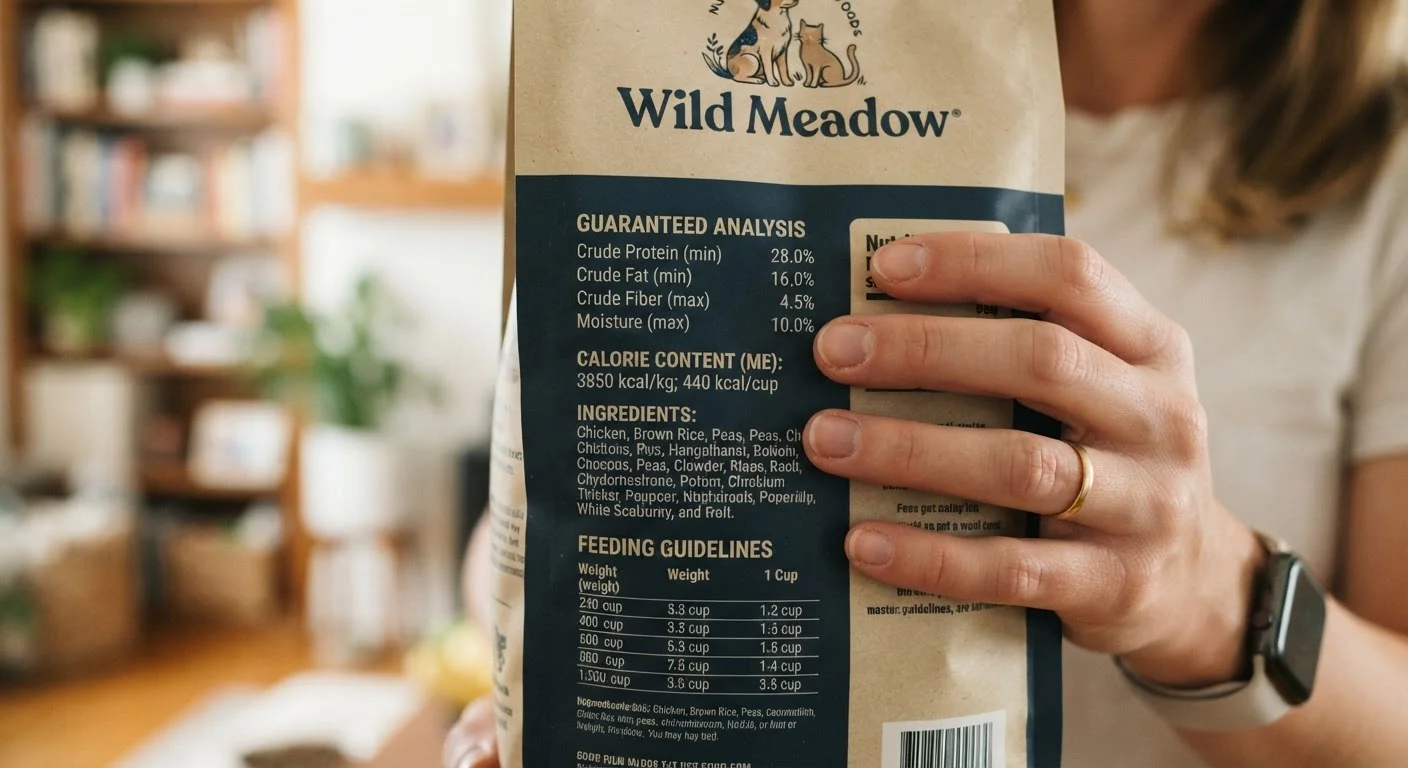
Why Pet Food Labels Are Worth Understanding
Pet food packaging is regulated at both the federal and state level, which means labels contain more structured, verifiable information than most grocery-store product packaging — if you know where to look. The challenge is that regulated content sits alongside marketing language, and the two can be easy to confuse.
Understanding what each section of a label is legally required to tell you — and what it's not required to disclose — puts you in a much stronger position as a consumer. It also helps you filter out claims that sound authoritative but carry little nutritional weight. For a broader foundation on what your pet actually needs from their diet, the complete picture of pet nutrition is a useful companion resource.
Labels Are a Starting Point, Not the Full Picture
No label can capture every variable affecting your individual pet — age, activity level, underlying health conditions, and body condition score all influence how much and what type of food is appropriate. Use what you learn here as an informed starting framework, then discuss specific dietary decisions with your veterinarian. This article provides general educational information, not personalized nutritional advice.
What You'll Need Before You Start
What you will need
The pet food bag or can
The primary source of all regulated label information you'll be evaluating.
Manufacturer's website or customer service line
Useful for obtaining exact nutrient analyses and sourcing details not required on the label itself.
Your veterinarian or a board-certified veterinary nutritionist
The appropriate professional resource for translating label data into personalized feeding guidance.
You don't need any specialized background to work through this process. Having a specific bag or can in hand makes the steps more concrete — labels vary enough between manufacturers that abstract examples are less useful than working with a real product.
How to Read a Pet Food Label Step by Step
Find the AAFCO Nutritional Adequacy Statement
Look for a sentence that typically reads something like: "[Product name] is formulated to meet the nutritional levels established by the AAFCO Dog (or Cat) Food Nutrient Profiles for [life stage]." AAFCO — the Association of American Feed Control Officials — sets the minimum nutritional standards that pet foods sold in the US must meet to be called "complete and balanced."
This statement tells you two critical things: whether the food is nutritionally complete, and which life stage it's designed for (growth/puppy or kitten, adult maintenance, all life stages, or senior). A food labeled for "all life stages" meets the higher threshold set for growth and reproduction — meaning it's appropriate for most pets but may contain more calories than a sedentary adult needs.
If the label carries no AAFCO statement at all, the product is a treat or supplement, not a complete diet — do not use it as a sole food source.
Read the Ingredient List Critically
Ingredients are listed in descending order by weight before cooking. This matters because whole meats contain significant moisture, which makes them heavier — and thus higher on the list — than they would be on a dry-weight basis. A whole chicken listed first may contribute less actual protein than a concentrated chicken meal listed third.
Look for named protein sources (chicken, salmon, beef) rather than vague terms like "meat" or "poultry." Similarly, named fat sources (chicken fat) are preferable to unspecified ones. The presence of multiple grain or carbohydrate sources listed separately — for example, ground corn, corn gluten meal, and corn bran as three distinct entries — can indicate a higher total contribution from that ingredient than any single entry suggests.
For a deeper look at how ingredient quality maps to your pet's overall nutrition, see the six nutrients every pet diet should cover.
Interpret the Guaranteed Analysis Panel
The guaranteed analysis (GA) lists minimum percentages of crude protein and crude fat, and maximum percentages of crude fiber and moisture. These are regulatory guarantees — minimums and maximums set to protect consumers — not precise measurements of what's actually in the bag on any given day.
One important limitation: the GA doesn't tell you about protein quality. A food can meet a minimum protein percentage using lower-digestibility sources. The GA also makes direct comparisons between dry and wet foods difficult, because moisture content differs dramatically. To compare them accurately, you'd need to calculate nutrients on a dry-matter basis — divide each nutrient percentage by the percentage of dry matter (100 minus moisture %) to get a like-for-like figure.
For a broader comparison of how dry and wet formulas differ nutritionally, see our article on dry kibble vs. wet food.
Decode Marketing Claims on the Front of the Bag
Front-of-bag language is where marketing has the most room to operate. Terms like "natural," "holistic," "human-grade," and "grain-free" sound meaningful but carry limited regulatory definition. AAFCO has a working definition for "natural" — it generally excludes chemically synthesized ingredients — but "holistic" has no regulatory meaning whatsoever.
"Grain-free" simply means the food substitutes other carbohydrate sources (often legumes or potatoes) for grains. It is not synonymous with low-carbohydrate or higher-quality. The FDA has investigated a possible link between grain-free diets and dilated cardiomyopathy (an enlarged heart condition) in dogs, though research is ongoing and causation has not been established.
For a fuller look at which claims hold up to scrutiny, see pet food claims that sound scientific but aren't.
Check the Feeding Guidelines and Adjust for Your Pet
Feeding guidelines appear as a chart or table, typically organized by body weight. Treat these as a starting range, not a fixed prescription. Manufacturers design guidelines for average, moderately active animals — your pet's actual needs may be higher or lower depending on age, reproductive status, activity level, and health conditions.
Begin at the lower end of the suggested range for your pet's current weight, then observe body condition over two to four weeks. If your pet's ribs become difficult to feel, reduce the amount slightly. If they become too prominent, increase it. Your veterinarian can show you how to assess body condition score — a simple hands-on method that's more reliable than the scale alone.
Use the Label as a Shortlist, Then Go Deeper
A label tells you a lot, but not everything. It won't tell you about a manufacturer's quality control practices, sourcing standards, or recall history. Once you've used the label to narrow your options to foods that are AAFCO-compliant for your pet's life stage, consider contacting the manufacturer directly to ask about nutrient testing frequency, ingredient sourcing, and whether they employ a board-certified veterinary nutritionist.
For a structured approach to evaluating a new food from start to finish, use the pet food evaluation checklist. And for broader context on how food choices fit into your pet's overall health, the Pet Nutrition hub covers everything from macronutrient science to meal scheduling.
Feeding Guidelines Can Be Misleading
Manufacturers calculate feeding amounts based on average animals, and their estimates often skew toward the higher end. Feeding your pet significantly more than their actual caloric need over time is a common contributor to weight gain. Always verify portion sizes with your vet and adjust for your pet's specific weight, age, and activity level. See our guide on why portion size is routinely underestimated for more detail.
Putting It All Together
Reading a pet food label well is a skill that compounds over time. The first bag takes longer; by the third or fourth, checking the AAFCO statement, scanning the ingredient list for named proteins, and mentally discounting front-of-bag marketing language becomes second nature.
No label can replace a conversation with your veterinarian, particularly if your pet has a health condition, is a senior, or is experiencing digestive or skin issues that may have a dietary component. Use labels to narrow your options to nutritionally sound candidates, then bring those candidates to your vet for a final check.
When in Doubt, Ask Your Vet
If a label raises questions you can't resolve — unfamiliar ingredients, conflicting claims, or a formula change — bring the bag to your next veterinary appointment. Vets and veterinary nutritionists can interpret label information in the context of your pet's health history, which no label can do on its own.
This article is for general informational and educational purposes only and does not constitute veterinary or nutritional advice. Always consult a licensed veterinarian for guidance specific to your pet's health and dietary needs.