Why Filter Type Matters
Not all water filtration systems work the same way, and not all tap water has the same problems. Municipal water supplies in the U.S. are regulated under the Safe Drinking Water Act, but treated water can still contain trace levels of chlorine, lead (often from household pipes), sediment, and other compounds. Well water presents its own distinct challenges, including bacteria, nitrates, and iron.
Choosing the right filter starts with knowing what's actually in your water. Your local utility is required to publish an annual Consumer Confidence Report, and independent test kits are widely available. Once you know your contaminants, you can match them to a system certified to address them - specifically, filters carrying NSF/ANSI certifications, which are independently verified performance standards.
Beyond contaminant removal, the practical factors - installation complexity, filter replacement costs, water volume needs, and whether you rent or own - all shape which system makes sense.
Pitcher Filters
Pitcher filters are the most accessible entry point into home water filtration. They require no installation, work in any living situation, and have a low upfront cost. Most use activated carbon to reduce chlorine taste, odor, and some organic compounds. Certain models are certified to also reduce lead and other heavy metals.
The limitations are meaningful: pitchers filter water slowly (typically 1-2 cups per minute), hold limited volume (usually 6-12 cups), and require cartridge replacement every 40-200 gallons depending on the model. Over a year, replacement filter costs can exceed the pitcher's original price. They are not well-suited for households with high daily water demand.
Check the Certification, Not Just the Claim
Marketing labels like "advanced filtration" or "removes 99% of impurities" are not independently verified. Before purchasing any filter, look for a specific NSF/ANSI certification number on the packaging or the manufacturer's website. The NSF International database lets you search certified products by contaminant and standard.
Faucet-Mount Filters
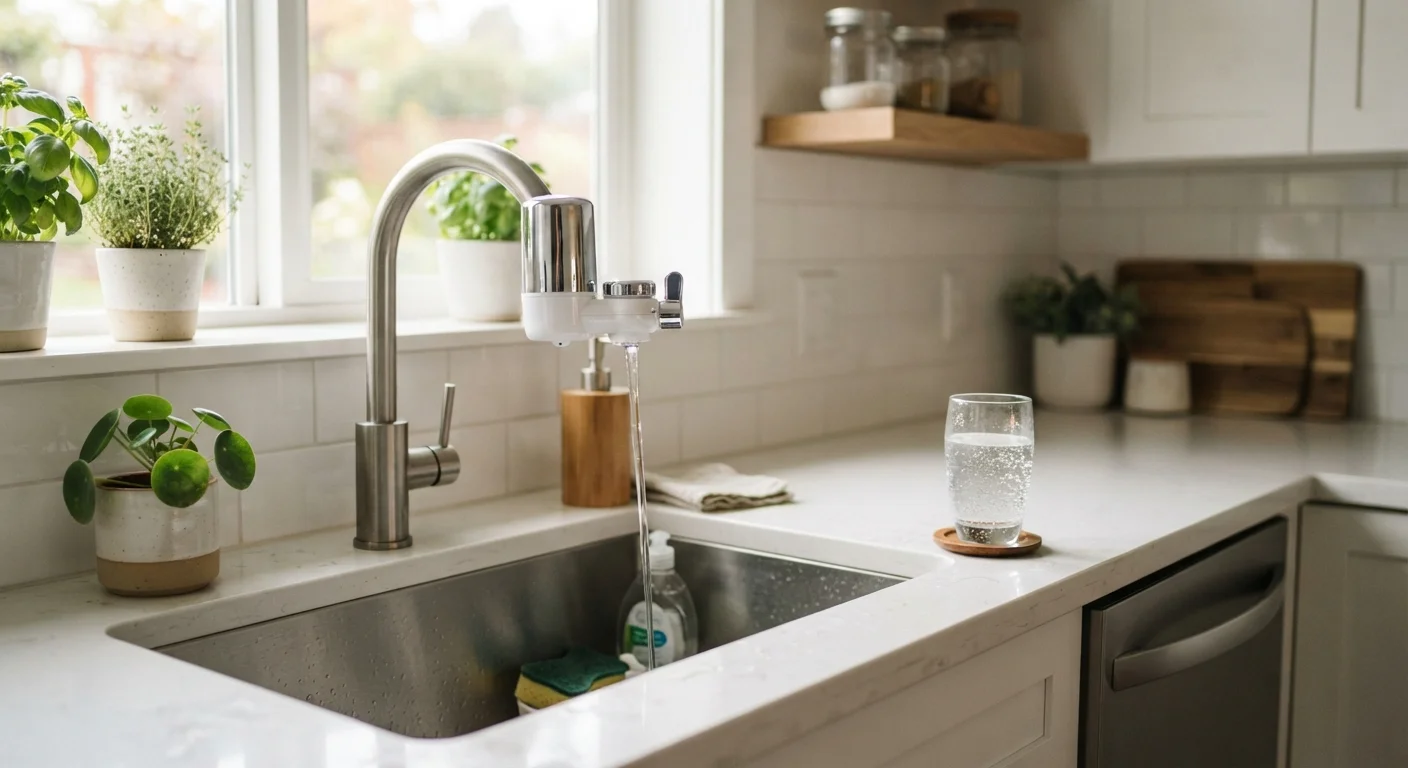
Faucet-mount filters attach directly to a standard kitchen tap and let you switch between filtered and unfiltered water on demand. They use activated carbon filtration and are certified by NSF/ANSI Standard 42 (aesthetic effects like chlorine) and some by Standard 53 (health effects including lead). Setup requires no tools in most cases.
These filters work at a faster flow rate than pitchers and cost relatively little upfront. However, they don't fit all faucet types - pull-out and pull-down spray faucets are typically incompatible. Filter cartridges usually need replacement every 100-200 gallons. They also add visible bulk to the faucet, which some users find inconvenient.
Under-Sink Filters
Under-sink systems are installed below the kitchen counter and connect directly to the cold-water supply line, typically delivering filtered water through a dedicated tap. Many use multi-stage filtration - combining sediment pre-filters, activated carbon, and in some cases reverse osmosis (RO) membranes - which broadens the range of contaminants addressed significantly.
Reverse osmosis systems, a common under-sink option, are certified to reduce a wide array of contaminants including lead, arsenic, nitrates, fluoride, and certain pharmaceuticals. The trade-off: RO systems waste some water in the filtration process (ratios vary by model), require more maintenance, and cost more upfront - often $150-$500 or more for the unit, plus professional installation in some cases. For households that consume significant filtered water daily, the per-gallon cost over time is generally lower than pitchers.
| Pitcher | Faucet-Mount | Under-Sink | Whole-House | |
|---|---|---|---|---|
| Installation required | None | Minimal (tool-free) | Moderate to complex | Professional plumber |
| Upfront cost range | $20-$60 | $25-$80 | $150-$600+ | $300-$3,000+ |
| Filter replacement frequency | Every 40-200 gal. | Every 100-200 gal. | Every 6-12 months | Every 3-12 months |
| Contaminant coverage | Moderate | Moderate | High (RO: very high) | Varies by type |
| Suitable for renters | Yes | Usually yes | Possible with care | No |
| Whole-home coverage | No | No | No | Yes |
| Water flow impact | Slow fill | Slight reduction | Minimal at tap | Minimal |
Whole-House Filters
Whole-house systems (also called point-of-entry filters) are installed on the main water line entering the home, so every faucet, shower, and appliance receives filtered water. This makes them particularly valuable where the concern extends beyond drinking water - for example, chlorine that affects showering, or sediment that damages appliances and plumbing.
These systems vary widely in what they address. Basic sediment and carbon systems protect appliances and improve taste and odor throughout the home. Specialized systems can address iron, sulfur, hardness (water softeners), or bacteria in well water. Installation requires a licensed plumber, and costs typically range from several hundred to several thousand dollars depending on system complexity.
Whole-House Systems Don't Replace Point-of-Use Filters for Drinking
A sediment or carbon whole-house filter improves water quality throughout the home but may not reduce all drinking-water contaminants to the same extent as a dedicated under-sink or RO system. If your primary concern is drinking water safety - particularly lead or nitrates - a point-of-use system at the kitchen tap may still be warranted alongside a whole-house setup.
For households concerned with both air and water quality, it's worth noting that water filtration addresses dissolved and particulate contaminants in drinking water, while separate technologies handle indoor air. Our article on air purifiers vs. dehumidifiers covers parallel decisions for improving indoor air quality.
Making the Right Choice
When evaluating water filtration systems, four factors matter most:
- Contaminant profile: Test your water or review your utility report before committing to any system.
- Volume needs: Higher daily consumption favors under-sink or whole-house systems over pitchers.
- Living situation: Renters benefit from portable, non-invasive options; homeowners have the full range available.
- Total cost of ownership: Factor in cartridge/membrane replacement frequency and costs, not just the purchase price.
Always look for NSF/ANSI certification specific to the contaminants you want removed - NSF 42 covers aesthetic reduction, NSF 53 covers health-based reduction, and NSF 58 covers reverse osmosis systems. A certified filter for the right problem is far more useful than an uncertified system with broader marketing claims.
~286M
Americans served by community water systems
According to the U.S. EPA, the vast majority of Americans receive water from regulated community systems covered by federal standards.
NSF 53
Certification for health-effects reduction
NSF/ANSI Standard 53 is the benchmark certification verifying a filter reduces specific health-related contaminants such as lead or cryptosporidium.