What Each Device Actually Does
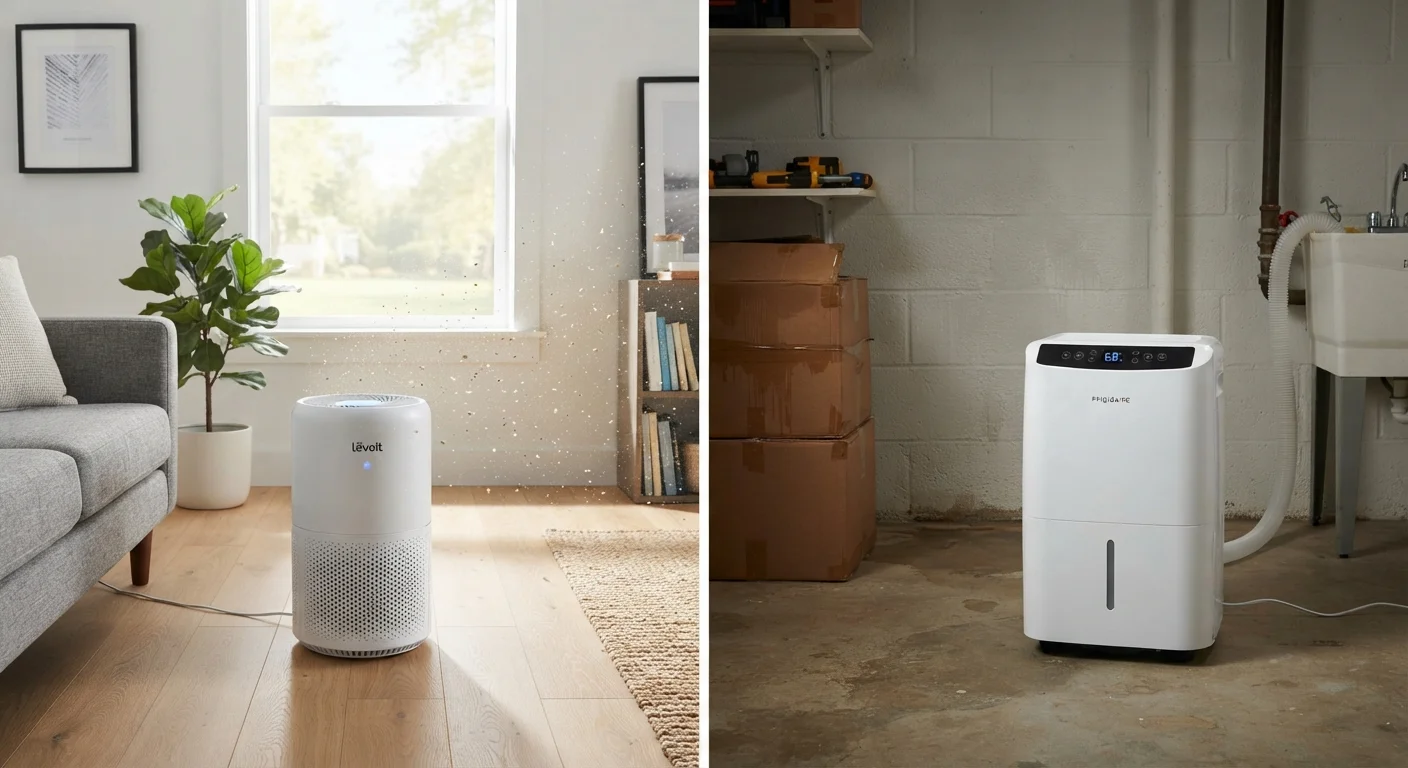
Despite both being marketed as indoor air quality solutions, air purifiers and dehumidifiers work on entirely different problems.
An air purifier draws air through one or more filters - commonly a HEPA (High-Efficiency Particulate Air) filter and an activated carbon layer - and traps or neutralizes airborne particles and gases. This includes dust, pollen, pet dander, smoke, volatile organic compounds (VOCs), and mold spores already floating in the air. The purified air is then circulated back into the room. Air purifiers do not remove moisture or affect humidity levels.
A dehumidifier pulls humid air over a cold coil, causing water vapor to condense into liquid, which drains into a collection tank or hose. The drier air is returned to the room. This process lowers relative humidity - the percentage of water vapor in the air - but does not filter out particles or pollutants. A dehumidifier makes the environment less hospitable to mold, dust mites, and bacteria that thrive in moisture-rich conditions.
| Criterion | Air Purifier | Dehumidifier |
|---|---|---|
| Primary function | Filters airborne particles and pollutants | Removes excess moisture from air |
| Targets | Dust, pollen, dander, smoke, VOCs | Humidity, mold conditions, condensation |
| Affects humidity | No | Yes - reduces relative humidity |
| Filters particles | Yes - via HEPA and carbon filters | No |
| Ongoing maintenance | Filter replacements every 6-12 months | Tank emptying, coil and tank cleaning |
| Best room placement | Bedrooms, living areas, offices | Basements, bathrooms, humid spaces |
| Heat output | Minimal | Moderate - generates some warmth |
Identifying Your Actual Indoor Air Problem
Choosing between these devices starts with correctly diagnosing what's bothering you.
Signs you likely need an air purifier:
- Allergy or asthma symptoms that worsen indoors
- Visible dust accumulation on surfaces despite regular cleaning
- Pet odors or dander affecting air quality
- Smoke exposure from cooking, tobacco, or nearby wildfires
- Concern about VOCs from new furniture, flooring, or paint
Signs you likely need a dehumidifier:
- Relative humidity consistently above 50% (measurable with a hygrometer)
- Condensation forming on windows or cold surfaces
- Musty or earthy smell in basements, bathrooms, or closets
- Visible mold or mildew on walls, grout, or ceilings
- Warping wood floors or peeling wallpaper
Overlapping Symptoms Can Be Misleading
Mold spores, dust mites, and high humidity can all produce similar respiratory irritation and allergy-like symptoms. A hygrometer (humidity meter) costs very little and can confirm whether moisture is a contributing factor before you decide on equipment. If symptoms are severe or persistent, consult a qualified healthcare professional rather than relying solely on device selection.
Some symptoms overlap - for instance, mold spores in the air can trigger the same respiratory response as pollen. If you're experiencing persistent symptoms, consulting a qualified healthcare professional or a certified indoor air quality specialist can help pinpoint the source before you invest in equipment.
Key Differences at a Glance
Understanding the practical distinctions helps set realistic expectations. Neither device is a universal fix, and each has meaningful limitations.
Air purifiers require ongoing filter replacements - HEPA filters typically need changing every 6-12 months depending on usage and air quality. Running costs include both electricity and replacement filters. Coverage area is also limited; a unit rated for 300 square feet won't meaningfully improve air quality across an open-plan 1,000-square-foot space.
Dehumidifiers require emptying the water collection tank regularly (some models connect to a drain for continuous operation) and periodic cleaning of the coils and tank to prevent bacterial growth. They consume more electricity than most air purifiers and generate some heat as a byproduct - a consideration in warmer months.
30-50%
Recommended indoor relative humidity range
The U.S. Environmental Protection Agency advises maintaining indoor humidity in this range to limit mold growth and dust mite activity.
99.97%
Particle capture rate of true HEPA filters
HEPA filters meeting the standard capture 99.97% of particles at 0.3 microns - the most penetrating particle size - according to the U.S. Department of Energy standard.
Just as different water quality concerns call for different solutions - much like the range of options covered in our guide to home water filtration types - indoor air problems call for targeted tools rather than one-size-fits-all devices.
When Using Both Makes Sense
In some households, both devices serve complementary roles. A dehumidifier in a basement reduces the moisture that lets mold grow; an air purifier in the main living areas captures the spores that do become airborne before residents inhale them. Similarly, in climates with both high humidity and high pollen seasons, each device addresses a distinct seasonal concern.
That said, running both simultaneously in the same room is generally redundant - and costly. A more practical approach is to assess each problem space individually, deploy the appropriate device where it's most needed, and monitor results using a hygrometer for humidity and air quality monitors for particulate levels.
Neither device replaces addressing root causes: improving ventilation, sealing moisture entry points, eliminating pollution sources, and maintaining HVAC systems are foundational steps that improve the effectiveness of any supplemental device.