What a Bank Statement Is — and Why It Matters
A bank statement is an official record your financial institution produces — typically monthly — summarizing every transaction that passed through your account during a set period. It is not a budget, a credit report, or a receipt; it is a chronological ledger of your account activity that the bank is legally required to make available to you.
Reading it carefully serves several practical purposes: it lets you catch billing errors and fraudulent charges, verify that your paycheck and automatic payments posted correctly, and understand exactly what fees you're paying. Many consumers skim or ignore their statements entirely — a habit that can make small problems grow unnoticed. If you're just getting started with bank accounts, our article on opening your first bank account walks through the basics. For readers who want a broader picture of their financial records, understanding your credit report is a natural companion read.
What you will need
How to Read Your Statement Step by Step
Work through the steps below using your most recent statement. The process takes most people 10–20 minutes and pays dividends in financial awareness.
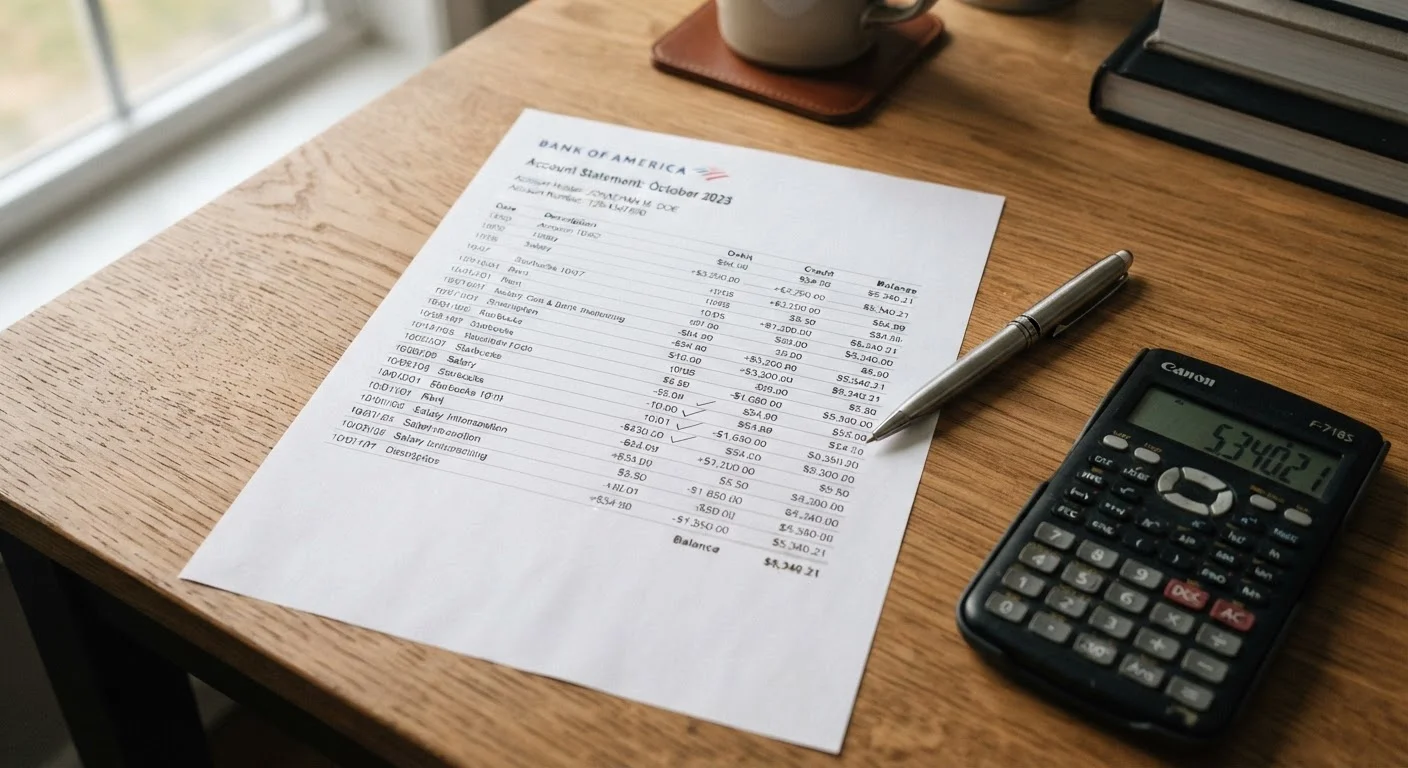
Bank Statement (Paper or Digital)
The primary document you will read and verify against your own records.
Personal Transaction Log or Budgeting App
Used to cross-reference statement entries against your own spending records.
Account Fee Schedule
Lists all fees your account type may incur, so you can verify charges are legitimate.
Locate and Identify the Statement Header
At the top of every bank statement you will find the statement period (e.g., June 1–June 30), your account number (usually partially masked), and the bank's name and contact information. Confirm the account number matches the account you intended to review — households with multiple accounts sometimes mix statements up.
Check the Opening and Closing Balances
The opening balance is the amount in your account at the start of the period; the closing balance reflects what remained at the end. Confirm the opening balance matches the closing balance from your previous statement — a discrepancy here warrants immediate follow-up with your bank.
Review All Deposits and Credits
Every inflow — direct deposits, transfers in, interest earned, refunds — should appear in the credits column. Match each entry to a known source: payroll deposit, government benefit, peer-to-peer transfer, or refund. Flag any credit you cannot identify; unexpected deposits can sometimes be errors that the bank will later reverse, temporarily inflating your balance.
Decode Withdrawals and Debits
Debits include debit card purchases, ATM withdrawals, bill payments, and electronic transfers. Merchant names on statements are often abbreviated billing descriptors set by the business, not always the name you recognize from the storefront. If a descriptor is unclear, search it online combined with the dollar amount — this resolves most mysteries. Check that every debit aligns with a purchase you made or a recurring bill you authorized.
Scrutinize Every Fee Line
Banks may charge monthly maintenance fees, minimum balance fees, ATM out-of-network fees, paper statement fees, wire transfer fees, and overdraft fees. Compare each fee against your account's fee schedule to confirm it was applied correctly. If you were charged a fee you believe you shouldn't owe — for example, you met the minimum balance requirement — gather your documentation and contact the bank. Many routine fees are waivable when disputed politely and with evidence. For a deeper look at one of the most common charges, see our guide on how overdraft fees work and how to avoid them.
Flag and Report Any Discrepancies
Make a list of any transactions you cannot verify or did not authorize. Contact your bank's customer service — by phone, secure message, or branch visit — and initiate a formal dispute for each flagged item. Keep a written record of your dispute, including the date, the representative's name, and any reference or case number provided.
Dispute Errors Within Your Bank's Window
Most banks require you to report unauthorized or erroneous transactions within 60 days of the statement date. Missing that window can limit your ability to recover funds. Check your account agreement for the exact deadline that applies to your account type.
Never Ignore Unfamiliar Transactions
A charge you don't recognize — even a small one — can signal the beginning of fraudulent activity. Bad actors sometimes test stolen card details with micro-transactions before attempting larger ones. Contact your bank immediately if anything looks suspicious.
Go Paperless for Easier Search
Digital statements let you search by keyword, date, or amount in seconds. Most banks retain online statements for at least 12 months, making year-end budget reviews much faster. Enrolling also reduces the risk of paper statements being intercepted.
Common Codes and Abbreviations Explained
Statements are often dense with shorthand. Here are some of the most frequently encountered codes and what they mean:
| Code / Label | Meaning |
|---|---|
| ACH | Automated Clearing House — an electronic bank-to-bank transfer, commonly used for payroll and bill payments |
| POS | Point of Sale — a debit card purchase made at a physical or online merchant |
| NSF | Non-Sufficient Funds — a transaction was attempted when the balance was too low; often triggers a fee |
| OD | Overdraft — your account went negative; the bank may have covered the transaction and charged a fee |
| CR | Credit — money added to your account |
| DR | Debit — money removed from your account |
| Int Pd | Interest Paid — interest earned on a savings or money market balance |
Your institution may use slightly different terminology. When in doubt, your account agreement or the bank's FAQ section will define any codes specific to their platform. Staying on top of these details also puts you in a stronger position if you ever decide to switch banks.
This article is for general informational purposes only and does not constitute financial or legal advice. Consult a qualified financial professional for guidance specific to your situation.