
Why These Two Terms Get Mixed Up
Both the deductible and the out-of-pocket maximum are spending limits that appear on nearly every health insurance plan. That's where most of the confusion starts — they sound like they do the same thing. They don't.
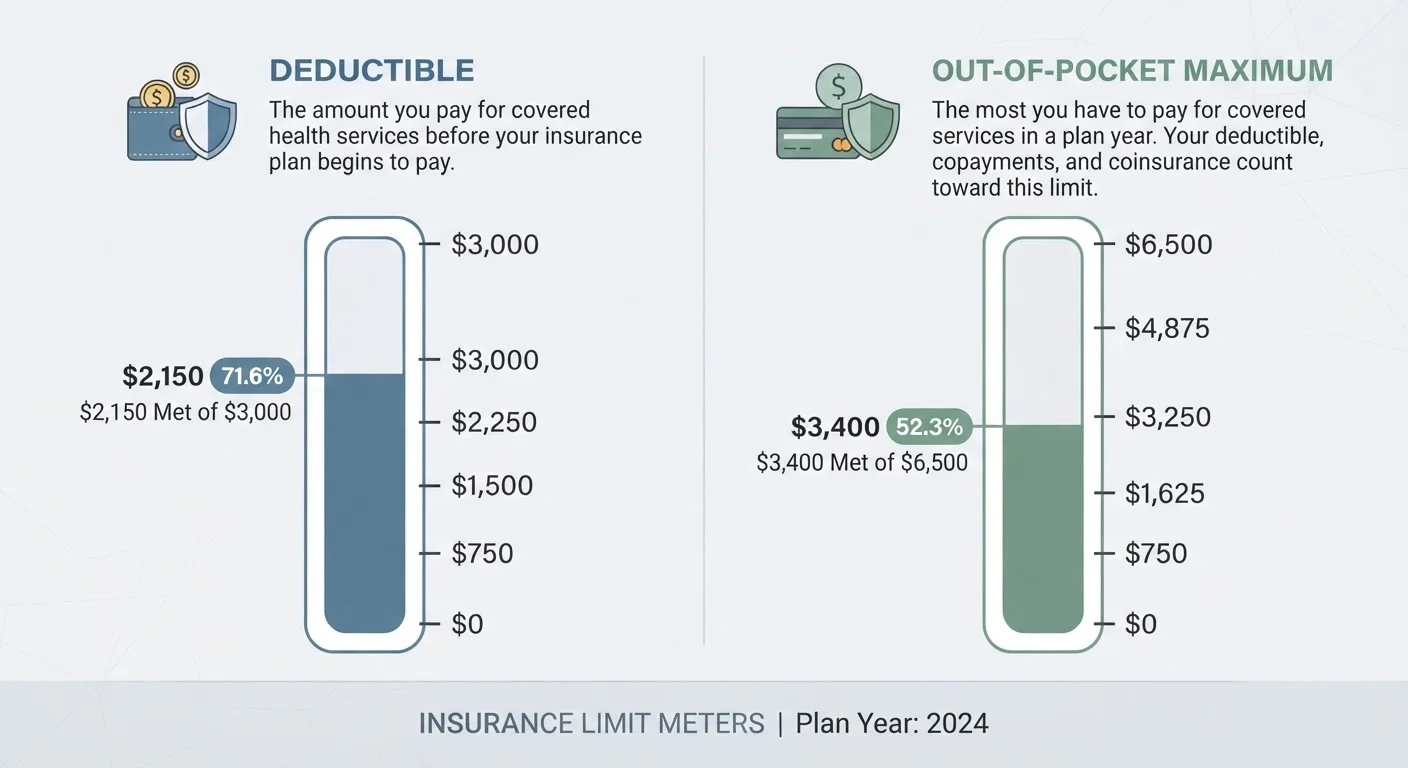
A deductible is the amount you pay for covered services before your insurance plan begins sharing the cost. If your deductible is $1,500, you pay the first $1,500 of covered medical bills each year. After that, your insurer generally starts paying its share — but you're often still responsible for copays (a fixed fee per visit) and coinsurance (a percentage of each bill).
An out-of-pocket maximum (sometimes called an out-of-pocket limit) is the absolute most you can be required to pay for covered services in a plan year. Once your spending reaches that cap — including what you paid toward your deductible, plus any copays and coinsurance — your insurer covers 100% of covered costs for the rest of the year.
For a broader foundation on how these figures fit alongside premiums and copays, see our plain-English breakdown of key policy terms.
| Criterion | Deductible | Out-of-Pocket Maximum |
|---|---|---|
| What it represents | Amount you pay before insurer shares costs | Most you can pay in a plan year |
| When it's satisfied | After spending the set dollar amount on covered care | After total covered spending reaches the cap |
| What happens after | Insurer begins paying its share (coinsurance kicks in) | Insurer pays 100% of covered costs |
| Includes premiums? | No | No |
| Counts toward the other? | Yes — deductible spending counts toward the maximum | N/A — it is the ceiling |
| Resets | Each plan year | Each plan year |
| Typical range (health plans) | Varies widely by plan type and tier | Generally higher than the deductible |
How They Work Together in Practice
Think of the two limits as checkpoints on the same road. The deductible is the first checkpoint — you pay in full until you reach it. The out-of-pocket maximum is the final checkpoint — after which you owe nothing more for covered care that year.
Here's a simplified example: suppose your plan has a $1,500 deductible and a $5,000 out-of-pocket maximum, with 20% coinsurance after the deductible.
- You have a procedure that costs $3,000. You pay the first $1,500 (your full deductible).
- Of the remaining $1,500, you owe 20% coinsurance — another $300.
- Your total out-of-pocket so far: $1,800. Your remaining maximum: $3,200.
- If you continue having covered expenses, you keep paying coinsurance until your cumulative payments reach $5,000. After that, the insurer pays 100% for the rest of the plan year.
One critical detail: not every expense counts toward both limits. Premiums — your monthly payment to maintain coverage — never count toward either. Services excluded from your plan, or out-of-network care under some plans, may not count either. Always read your Summary of Benefits and Coverage to confirm what applies.
$1,763
Average individual deductible for employer-sponsored plans
According to KFF's 2023 Employer Health Benefits Survey, the average annual deductible for single coverage in employer-sponsored plans was approximately $1,763.
$9,450
ACA out-of-pocket maximum limit for individual plans
The Affordable Care Act sets annual caps on out-of-pocket maximums for marketplace plans; for 2024, the limit for individual coverage was $9,450, per HealthCare.gov.
For a deeper look at how deductible levels affect your overall cost picture, see The True Cost of a Low-Deductible Insurance Plan.
What Resets, When, and Why It Matters
Both the deductible and the out-of-pocket maximum typically reset at the start of each new plan year — not necessarily January 1st, but whenever your coverage year begins. That means any progress you've made toward either limit starts over.
Timing matters most when you're scheduling elective care. If you've nearly met your out-of-pocket maximum, having a procedure before your plan year ends may cost you far less than waiting until it resets. Conversely, if the year just started and you haven't touched your deductible, you'll pay full price for most services until you do.
Plan-Year Timing Can Affect Your Costs
If you expect significant medical expenses, knowing exactly when your plan year starts and ends is valuable. Progress toward your deductible and out-of-pocket maximum is lost when the year resets. Some employer plans run on a fiscal or enrollment year rather than a calendar year, so the reset date may not be January 1st. Check your Summary of Benefits and Coverage or ask your HR department to confirm your plan year dates.
Family plans add another layer. Most plans have both individual and family deductibles and out-of-pocket maximums. An individual family member can satisfy their individual limit, triggering insurer cost-sharing for that person, even before the family-wide limit is met. Verify how your specific plan structures these embedded limits.
Understanding these mechanics — and comparing them across plans — is a core part of choosing coverage that fits your actual situation. The Coverage Types hub offers a structured overview of how different plans are built. For a side-by-side look at these two limits from a slightly different angle, see Out-of-Pocket Maximum vs. Deductible: Two Limits That Work Differently.
This article is for general informational and educational purposes only and does not constitute personalized insurance, financial, or legal advice. Coverage terms, limits, and rules vary by plan and provider. Always review your actual policy documents and consult a licensed insurance agent or adviser for guidance specific to your situation.