The Sequence: Grace Period → Lapse → Reinstatement
When a premium payment is missed, most people assume their coverage vanishes instantly. It doesn't. Instead, a predictable sequence unfolds — and knowing each stage gives you time to act before real harm is done.
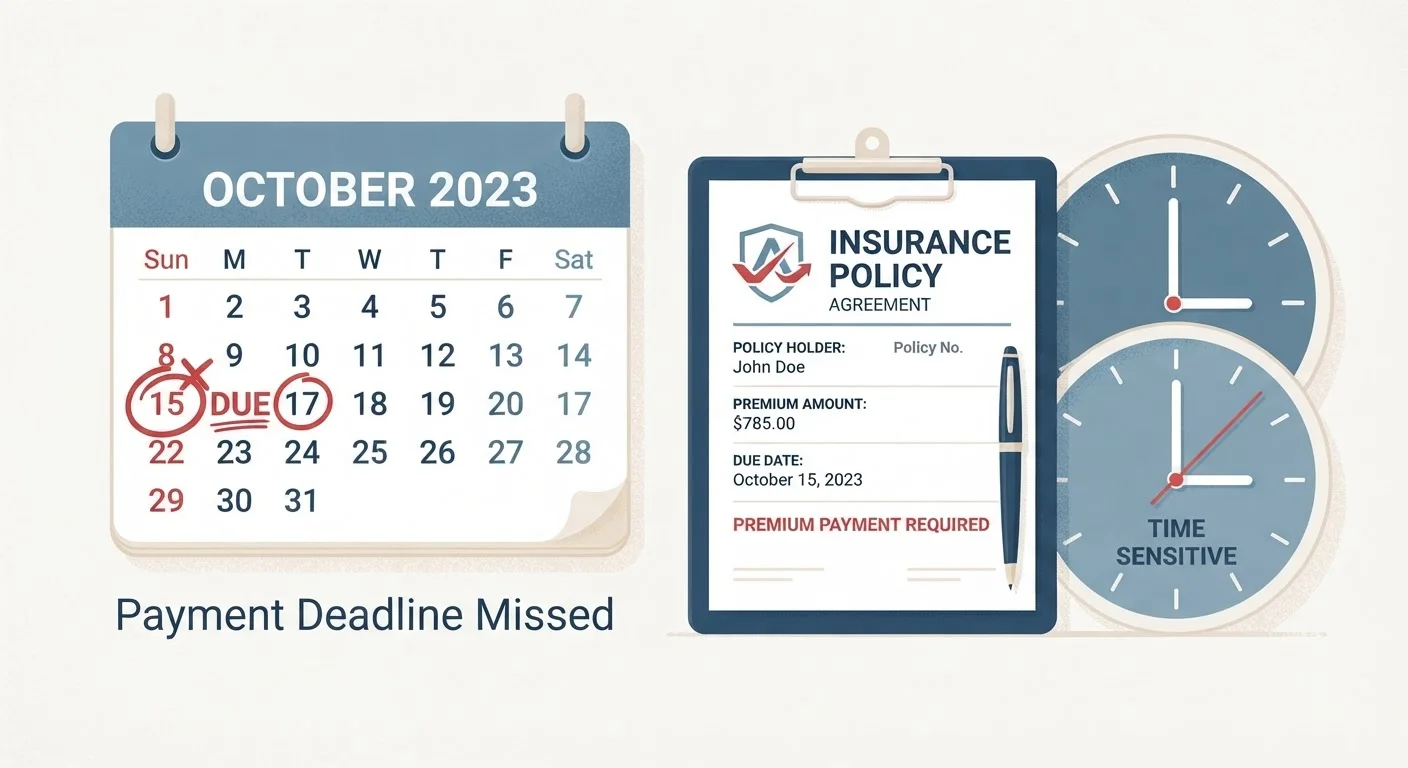
Think of it as three distinct phases. First, the insurer grants a grace period: a defined window in which you can still pay and your coverage stays in force. Second, if that window closes without payment, the policy lapses — coverage ends. Third, depending on the insurer and policy type, you may be able to pursue reinstatement to reactivate the policy.
Understanding how these three terms connect helps you read your policy more clearly and respond appropriately if a payment is missed. For a broader foundation, see the plain-English breakdown of premiums and how they work.
90 days
ACA marketplace grace period for subsidy recipients
Federal rules under the Affordable Care Act provide a 90-day grace period for eligible marketplace policyholders who receive premium tax credits.
10–31 days
Typical auto/home grace period range by state
Most state insurance regulations mandate minimum grace periods for auto and property policies, commonly falling between 10 and 31 days.
30 days
Standard life insurance grace period
Most state laws require life insurance policies to include at least a 30-day grace period after a missed premium payment.
Grace Periods: You Still Have Time
A grace period is the buffer built into your policy between a missed payment and any actual change in your coverage status. During this time, you are still insured. If a covered event happens — a car accident, a medical procedure, storm damage to your home — your policy should respond just as it normally would.
Grace periods are not a courtesy an insurer can skip. In many states, minimum grace period lengths are set by law. For health insurance purchased through the ACA marketplace, federal rules generally provide a 90-day grace period for policyholders who receive premium tax credits. For most auto and homeowners policies, the window is shorter — often 10 to 30 days. Life insurance policies are commonly granted 30 to 31 days by state regulation.
Contact Your Insurer Before the Due Date
If you know a payment will be late, call your insurer before it's due — not after. Many insurers have hardship options, payment deferrals, or can at minimum confirm exactly when your grace period ends. Proactive communication often results in more options than waiting until coverage has already lapsed.
One important nuance: if you file a claim during the grace period and still haven't paid, many insurers will subtract the overdue premium from the claim payout rather than deny the claim outright. Your policy documents will specify exactly how this works.
Lapses: When Coverage Actually Ends
A lapse occurs the moment the grace period expires without a payment being received. From that point forward, you have no active coverage. Any loss or event that happens after a lapse is your financial responsibility — the insurer has no obligation to pay.
The practical consequences depend heavily on policy type. A lapsed auto policy means you're driving uninsured, which carries both legal exposure and personal financial risk. A lapsed health policy means any medical costs are entirely out of pocket. A lapsed life insurance policy means the death benefit no longer exists, which can be a serious financial blow to the people depending on it.
Beyond the immediate loss of protection, a lapse creates a coverage gap — a period on record when you had no insurance. Insurers treat gaps as a risk signal. When you apply for new coverage or try to reinstate your old policy, that gap may result in higher premiums or underwriting scrutiny. This is a well-documented pattern in auto insurance, where even a brief lapse can shift you into a higher-rate tier.
Coverage gaps are also one of the most common reasons people discover they weren't protected at the moment they needed to be. The coverage blind spots that surface after filing a claim article covers related scenarios worth reviewing.
Reinstatement: Getting Your Policy Back
Reinstatement is the process of reactivating a policy that has lapsed. Not every insurer offers it, and the terms vary significantly by policy type and how long the lapse lasted.
For life insurance, many policies include a contractual reinstatement provision — often valid for up to three to five years after the lapse date. To reinstate, you typically must pay all overdue premiums, plus interest in some cases, and submit evidence of insurability (meaning you may need to pass a health review again). If your health has changed since the original policy was issued, reinstatement may be denied or offered at a different rate.
For auto and home insurance, reinstatement is more variable. Some insurers will reinstate promptly upon payment of overdue premiums, especially for short lapses. Others will treat the lapse as a cancellation and require you to apply for a new policy. A new application means current underwriting standards apply — which may mean different pricing.
For health insurance, reinstatement rules depend on whether you're in a marketplace plan, an employer plan, or another type. Missing payments on a marketplace plan can ultimately result in termination for the rest of the plan year with limited options to re-enroll before the next open enrollment period.
Reinstatement Is Not Guaranteed
Even if your policy includes a reinstatement provision, insurers retain the right to apply current underwriting standards, require health documentation, or decline the request altogether. Never assume reinstatement is automatic — confirm the process and timeline with your insurer in writing.
The full insurance glossary covers reinstatement alongside dozens of other policy terms worth knowing before you need them.
This article is for general informational purposes only and does not constitute insurance, financial, or legal advice. Coverage terms, grace periods, and reinstatement rules vary by insurer, policy type, and state. Always read your actual policy documents and consult a licensed insurance professional for guidance specific to your situation.