
Why Plan Type Matters Before You Compare Premiums
When shopping for health insurance - whether through an employer, a marketplace, or a government program - you'll almost always see plans labeled HMO, PPO, EPO, or HDHP. These letters describe how the plan is structured, not just how much it costs. The structure determines which doctors you can see, whether you need permission before seeing a specialist, and how much you'll pay when you actually use care.
Before comparing monthly premiums, it helps to understand what each plan type actually requires of you. A low monthly payment can come with trade-offs that cost more in the long run - or create real headaches when you need care. For a refresher on the cost terms that appear across all of these plans, see our guide on deductibles, premiums, and copays.
HMO, PPO, EPO, and HDHP: What Each One Means
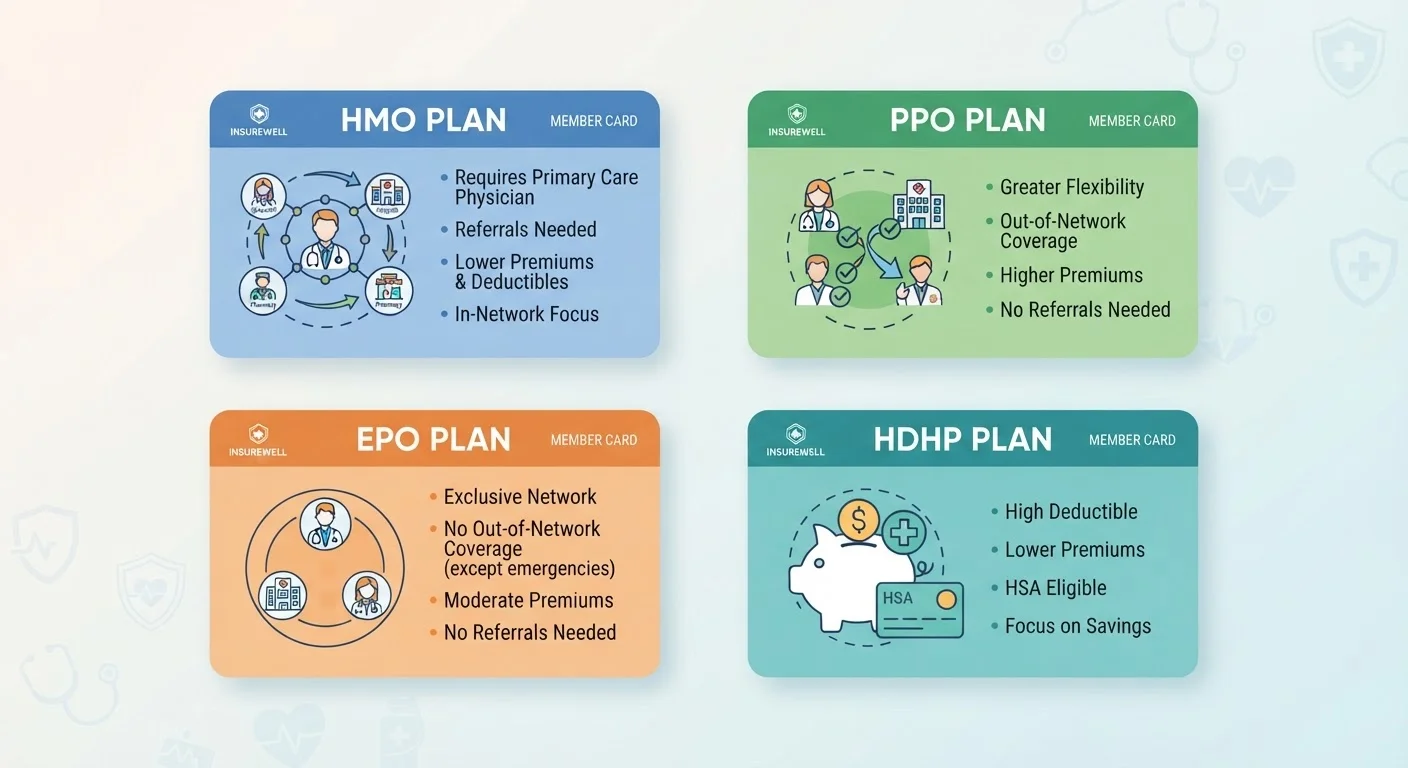
HMO (Health Maintenance Organization): You select a primary care physician (PCP) who acts as your main point of contact for care. If you need to see a specialist, your PCP generally must issue a referral first. Coverage is typically limited to in-network providers, with limited or no coverage for out-of-network care except in emergencies. The trade-off for these restrictions is usually a lower premium and predictable copays.
PPO (Preferred Provider Organization): You can see any doctor or specialist without a referral, in-network or out-of-network. Out-of-network visits are covered, though at a higher cost-sharing rate. PPOs generally carry higher premiums and sometimes higher deductibles than HMOs, but they offer the broadest flexibility - useful if you have established relationships with specific providers or see multiple specialists.
EPO (Exclusive Provider Organization): Like a PPO, an EPO does not require referrals to see specialists. But like an HMO, it restricts coverage to in-network providers (except emergencies). This structure can be a practical middle ground: fewer administrative steps, but you'll need to confirm that your preferred providers are in-network before enrolling.
HDHP (High-Deductible Health Plan): An HDHP is defined by its deductible level - the IRS sets minimum thresholds each year that a plan must meet to qualify. You pay more out of pocket before coverage kicks in, but monthly premiums are typically lower. The significant advantage: HDHPs are the only plan type that qualifies you to open and contribute to a Health Savings Account (HSA), a tax-advantaged account you can use to pay for eligible medical expenses.
| HMO | PPO | EPO | HDHP | |
|---|---|---|---|---|
| Referrals required | Yes, from your PCP | No | No | Varies by plan structure |
| Out-of-network coverage | Emergency only | Yes, at higher cost | Emergency only | Depends on base plan type |
| Typical monthly premium | Lower | Higher | Moderate | Lower |
| Deductible level | Moderate | Moderate to high | Moderate | High (IRS-defined minimum) |
| HSA eligible | No | No | No | Yes |
| Best flexibility | Low | High | Moderate | Depends on underlying network |
How to Think About Your Own Situation
The right plan type depends on two main factors: how often you use healthcare and how much financial uncertainty you can absorb.
If you have ongoing health conditions, take maintenance medications, or see several specialists, a plan that minimizes friction - like a PPO or EPO - may be worth paying more for each month. If you're generally healthy and rarely need care beyond preventive visits, a lower-premium HMO or HDHP may mean you spend significantly less overall. Pairing an HDHP with an HSA lets you build a tax-free reserve for future medical costs, which can be a sound long-term strategy - though it requires discipline and some financial cushion to cover the higher deductible if something unexpected happens.
Also check the specific network for any plan you're considering. An EPO or HMO with a narrow network in your area could leave your current doctors uncovered, which matters more than the plan type label itself. You can also explore whether supplemental health insurance might help cover gaps that any of these plan types leave behind.
Check the Network Before You Enroll
Plan type is just the framework - the provider network is what determines whether your actual doctors are covered. Before finalizing a choice, use the insurer's online directory to confirm that your primary care doctor, any specialists you see, and your preferred hospital are all included. A plan with a smaller network can create real disruption to ongoing care, even if the premium looks attractive.
This article is for general informational purposes only and does not constitute personalized insurance, financial, or medical advice. Coverage details, costs, and eligibility vary by plan, provider, and location. Always review your plan documents carefully and consult a licensed insurance professional before enrolling.